Mind Mapsमाइंड मैप्स › Polityराजव्यवस्था
Elections, Election Commission & Electoral Reforms in India — mind mapमाइंड मैप
Original study maps by Rishabh Singh. Read dated facts in their exam-year context. Sources & corrections.ऋषभ सिंह के मूल अध्ययन मानचित्र। पुराने तथ्यों को संबंधित परीक्षा वर्ष के संदर्भ में पढ़ें। स्रोत और सुधार।
122 branches and entriesशाखाएँ और बिंदु · 1 sheet(s)शीट
See the original map layoutमूल मानचित्र का स्वरूप देखें
Tap the image to open its full preview. Read individual branches below for comfortable revision.पूरा पूर्वावलोकन खोलने के लिए चित्र पर टैप करें। आसानी से पढ़ने के लिए नीचे शाखाएँ देखें।
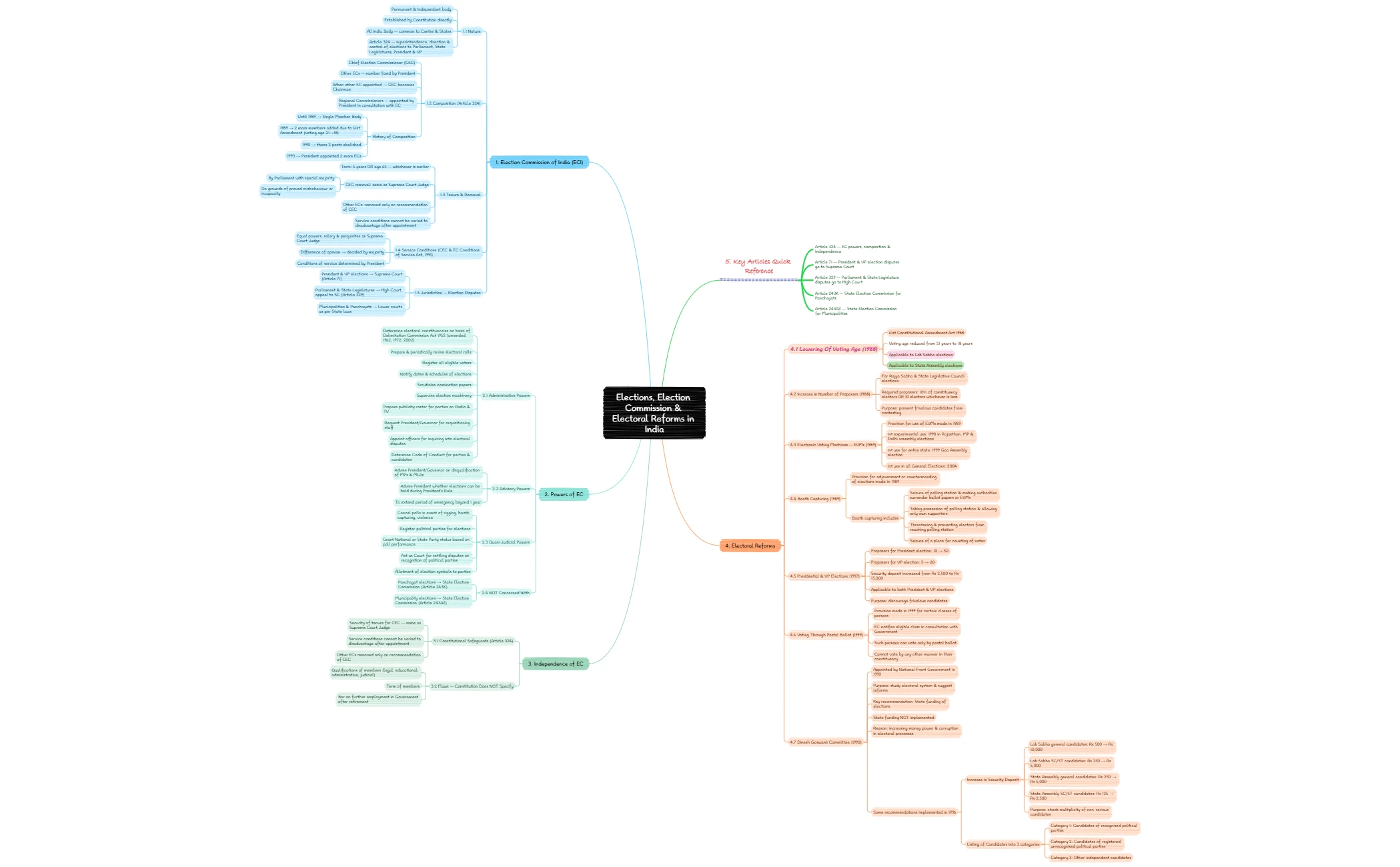
Read the branchesशाखाएँ पढ़ें
Elections, Election Commission & Electoral Reforms in India
Elections, Election Commission & Electoral Reforms in India
5. Key Articles Quick Reference
Article 324 — EC powers, composition & independence
Article 71 — President & VP election disputes go to Supreme Court
Article 329 — Parliament & State Legislature disputes go to High Court
Article 243K — State Election Commission for Panchayats
Article 243AZ — State Election Commission for Municipalities
4. Electoral Reforms
4.1 Lowering of Voting Age (1988)
61st Constitutional Amendment Act 1988
Voting age reduced from 21 years to 18 years
Applicable to Lok Sabha elections
Applicable to State Assembly elections
4.2 Increase in Number of Proposers (1988)
For Rajya Sabha & State Legislative Council elections
Required proposers: 10% of constituency electors OR 10 electors whichever is less
Purpose: prevent frivolous candidates from contesting
4.3 Electronic Voting Machines — EVMs (1989)
Provision for use of EVMs made in 1989
1st experimental use: 1998 in Rajasthan, MP & Delhi assembly elections
1st use for entire state: 1999 Goa Assembly election
1st use in all General Elections: 2004
4.4 Booth Capturing (1989)
Provision for adjournment or countermanding of elections made in 1989
Booth capturing includes
Seizure of polling station & making authorities surrender ballot papers or EVMs
Taking possession of polling station & allowing only own supporters
Threatening & preventing electors from reaching polling station
Seizure of a place for counting of votes
4.5 Presidential & VP Elections (1997)
Proposers for President election: 10 → 50
Proposers for VP election: 5 → 20
Security deposit increased from Rs 2,500 to Rs 15,000
Applicable to both President & VP elections
Purpose: discourage frivolous candidates
4.6 Voting Through Postal Ballot (1999)
Provision made in 1999 for certain classes of persons
EC notifies eligible class in consultation with Government
Such persons can vote only by postal ballot
Cannot vote by any other manner in their constituency
4.7 Dinesh Goswami Committee (1990)
Appointed by National Front Government in 1990
Purpose: study electoral system & suggest reforms
Key recommendation: State funding of elections
State funding NOT implemented
Reason: increasing money power & corruption in electoral processes
Some recommendations implemented in 1996
Increase in Security Deposit
Lok Sabha general candidates: Rs 500 → Rs 10,000
Lok Sabha SC/ST candidates: Rs 250 → Rs 5,000
State Assembly general candidates: Rs 250 → Rs 5,000
State Assembly SC/ST candidates: Rs 125 → Rs 2,500
Purpose: check multiplicity of non-serious candidates
Listing of Candidates into 3 categories
Category 1: Candidates of recognised political parties
Category 2: Candidates of registered-unrecognised political parties
Category 3: Other independent candidates
3. Independence of EC
3.1 Constitutional Safeguards (Article 324)
Security of tenure for CEC — same as Supreme Court Judge
Service conditions cannot be varied to disadvantage after appointment
Other ECs removed only on recommendation of CEC
3.2 Flaws — Constitution Does NOT Specify
Qualifications of members (legal, educational, administrative, judicial)
Term of members
Bar on further employment in Government after retirement
2. Powers of EC
2.1 Administrative Powers
Determine electoral constituencies on basis of Delimitation Commission Act 1952 (amended 1962, 1972, 2002)
Prepare & periodically revise electoral rolls
Register all eligible voters
Notify dates & schedules of elections
Scrutinize nomination papers
Supervise election machinery
Prepare publicity roster for parties on Radio & TV
Request President/Governor for requisitioning staff
Appoint officers for inquiring into electoral disputes
Determine Code of Conduct for parties & candidates
2.2 Advisory Powers
Advise President/Governor on disqualification of MPs & MLAs
Advise President whether elections can be held during President's Rule
To extend period of emergency beyond 1 year
2.3 Quasi-Judicial Powers
Cancel polls in event of rigging, booth capturing, violence
Register political parties for elections
Grant National or State Party status based on poll performance
Act as Court for settling disputes on recognition of political parties
Allotment of election symbols to parties
2.4 NOT Concerned With
Panchayat elections → State Election Commission (Article 243K)
Municipality elections → State Election Commission (Article 243AZ)
1. Election Commission of India (ECI)
1.1 Nature
Permanent & Independent body
Established by Constitution directly
All India Body — common to Centre & States
Article 324 — superintendence, direction & control of elections to Parliament, State Legislatures, President & VP
1.2 Composition (Article 324)
Chief Election Commissioner (CEC)
Other ECs — number fixed by President
When other EC appointed → CEC becomes Chairman
Regional Commissioners — appointed by President in consultation with EC
History of Composition
Until 1989 → Single Member Body
1989 → 2 more members added due to 61st Amendment (voting age 21→18)
1990 → those 2 posts abolished
1993 → President appointed 2 more ECs
1.3 Tenure & Removal
Term: 6 years OR age 65 — whichever is earlier
CEC removal: same as Supreme Court Judge
By Parliament with special majority
On grounds of proved misbehaviour or incapacity
Other ECs: removed only on recommendation of CEC
Service conditions cannot be varied to disadvantage after appointment
1.4 Service Conditions (CEC & EC Conditions of Service Act, 1991)
Equal powers, salary & perquisites as Supreme Court Judge
Difference of opinion → decided by majority
Conditions of service determined by President
1.5 Jurisdiction — Election Disputes
President & VP elections → Supreme Court (Article 71)
Parliament & State Legislatures → High Court, appeal to SC (Article 329)
Municipalities & Panchayats → Lower courts as per State laws