Mind Mapsमाइंड मैप्स › Physicsभौतिकी
Sound — mind mapमाइंड मैप
Original study maps by Rishabh Singh. Read dated facts in their exam-year context. Sources & corrections.ऋषभ सिंह के मूल अध्ययन मानचित्र। पुराने तथ्यों को संबंधित परीक्षा वर्ष के संदर्भ में पढ़ें। स्रोत और सुधार।
38 branches and entriesशाखाएँ और बिंदु · 1 sheet(s)शीट
See the original map layoutमूल मानचित्र का स्वरूप देखें
Tap the image to open its full preview. Read individual branches below for comfortable revision.पूरा पूर्वावलोकन खोलने के लिए चित्र पर टैप करें। आसानी से पढ़ने के लिए नीचे शाखाएँ देखें।
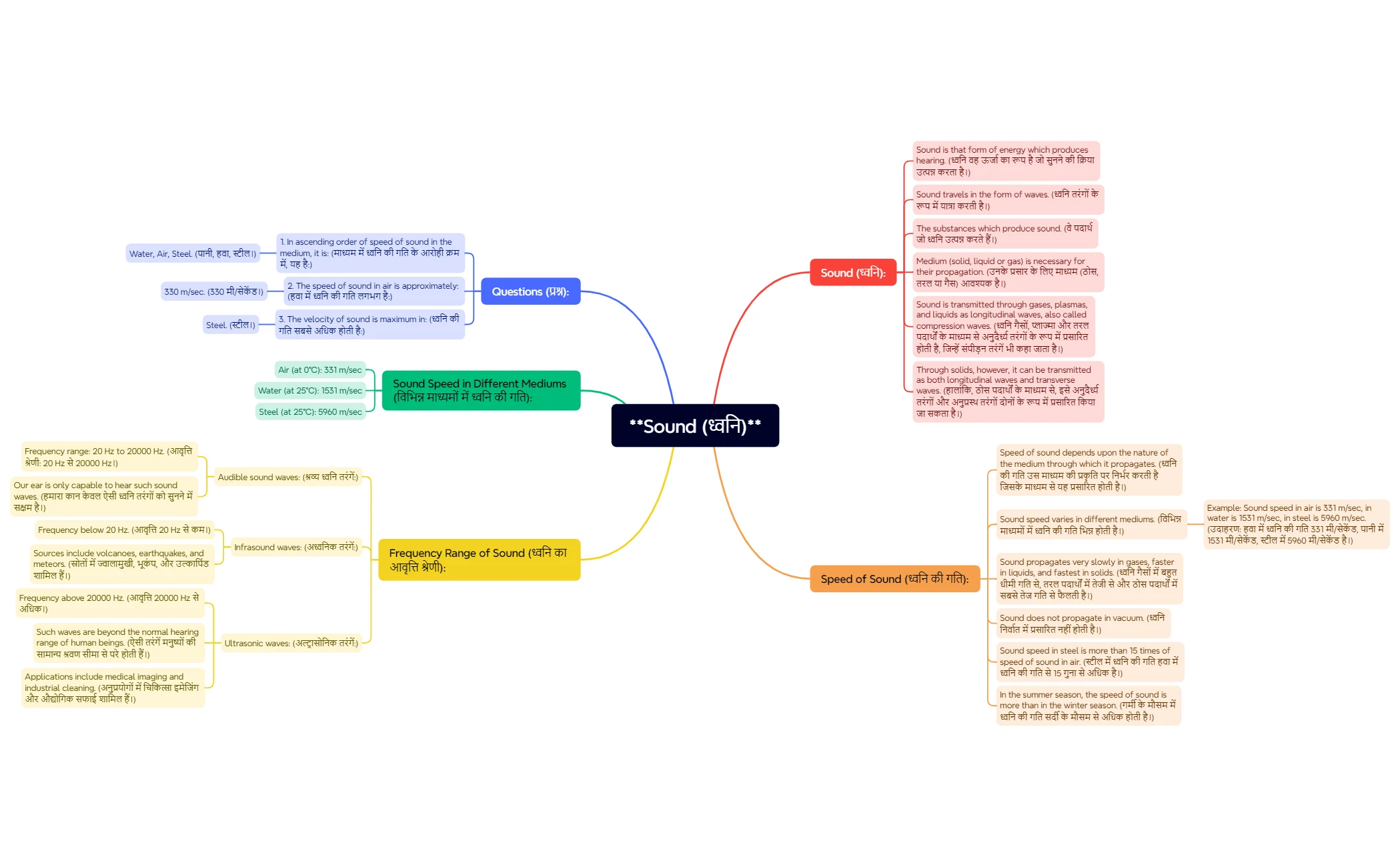
Read the branchesशाखाएँ पढ़ें
Sound (ध्वनि)
Sound (ध्वनि)
Sound (ध्वनि):
Sound is that form of energy which produces hearing. (ध्वनि वह ऊर्जा का रूप है जो सुनने की क्रिया उत्पन्न करता है।)
Sound travels in the form of waves. (ध्वनि तरंगों के रूप में यात्रा करती है।)
The substances which produce sound. (वे पदार्थ जो ध्वनि उत्पन्न करते हैं।)
Medium (solid, liquid or gas) is necessary for their propagation. (उनके प्रसार के लिए माध्यम (ठोस, तरल या गैस) आवश्यक है।)
Sound is transmitted through gases, plasmas, and liquids as longitudinal waves, also called compression waves. (ध्वनि गैसों, प्लाज्मा और तरल पदार्थों के माध्यम से अनुदैर्ध्य तरंगों के रूप में प्रसारित होती है, जिन्हें संपीड़न तरंगें भी कहा जाता है।)
Through solids, however, it can be transmitted as both longitudinal waves and transverse waves. (हालांकि, ठोस पदार्थों के माध्यम से, इसे अनुदैर्ध्य तरंगों और अनुप्रस्थ तरंगों दोनों के रूप में प्रसारित किया जा सकता है।)
Speed of Sound (ध्वनि की गति):
Speed of sound depends upon the nature of the medium through which it propagates. (ध्वनि की गति उस माध्यम की प्रकृति पर निर्भर करती है जिसके माध्यम से यह प्रसारित होती है।)
Sound speed varies in different mediums. (विभिन्न माध्यमों में ध्वनि की गति भिन्न होती है।)
Example: Sound speed in air is 331 m/sec, in water is 1531 m/sec, in steel is 5960 m/sec. (उदाहरण: हवा में ध्वनि की गति 331 मी/सेकेंड, पानी में 1531 मी/सेकेंड, स्टील में 5960 मी/सेकेंड है।)
Sound propagates very slowly in gases, faster in liquids, and fastest in solids. (ध्वनि गैसों में बहुत धीमी गति से, तरल पदार्थों में तेजी से और ठोस पदार्थों में सबसे तेज गति से फैलती है।)
Sound does not propagate in vacuum. (ध्वनि निर्वात में प्रसारित नहीं होती है।)
Sound speed in steel is more than 15 times of speed of sound in air. (स्टील में ध्वनि की गति हवा में ध्वनि की गति से 15 गुना से अधिक है।)
In the summer season, the speed of sound is more than in the winter season. (गर्मी के मौसम में ध्वनि की गति सर्दी के मौसम से अधिक होती है।)
Frequency Range of Sound (ध्वनि का आवृत्ति श्रेणी):
Audible sound waves: (श्रव्य ध्वनि तरंगें:)
Frequency range: 20 Hz to 20000 Hz. (आवृत्ति श्रेणी: 20 Hz से 20000 Hz।)
Our ear is only capable to hear such sound waves. (हमारा कान केवल ऐसी ध्वनि तरंगों को सुनने में सक्षम है।)
Infrasound waves: (अध्वनिक तरंगें:)
Frequency below 20 Hz. (आवृत्ति 20 Hz से कम।)
Sources include volcanoes, earthquakes, and meteors. (स्रोतों में ज्वालामुखी, भूकंप, और उल्कापिंड शामिल हैं।)
Ultrasonic waves: (अल्ट्रासोनिक तरंगें:)
Frequency above 20000 Hz. (आवृत्ति 20000 Hz से अधिक।)
Such waves are beyond the normal hearing range of human beings. (ऐसी तरंगें मनुष्यों की सामान्य श्रवण सीमा से परे होती हैं।)
Applications include medical imaging and industrial cleaning. (अनुप्रयोगों में चिकित्सा इमेजिंग और औद्योगिक सफाई शामिल हैं।)
Sound Speed in Different Mediums (विभिन्न माध्यमों में ध्वनि की गति):
Air (at 0°C): 331 m/sec
Water (at 25°C): 1531 m/sec
Steel (at 25°C): 5960 m/sec
Questions (प्रश्न):
1. In ascending order of speed of sound in the medium, it is: (माध्यम में ध्वनि की गति के आरोही क्रम में, यह है:)
Water, Air, Steel. (पानी, हवा, स्टील।)
2. The speed of sound in air is approximately: (हवा में ध्वनि की गति लगभग है:)
330 m/sec. (330 मी/सेकेंड।)
3. The velocity of sound is maximum in: (ध्वनि की गति सबसे अधिक होती है:)
Steel. (स्टील।)