Mind Mapsमाइंड मैप्स › Physicsभौतिकी
Physical Properties of Matter — mind mapमाइंड मैप
Original study maps by Rishabh Singh. Read dated facts in their exam-year context. Sources & corrections.ऋषभ सिंह के मूल अध्ययन मानचित्र। पुराने तथ्यों को संबंधित परीक्षा वर्ष के संदर्भ में पढ़ें। स्रोत और सुधार।
78 branches and entriesशाखाएँ और बिंदु · 1 sheet(s)शीट
See the original map layoutमूल मानचित्र का स्वरूप देखें
Tap the image to open its full preview. Read individual branches below for comfortable revision.पूरा पूर्वावलोकन खोलने के लिए चित्र पर टैप करें। आसानी से पढ़ने के लिए नीचे शाखाएँ देखें।
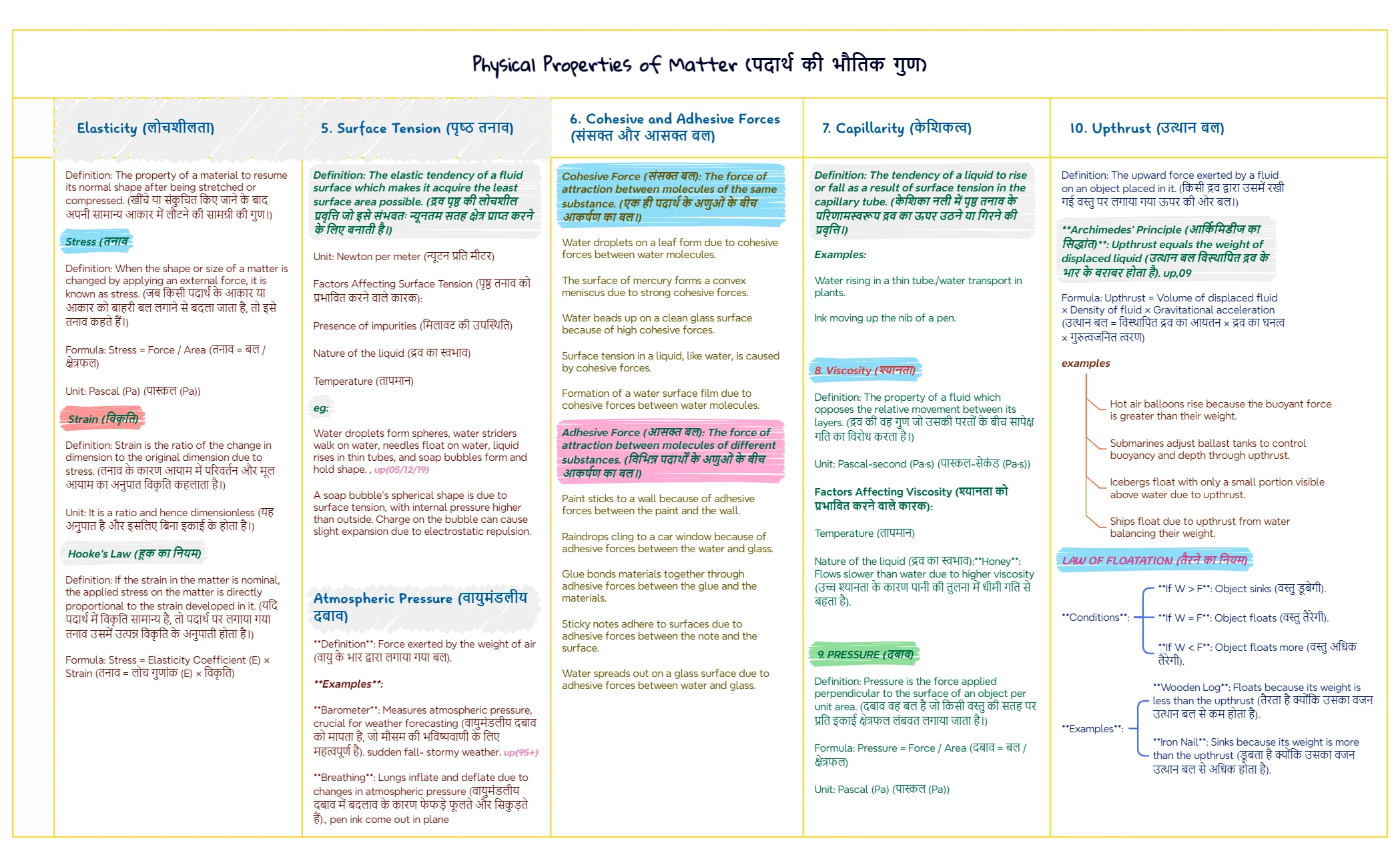
Read the branchesशाखाएँ पढ़ें
Physical Properties of Matter (पदार्थ की भौतिक गुण)
Physical Properties of Matter (पदार्थ की भौतिक गुण)
Elasticity (लोचशीलता)
Definition: The property of a material to resume its normal shape after being stretched or compressed. (खींचे या संकुचित किए जाने के बाद अपनी सामान्य आकार में लौटने की सामग्री की गुण।)
Stress (तनाव
Definition: When the shape or size of a matter is changed by applying an external force, it is known as stress. (जब किसी पदार्थ के आकार या आकार को बाहरी बल लगाने से बदला जाता है, तो इसे तनाव कहते हैं।)
Formula: Stress = Force / Area (तनाव = बल / क्षेत्रफल)
Unit: Pascal (Pa) (पास्कल (Pa))
Strain (विकृति)
Definition: Strain is the ratio of the change in dimension to the original dimension due to stress. (तनाव के कारण आयाम में परिवर्तन और मूल आयाम का अनुपात विकृति कहलाता है।)
Unit: It is a ratio and hence dimensionless (यह अनुपात है और इसलिए बिना इकाई के होता है।)
Hooke's Law (हूक का नियम)
Definition: If the strain in the matter is nominal, the applied stress on the matter is directly proportional to the strain developed in it. (यदि पदार्थ में विकृति सामान्य है, तो पदार्थ पर लगाया गया तनाव उसमें उत्पन्न विकृति के अनुपाती होता है।)
Formula: Stress = Elasticity Coefficient (E) × Strain (तनाव = लोच गुणांक (E) × विकृति)
5. Surface Tension (पृष्ठ तनाव)
Definition: The elastic tendency of a fluid surface which makes it acquire the least surface area possible. (द्रव पृष्ठ की लोचशील प्रवृत्ति जो इसे संभवतः न्यूनतम सतह क्षेत्र प्राप्त करने के लिए बनाती है।)
Unit: Newton per meter (न्यूटन प्रति मीटर)
Factors Affecting Surface Tension (पृष्ठ तनाव को प्रभावित करने वाले कारक):
Presence of impurities (मिलावट की उपस्थिति)
Nature of the liquid (द्रव का स्वभाव)
Temperature (तापमान)
eg:
Water droplets form spheres, water striders walk on water, needles float on water, liquid rises in thin tubes, and soap bubbles form and hold shape. , up{05/12/19}
A soap bubble's spherical shape is due to surface tension, with internal pressure higher than outside. Charge on the bubble can cause slight expansion due to electrostatic repulsion.
Study map
Atmospheric Pressure (वायुमंडलीय दबाव)
Definition: Force exerted by the weight of air (वायु के भार द्वारा लगाया गया बल).
Examples:
Barometer: Measures atmospheric pressure, crucial for weather forecasting (वायुमंडलीय दबाव को मापता है, जो मौसम की भविष्यवाणी के लिए महत्वपूर्ण है). sudden fall- stormy weather. up{95+}
Breathing: Lungs inflate and deflate due to changes in atmospheric pressure (वायुमंडलीय दबाव में बदलाव के कारण फेफड़े फूलते और सिकुड़ते हैं)., pen ink come out in plane
up,19
up,95+1
6. Cohesive and Adhesive Forces (संसक्त और आसक्त बल)
Cohesive Force (संसक्त बल): The force of attraction between molecules of the same substance. (एक ही पदार्थ के अणुओं के बीच आकर्षण का बल।)
Water droplets on a leaf form due to cohesive forces between water molecules.
The surface of mercury forms a convex meniscus due to strong cohesive forces.
Water beads up on a clean glass surface because of high cohesive forces.
Surface tension in a liquid, like water, is caused by cohesive forces.
Formation of a water surface film due to cohesive forces between water molecules.
Adhesive Force (आसक्त बल): The force of attraction between molecules of different substances. (विभिन्न पदार्थों के अणुओं के बीच आकर्षण का बल।)
Paint sticks to a wall because of adhesive forces between the paint and the wall.
Raindrops cling to a car window because of adhesive forces between the water and glass.
Glue bonds materials together through adhesive forces between the glue and the materials.
Sticky notes adhere to surfaces due to adhesive forces between the note and the surface.
Water spreads out on a glass surface due to adhesive forces between water and glass.
7. Capillarity (केशिकत्व)
Definition: The tendency of a liquid to rise or fall as a result of surface tension in the capillary tube. (केशिका नली में पृष्ठ तनाव के परिणामस्वरूप द्रव का ऊपर उठने या गिरने की प्रवृत्ति।)
Examples:
Water rising in a thin tube./water transport in plants.
Ink moving up the nib of a pen.
Study map
8. Viscosity (श्यानता)
Definition: The property of a fluid which opposes the relative movement between its layers. (द्रव की वह गुण जो उसकी परतों के बीच सापेक्ष गति का विरोध करता है।)
Unit: Pascal-second (Pa·s) (पास्कल-सेकंड (Pa·s))
Factors Affecting Viscosity (श्यानता को प्रभावित करने वाले कारक):
Temperature (तापमान)
Nature of the liquid (द्रव का स्वभाव):Honey: Flows slower than water due to higher viscosity (उच्च श्यानता के कारण पानी की तुलना में धीमी गति से बहता है).
Study map
9. Pressure (दबाव)
Definition: Pressure is the force applied perpendicular to the surface of an object per unit area. (दबाव वह बल है जो किसी वस्तु की सतह पर प्रति इकाई क्षेत्रफल लंबवत लगाया जाता है।)
Formula: Pressure = Force / Area (दबाव = बल / क्षेत्रफल)
Unit: Pascal (Pa) (पास्कल (Pa))
10. Upthrust (उत्थान बल)
Definition: The upward force exerted by a fluid on an object placed in it. (किसी द्रव द्वारा उसमें रखी गई वस्तु पर लगाया गया ऊपर की ओर बल।)
Archimedes' Principle (आर्किमिडीज का सिद्धांत): Upthrust equals the weight of displaced liquid (उत्थान बल विस्थापित द्रव के भार के बराबर होता है). up,09
Formula: Upthrust = Volume of displaced fluid × Density of fluid × Gravitational acceleration (उत्थान बल = विस्थापित द्रव का आयतन × द्रव का घनत्व × गुरुत्वजनित त्वरण)
examples
Hot air balloons rise because the buoyant force is greater than their weight.
Submarines adjust ballast tanks to control buoyancy and depth through upthrust.
Icebergs float with only a small portion visible above water due to upthrust.
Ships float due to upthrust from water balancing their weight.
Law of Floatation (तैरने का नियम)
Conditions:
If W > F: Object sinks (वस्तु डूबेगी).
If W = F: Object floats (वस्तु तैरेगी).
If W < F: Object floats more (वस्तु अधिक तैरेगी).
Examples:
Wooden Log: Floats because its weight is less than the upthrust (तैरता है क्योंकि उसका वजन उत्थान बल से कम होता है).
Iron Nail: Sinks because its weight is more than the upthrust (डूबता है क्योंकि उसका वजन उत्थान बल से अधिक होता है).