Mind Mapsमाइंड मैप्स › Physicsभौतिकी
Optics — mind mapमाइंड मैप
Original study maps by Rishabh Singh. Read dated facts in their exam-year context. Sources & corrections.ऋषभ सिंह के मूल अध्ययन मानचित्र। पुराने तथ्यों को संबंधित परीक्षा वर्ष के संदर्भ में पढ़ें। स्रोत और सुधार।
57 branches and entriesशाखाएँ और बिंदु · 1 sheet(s)शीट
See the original map layoutमूल मानचित्र का स्वरूप देखें
Tap the image to open its full preview. Read individual branches below for comfortable revision.पूरा पूर्वावलोकन खोलने के लिए चित्र पर टैप करें। आसानी से पढ़ने के लिए नीचे शाखाएँ देखें।
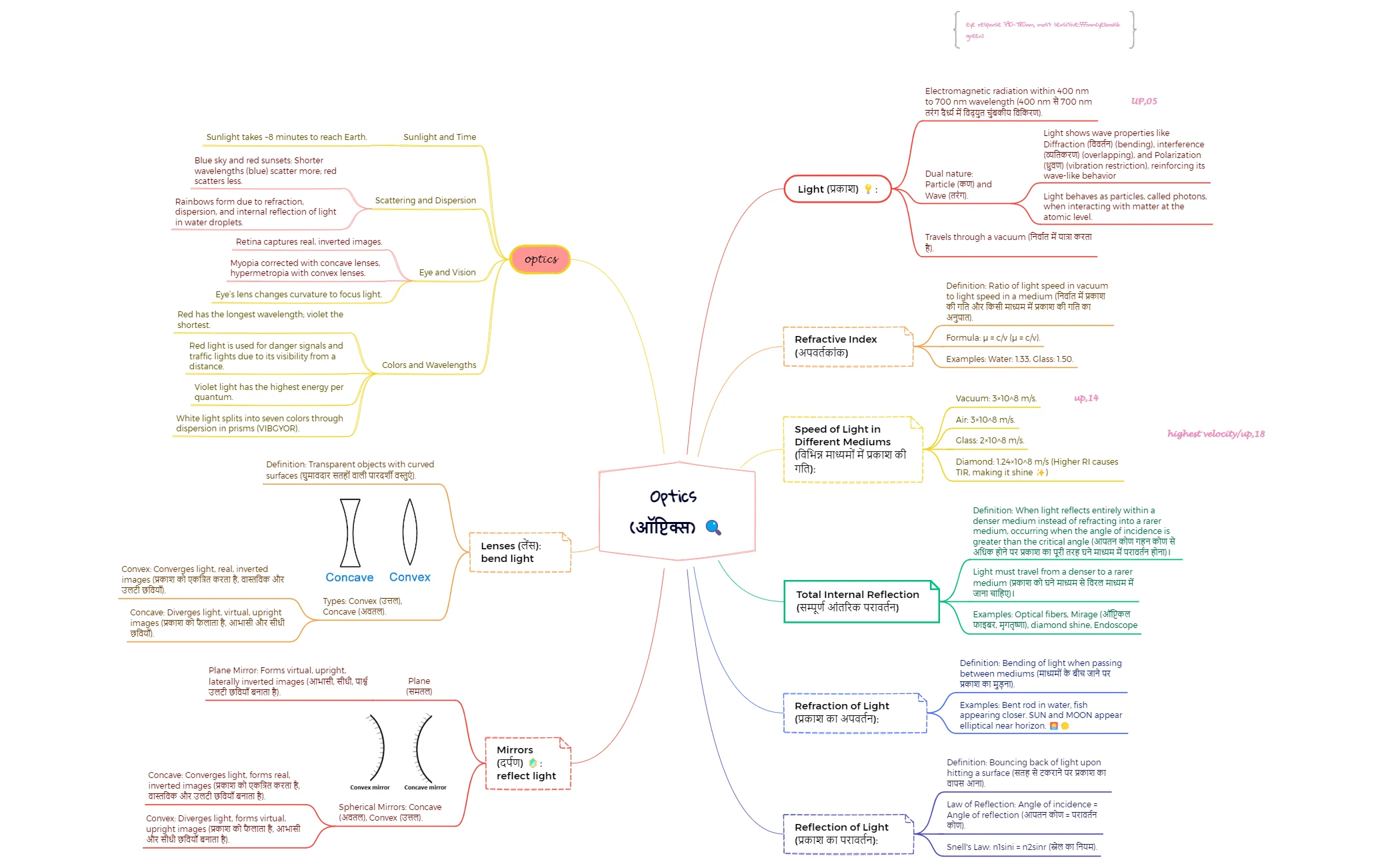
Read the branchesशाखाएँ पढ़ें
Optics (ऑप्टिक्स) 🔍
Optics (ऑप्टिक्स) 🔍
Light (प्रकाश) 💡:
Electromagnetic radiation within 400 nm to 700 nm wavelength (400 nm से 700 nm तरंग दैर्ध्य में विद्युत चुंबकीय विकिरण).
Dual nature: Particle (कण) and Wave (तरंग).
Light shows wave properties like Diffraction (विवर्तन) (bending), interference (व्यतिकरण) (overlapping), and Polarization (ध्रुवण) (vibration restriction), reinforcing its wave-like behavior
Light behaves as particles, called photons, when interacting with matter at the atomic level.
Travels through a vacuum (निर्वात में यात्रा करता है).
UP,05
Refractive Index (अपवर्तकांक)
Definition: Ratio of light speed in vacuum to light speed in a medium (निर्वात में प्रकाश की गति और किसी माध्यम में प्रकाश की गति का अनुपात).
Formula: µ = c/v (µ = c/v).
Examples: Water: 1.33, Glass: 1.50.
Speed of Light in Different Mediums (विभिन्न माध्यमों में प्रकाश की गति):
Vacuum: 3×10^8 m/s.
Air: 3×10^8 m/s.
Glass: 2×10^8 m/s.
Diamond: 1.24×10^8 m/s (Higher RI causes TIR, making it shine ✨)
up,14
Total Internal Reflection (सम्पूर्ण आंतरिक परावर्तन)
Definition: When light reflects entirely within a denser medium instead of refracting into a rarer medium, occurring when the angle of incidence is greater than the critical angle (आपतन कोण गहन कोण से अधिक होने पर प्रकाश का पूरी तरह घने माध्यम में परावर्तन होना)।
Light must travel from a denser to a rarer medium (प्रकाश को घने माध्यम से विरल माध्यम में जाना चाहिए)।
Examples: Optical fibers, Mirage (ऑप्टिकल फाइबर, मृगतृष्णा), diamond shine, Endoscope
Refraction of Light (प्रकाश का अपवर्तन):
Definition: Bending of light when passing between mediums (माध्यमों के बीच जाने पर प्रकाश का मुड़ना).
Examples: Bent rod in water, fish appearing closer. SUN and MOON appear elliptical near horizon. 🌅🌕
Reflection of Light (प्रकाश का परावर्तन):
Definition: Bouncing back of light upon hitting a surface (सतह से टकराने पर प्रकाश का वापस आना).
Law of Reflection: Angle of incidence = Angle of reflection (आपतन कोण = परावर्तन कोण).
Snell's Law: n1sini = n2sinr (स्नेल का नियम).
Mirrors (दर्पण) 🪞: reflect light
Plane (समतल)
Plane Mirror: Forms virtual, upright, laterally inverted images (आभासी, सीधी, पार्श्व उलटी छवियाँ बनाता है).
Spherical Mirrors: Concave (अवतल), Convex (उत्तल).
Concave: Converges light, forms real, inverted images (प्रकाश को एकत्रित करता है, वास्तविक और उलटी छवियाँ बनाता है).
Convex: Diverges light, forms virtual, upright images (प्रकाश को फैलाता है, आभासी और सीधी छवियाँ बनाता है).
Lenses (लेंस): bend light
Definition: Transparent objects with curved surfaces (घुमावदार सतहों वाली पारदर्शी वस्तुएं).
Types: Convex (उत्तल), Concave (अवतल).
Convex: Converges light, real, inverted images (प्रकाश को एकत्रित करता है, वास्तविक और उलटी छवियाँ).
Concave: Diverges light, virtual, upright images (प्रकाश को फैलाता है, आभासी और सीधी छवियाँ).
optics
Sunlight and Time
Sunlight takes ~8 minutes to reach Earth.
Scattering and Dispersion
Blue sky and red sunsets: Shorter wavelengths (blue) scatter more; red scatters less.
Rainbows form due to refraction, dispersion, and internal reflection of light in water droplets.
Eye and Vision
Retina captures real, inverted images.
Myopia corrected with concave lenses, hypermetropia with convex lenses.
Eye’s lens changes curvature to focus light.
Colors and Wavelengths
Red has the longest wavelength; violet the shortest.
Red light is used for danger signals and traffic lights due to its visibility from a distance.
Violet light has the highest energy per quantum.
White light splits into seven colors through dispersion in prisms (VIBGYOR).
eye response 390-780nm, most sensitive:555nm(yellowish green)
highest velocity/up,18