Mind Mapsमाइंड मैप्स › Physicsभौतिकी
Optics and Related Concepts — mind mapमाइंड मैप
Original study maps by Rishabh Singh. Read dated facts in their exam-year context. Sources & corrections.ऋषभ सिंह के मूल अध्ययन मानचित्र। पुराने तथ्यों को संबंधित परीक्षा वर्ष के संदर्भ में पढ़ें। स्रोत और सुधार।
47 branches and entriesशाखाएँ और बिंदु · 1 sheet(s)शीट
See the original map layoutमूल मानचित्र का स्वरूप देखें
Tap the image to open its full preview. Read individual branches below for comfortable revision.पूरा पूर्वावलोकन खोलने के लिए चित्र पर टैप करें। आसानी से पढ़ने के लिए नीचे शाखाएँ देखें।
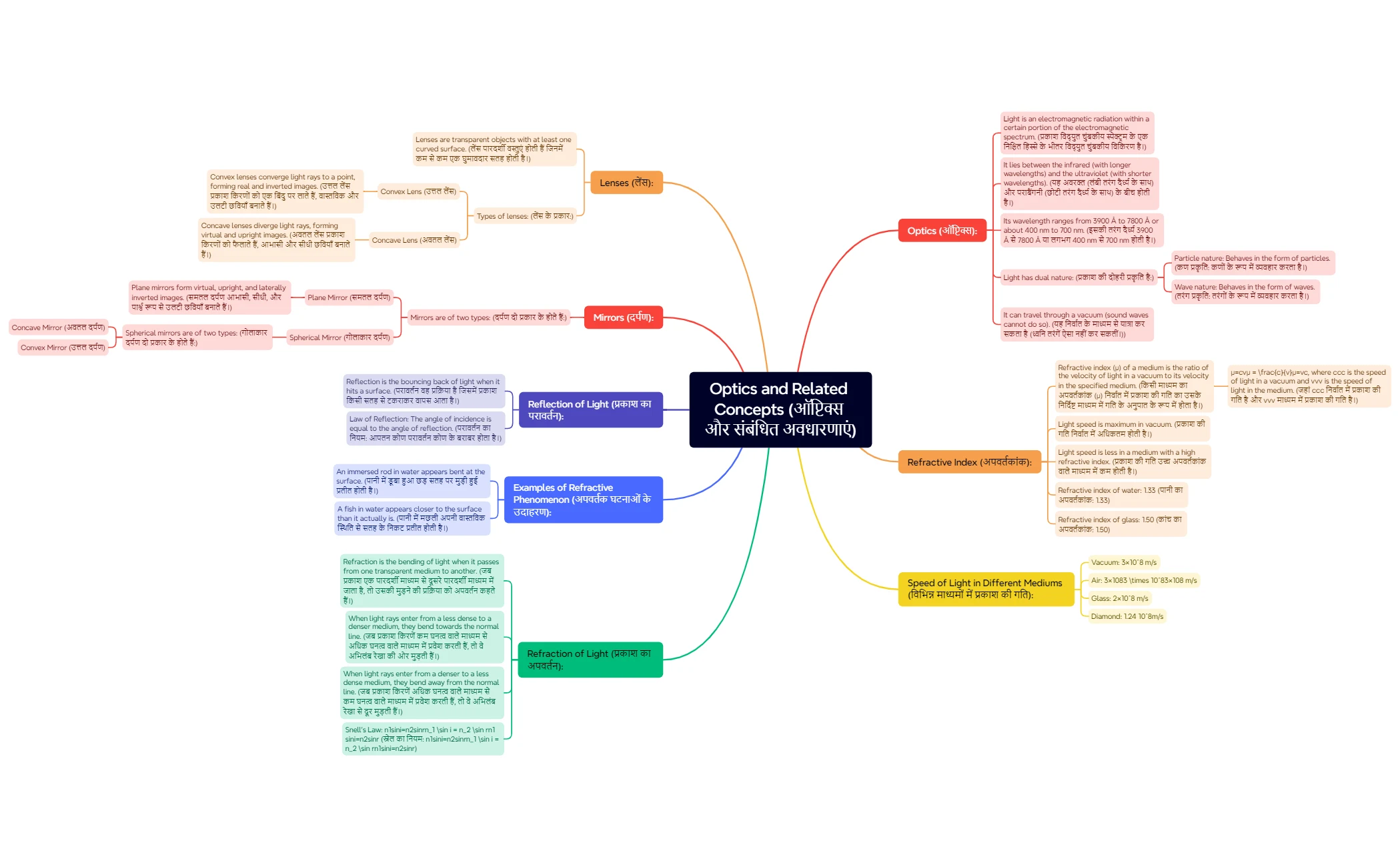
Read the branchesशाखाएँ पढ़ें
Optics and Related Concepts (ऑप्टिक्स और संबंधित अवधारणाएं)
Optics and Related Concepts (ऑप्टिक्स और संबंधित अवधारणाएं)
Optics (ऑप्टिक्स):
Light is an electromagnetic radiation within a certain portion of the electromagnetic spectrum. (प्रकाश विद्युत चुंबकीय स्पेक्ट्रम के एक निश्चित हिस्से के भीतर विद्युत चुंबकीय विकिरण है।)
It lies between the infrared (with longer wavelengths) and the ultraviolet (with shorter wavelengths). (यह अवरक्त (लंबी तरंग दैर्ध्य के साथ) और पराबैंगनी (छोटी तरंग दैर्ध्य के साथ) के बीच होती है।)
Its wavelength ranges from 3900 Å to 7800 Å or about 400 nm to 700 nm. (इसकी तरंग दैर्ध्य 3900 Å से 7800 Å या लगभग 400 nm से 700 nm होती है।)
Light has dual nature: (प्रकाश की दोहरी प्रकृति है:)
Particle nature: Behaves in the form of particles. (कण प्रकृति: कणों के रूप में व्यवहार करता है।)
Wave nature: Behaves in the form of waves. (तरंग प्रकृति: तरंगों के रूप में व्यवहार करता है।)
It can travel through a vacuum (sound waves cannot do so). (यह निर्वात के माध्यम से यात्रा कर सकता है (ध्वनि तरंगें ऐसा नहीं कर सकतीं।))
Refractive Index (अपवर्तकांक):
Refractive index (µ) of a medium is the ratio of the velocity of light in a vacuum to its velocity in the specified medium. (किसी माध्यम का अपवर्तकांक (µ) निर्वात में प्रकाश की गति का उसके निर्दिष्ट माध्यम में गति के अनुपात के रूप में होता है।)
µ=cvµ = \frac{c}{v}µ=vc, where ccc is the speed of light in a vacuum and vvv is the speed of light in the medium. (जहां ccc निर्वात में प्रकाश की गति है और vvv माध्यम में प्रकाश की गति है।)
Light speed is maximum in vacuum. (प्रकाश की गति निर्वात में अधिकतम होती है।)
Light speed is less in a medium with a high refractive index. (प्रकाश की गति उच्च अपवर्तकांक वाले माध्यम में कम होती है।)
Refractive index of water: 1.33 (पानी का अपवर्तकांक: 1.33)
Refractive index of glass: 1.50 (कांच का अपवर्तकांक: 1.50)
Speed of Light in Different Mediums (विभिन्न माध्यमों में प्रकाश की गति):
Vacuum: 3×10^8 m/s
Air: 3×1083 \times 10^83×108 m/s
Glass: 2×10^8 m/s
Diamond: 1.24 10^8m/s
Refraction of Light (प्रकाश का अपवर्तन):
Refraction is the bending of light when it passes from one transparent medium to another. (जब प्रकाश एक पारदर्शी माध्यम से दूसरे पारदर्शी माध्यम में जाता है, तो उसकी मुड़ने की प्रक्रिया को अपवर्तन कहते हैं।)
When light rays enter from a less dense to a denser medium, they bend towards the normal line. (जब प्रकाश किरणें कम घनत्व वाले माध्यम से अधिक घनत्व वाले माध्यम में प्रवेश करती हैं, तो वे अभिलंब रेखा की ओर मुड़ती हैं।)
When light rays enter from a denser to a less dense medium, they bend away from the normal line. (जब प्रकाश किरणें अधिक घनत्व वाले माध्यम से कम घनत्व वाले माध्यम में प्रवेश करती हैं, तो वे अभिलंब रेखा से दूर मुड़ती हैं।)
Snell's Law: n1sini=n2sinrn_1 \sin i = n_2 \sin rn1sini=n2sinr (स्नेल का नियम: n1sini=n2sinrn_1 \sin i = n_2 \sin rn1sini=n2sinr)
Examples of Refractive Phenomenon (अपवर्तक घटनाओं के उदाहरण):
An immersed rod in water appears bent at the surface. (पानी में डूबा हुआ छड़ सतह पर मुड़ी हुई प्रतीत होती है।)
A fish in water appears closer to the surface than it actually is. (पानी में मछली अपनी वास्तविक स्थिति से सतह के निकट प्रतीत होती है।)
Reflection of Light (प्रकाश का परावर्तन):
Reflection is the bouncing back of light when it hits a surface. (परावर्तन वह प्रक्रिया है जिसमें प्रकाश किसी सतह से टकराकर वापस आता है।)
Law of Reflection: The angle of incidence is equal to the angle of reflection. (परावर्तन का नियम: आपतन कोण परावर्तन कोण के बराबर होता है।)
Mirrors (दर्पण):
Mirrors are of two types: (दर्पण दो प्रकार के होते हैं:)
Plane Mirror (समतल दर्पण)
Plane mirrors form virtual, upright, and laterally inverted images. (समतल दर्पण आभासी, सीधी, और पार्श्व रूप से उलटी छवियाँ बनाते हैं।)
Spherical Mirror (गोलाकार दर्पण)
Spherical mirrors are of two types: (गोलाकार दर्पण दो प्रकार के होते हैं:)
Concave Mirror (अवतल दर्पण)
Convex Mirror (उत्तल दर्पण)
Lenses (लेंस):
Lenses are transparent objects with at least one curved surface. (लेंस पारदर्शी वस्तुएं होती हैं जिनमें कम से कम एक घुमावदार सतह होती है।)
Types of lenses: (लेंस के प्रकार:)
Convex Lens (उत्तल लेंस)
Convex lenses converge light rays to a point, forming real and inverted images. (उत्तल लेंस प्रकाश किरणों को एक बिंदु पर लाते हैं, वास्तविक और उलटी छवियाँ बनाते हैं।)
Concave Lens (अवतल लेंस)
Concave lenses diverge light rays, forming virtual and upright images. (अवतल लेंस प्रकाश किरणों को फैलाते हैं, आभासी और सीधी छवियाँ बनाते हैं।)