Mind Mapsमाइंड मैप्स › Physicsभौतिकी
Nuclear Physics — mind mapमाइंड मैप
Original study maps by Rishabh Singh. Read dated facts in their exam-year context. Sources & corrections.ऋषभ सिंह के मूल अध्ययन मानचित्र। पुराने तथ्यों को संबंधित परीक्षा वर्ष के संदर्भ में पढ़ें। स्रोत और सुधार।
53 branches and entriesशाखाएँ और बिंदु · 1 sheet(s)शीट
See the original map layoutमूल मानचित्र का स्वरूप देखें
Tap the image to open its full preview. Read individual branches below for comfortable revision.पूरा पूर्वावलोकन खोलने के लिए चित्र पर टैप करें। आसानी से पढ़ने के लिए नीचे शाखाएँ देखें।
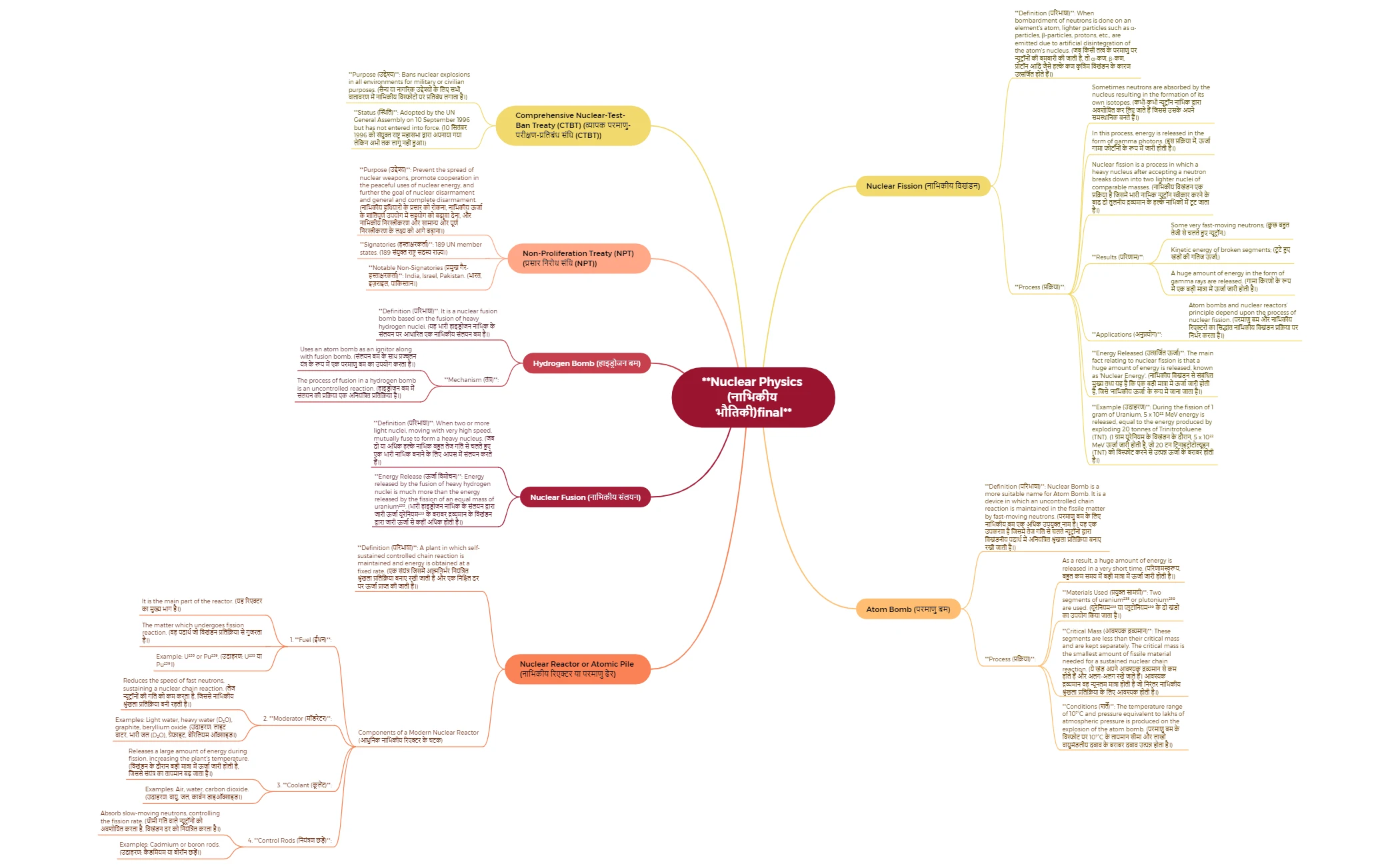
Read the branchesशाखाएँ पढ़ें
Nuclear Physics (नाभिकीय भौतिकी)final
Nuclear Physics (नाभिकीय भौतिकी)final
Nuclear Fission (नाभिकीय विखंडन)
Definition (परिभाषा): When bombardment of neutrons is done on an element's atom, lighter particles such as α-particles, β-particles, protons, etc., are emitted due to artificial disintegration of the atom's nucleus. (जब किसी तत्व के परमाणु पर न्यूट्रॉनों की बमबारी की जाती है, तो α-कण, β-कण, प्रोटॉन आदि जैसे हल्के कण कृत्रिम विखंडन के कारण उत्सर्जित होते हैं।)
Process (प्रक्रिया):
Sometimes neutrons are absorbed by the nucleus resulting in the formation of its own isotopes. (कभी-कभी न्यूट्रॉन नाभिक द्वारा अवशोषित कर लिए जाते हैं जिससे उसके अपने समस्थानिक बनते हैं।)
In this process, energy is released in the form of gamma photons. (इस प्रक्रिया में, ऊर्जा गामा फोटॉनों के रूप में जारी होती है।)
Nuclear fission is a process in which a heavy nucleus after accepting a neutron breaks down into two lighter nuclei of comparable masses. (नाभिकीय विखंडन एक प्रक्रिया है जिसमें भारी नाभिक न्यूट्रॉन स्वीकार करने के बाद दो तुलनीय द्रव्यमान के हल्के नाभिकों में टूट जाता है।)
Results (परिणाम):
Some very fast-moving neutrons; (कुछ बहुत तेजी से चलते हुए न्यूट्रॉन;)
Kinetic energy of broken segments; (टूटे हुए खंडों की गतिज ऊर्जा;)
A huge amount of energy in the form of gamma rays are released. (गामा किरणों के रूप में एक बड़ी मात्रा में ऊर्जा जारी होती है।)
Applications (अनुप्रयोग):
Atom bombs and nuclear reactors’ principle depend upon the process of nuclear fission. (परमाणु बम और नाभिकीय रिएक्टरों का सिद्धांत नाभिकीय विखंडन प्रक्रिया पर निर्भर करता है।)
Energy Released (उत्सर्जित ऊर्जा): The main fact relating to nuclear fission is that a huge amount of energy is released, known as 'Nuclear Energy'. (नाभिकीय विखंडन से संबंधित मुख्य तथ्य यह है कि एक बड़ी मात्रा में ऊर्जा जारी होती है, जिसे 'नाभिकीय ऊर्जा' के रूप में जाना जाता है।)
Example (उदाहरण): During the fission of 1 gram of Uranium, 5 x 10²² MeV energy is released, equal to the energy produced by exploding 20 tonnes of Trinitrotoluene (TNT). (1 ग्राम यूरेनियम के विखंडन के दौरान, 5 x 10²² MeV ऊर्जा जारी होती है, जो 20 टन ट्रिनाइट्रोटोल्यूइन (TNT) को विस्फोट करने से उत्पन्न ऊर्जा के बराबर होती है।)
Atom Bomb (परमाणु बम)
Definition (परिभाषा): Nuclear Bomb is a more suitable name for Atom Bomb. It is a device in which an uncontrolled chain reaction is maintained in the fissile matter by fast-moving neutrons. (परमाणु बम के लिए नाभिकीय बम एक अधिक उपयुक्त नाम है। यह एक उपकरण है जिसमें तेज गति से चलते न्यूट्रॉनों द्वारा विखंडनीय पदार्थ में अनियंत्रित श्रृंखला प्रतिक्रिया बनाए रखी जाती है।)
Process (प्रक्रिया):
As a result, a huge amount of energy is released in a very short time. (परिणामस्वरूप, बहुत कम समय में बड़ी मात्रा में ऊर्जा जारी होती है।)
Materials Used (प्रयुक्त सामग्री): Two segments of uranium²³⁵ or plutonium²³⁹ are used. (यूरेनियम²³⁵ या प्लूटोनियम²³⁹ के दो खंडों का उपयोग किया जाता है।)
Critical Mass (आवश्यक द्रव्यमान): These segments are less than their critical mass and are kept separately. The critical mass is the smallest amount of fissile material needed for a sustained nuclear chain reaction. (ये खंड अपने आवश्यक द्रव्यमान से कम होते हैं और अलग-अलग रखे जाते हैं। आवश्यक द्रव्यमान वह न्यूनतम मात्रा होती है जो निरंतर नाभिकीय श्रृंखला प्रतिक्रिया के लिए आवश्यक होती है।)
Conditions (शर्तें): The temperature range of 10⁷°C and pressure equivalent to lakhs of atmospheric pressure is produced on the explosion of the atom bomb. (परमाणु बम के विस्फोट पर 10⁷°C के तापमान सीमा और लाखों वायुमंडलीय दबाव के बराबर दबाव उत्पन्न होता है।)
Nuclear Reactor or Atomic Pile (नाभिकीय रिएक्टर या परमाणु ढेर)
Definition (परिभाषा): A plant in which self-sustained controlled chain reaction is maintained and energy is obtained at a fixed rate. (एक संयंत्र जिसमें आत्मनिर्भर नियंत्रित श्रृंखला प्रतिक्रिया बनाए रखी जाती है और एक निश्चित दर पर ऊर्जा प्राप्त की जाती है।)
Components of a Modern Nuclear Reactor (आधुनिक नाभिकीय रिएक्टर के घटक)
1. Fuel (ईंधन):
It is the main part of the reactor. (यह रिएक्टर का मुख्य भाग है।)
The matter which undergoes fission reaction. (वह पदार्थ जो विखंडन प्रतिक्रिया से गुजरता है।)
Example: U²³⁵ or Pu²³⁹. (उदाहरण: U²³⁵ या Pu²³⁹।)
2. Moderator (मॉडरेटर):
Reduces the speed of fast neutrons, sustaining a nuclear chain reaction. (तेज न्यूट्रॉनों की गति को कम करता है, जिससे नाभिकीय श्रृंखला प्रतिक्रिया बनी रहती है।)
Examples: Light water, heavy water (D₂O), graphite, beryllium oxide. (उदाहरण: लाइट वाटर, भारी जल (D₂O), ग्रेफाइट, बेरिलियम ऑक्साइड।)
3. Coolant (कूलेंट):
Releases a large amount of energy during fission, increasing the plant's temperature. (विखंडन के दौरान बड़ी मात्रा में ऊर्जा जारी होती है, जिससे संयंत्र का तापमान बढ़ जाता है।)
Examples: Air, water, carbon dioxide. (उदाहरण: वायु, जल, कार्बन डाइऑक्साइड।)
4. Control Rods (नियंत्रण छड़ें):
Absorb slow-moving neutrons, controlling the fission rate. (धीमी गति वाले न्यूट्रॉनों को अवशोषित करता है, विखंडन दर को नियंत्रित करता है।)
Examples: Cadmium or boron rods. (उदाहरण: कैडमियम या बोरॉन छड़ें।)
Nuclear Fusion (नाभिकीय संलयन)
Definition (परिभाषा): When two or more light nuclei, moving with very high speed, mutually fuse to form a heavy nucleus. (जब दो या अधिक हल्के नाभिक बहुत तेज गति से चलते हुए एक भारी नाभिक बनाने के लिए आपस में संलयन करते हैं।)
Energy Release (ऊर्जा विमोचन): Energy released by the fusion of heavy hydrogen nuclei is much more than the energy released by the fission of an equal mass of uranium²³⁵. (भारी हाइड्रोजन नाभिक के संलयन द्वारा जारी ऊर्जा यूरेनियम²³⁵ के बराबर द्रव्यमान के विखंडन द्वारा जारी ऊर्जा से कहीं अधिक होती है।)
Hydrogen Bomb (हाइड्रोजन बम)
Definition (परिभाषा): It is a nuclear fusion bomb based on the fusion of heavy hydrogen nuclei. (यह भारी हाइड्रोजन नाभिक के संलयन पर आधारित एक नाभिकीय संलयन बम है।)
Mechanism (तंत्र):
Uses an atom bomb as an ignitor along with fusion bomb. (संलयन बम के साथ प्रज्वलन यंत्र के रूप में एक परमाणु बम का उपयोग करता है।)
The process of fusion in a hydrogen bomb is an uncontrolled reaction. (हाइड्रोजन बम में संलयन की प्रक्रिया एक अनियंत्रित प्रतिक्रिया है।)
Non-Proliferation Treaty (NPT) (प्रसार निरोध संधि (NPT))
Purpose (उद्देश्य): Prevent the spread of nuclear weapons, promote cooperation in the peaceful uses of nuclear energy, and further the goal of nuclear disarmament and general and complete disarmament. (नाभिकीय हथियारों के प्रसार को रोकना, नाभिकीय ऊर्जा के शांतिपूर्ण उपयोग में सहयोग को बढ़ावा देना, और नाभिकीय निरस्त्रीकरण और सामान्य और पूर्ण निरस्त्रीकरण के लक्ष्य को आगे बढ़ाना।)
Signatories (हस्ताक्षरकर्ता): 189 UN member states. (189 संयुक्त राष्ट्र सदस्य राज्य।)
Notable Non-Signatories (प्रमुख गैर-हस्ताक्षरकर्ता): India, Israel, Pakistan. (भारत, इज़राइल, पाकिस्तान।)
Comprehensive Nuclear-Test-Ban Treaty (CTBT) (व्यापक परमाणु-परीक्षण-प्रतिबंध संधि (CTBT))
Purpose (उद्देश्य): Bans nuclear explosions in all environments for military or civilian purposes. (सैन्य या नागरिक उद्देश्यों के लिए सभी वातावरण में नाभिकीय विस्फोटों पर प्रतिबंध लगाता है।)
Status (स्थिति): Adopted by the UN General Assembly on 10 September 1996 but has not entered into force. (10 सितंबर 1996 को संयुक्त राष्ट्र महासभा द्वारा अपनाया गया लेकिन अभी तक लागू नहीं हुआ।)