Mind Mapsमाइंड मैप्स › Physicsभौतिकी
Electric Current — mind mapमाइंड मैप
Original study maps by Rishabh Singh. Read dated facts in their exam-year context. Sources & corrections.ऋषभ सिंह के मूल अध्ययन मानचित्र। पुराने तथ्यों को संबंधित परीक्षा वर्ष के संदर्भ में पढ़ें। स्रोत और सुधार।
43 branches and entriesशाखाएँ और बिंदु · 1 sheet(s)शीट
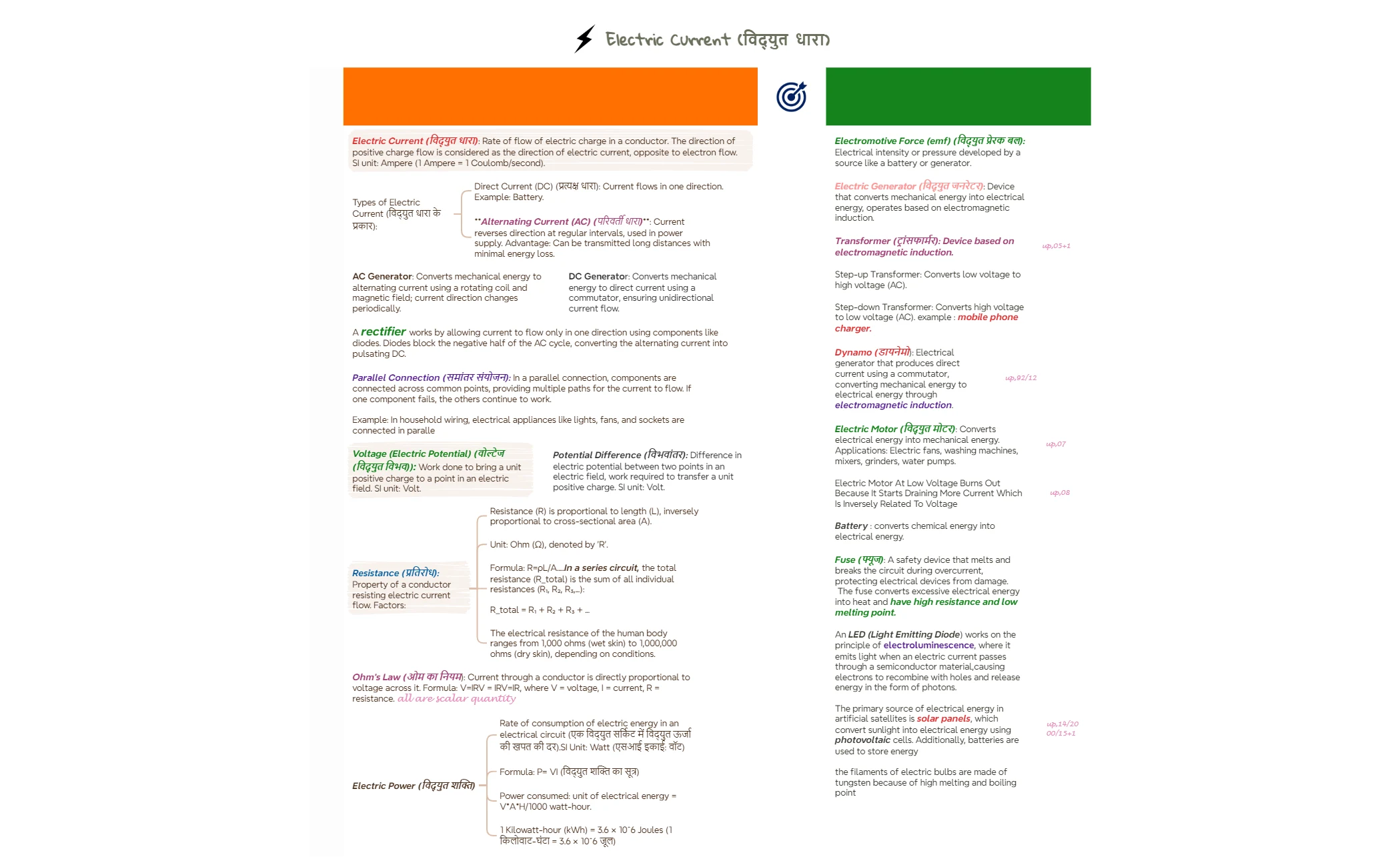
See the original map layoutमूल मानचित्र का स्वरूप देखें
Tap the image to open its full preview. Read individual branches below for comfortable revision.पूरा पूर्वावलोकन खोलने के लिए चित्र पर टैप करें। आसानी से पढ़ने के लिए नीचे शाखाएँ देखें।
Read the branchesशाखाएँ पढ़ें
Electric Current (विद्युत धारा)
Electric Current (विद्युत धारा)
Study map
Electric Current (विद्युत धारा): Rate of flow of electric charge in a conductor. The direction of positive charge flow is considered as the direction of electric current, opposite to electron flow. SI unit: Ampere (1 Ampere = 1 Coulomb/second).
Types of Electric Current (विद्युत धारा के प्रकार):
Direct Current (DC) (प्रत्यक्ष धारा): Current flows in one direction. Example: Battery.
Alternating Current (AC) (परिवर्ती धारा): Current reverses direction at regular intervals, used in power supply. Advantage: Can be transmitted long distances with minimal energy loss.
AC Generator: Converts mechanical energy to alternating current using a rotating coil and magnetic field; current direction changes periodically.
DC Generator: Converts mechanical energy to direct current using a commutator, ensuring unidirectional current flow.
A rectifier works by allowing current to flow only in one direction using components like diodes. Diodes block the negative half of the AC cycle, converting the alternating current into pulsating DC.
Parallel Connection (समांतर संयोजन): In a parallel connection, components are connected across common points, providing multiple paths for the current to flow. If one component fails, the others continue to work. Example: In household wiring, electrical appliances like lights, fans, and sockets are connected in paralle
Voltage (Electric Potential) (वोल्टेज (विद्युत विभव)): Work done to bring a unit positive charge to a point in an electric field. SI unit: Volt.
Potential Difference (विभवांतर): Difference in electric potential between two points in an electric field, work required to transfer a unit positive charge. SI unit: Volt.
Resistance (प्रतिरोध): Property of a conductor resisting electric current flow. Factors:
Resistance (R) is proportional to length (L), inversely proportional to cross-sectional area (A).
Unit: Ohm (Ω), denoted by 'R'.
Formula: R=ρL/A.....In a series circuit, the total resistance (R_total) is the sum of all individual resistances (R₁, R₂, R₃,...): R_total = R₁ + R₂ + R₃ + ...
The electrical resistance of the human body ranges from 1,000 ohms (wet skin) to 1,000,000 ohms (dry skin), depending on conditions.
Ohm's Law (ओम का नियम): Current through a conductor is directly proportional to voltage across it. Formula: V=IRV = IRV=IR, where V = voltage, I = current, R = resistance. all are scalar quantity
Electric Power (विद्युत शक्ति)
Rate of consumption of electric energy in an electrical circuit (एक विद्युत सर्किट में विद्युत ऊर्जा की खपत की दर).SI Unit: Watt (एसआई इकाई: वॉट)
Formula: P= VI (विद्युत शक्ति का सूत्र)
Power consumed: unit of electrical energy = V*A*H/1000 watt-hour.
1 Kilowatt-hour (kWh) = 3.6 × 10^6 Joules (1 किलोवाट-घंटा = 3.6 × 10^6 जूल)
Study map
Study map
Electromotive Force (emf) (विद्युत प्रेरक बल): Electrical intensity or pressure developed by a source like a battery or generator.
Electric Generator (विद्युत जनरेटर): Device that converts mechanical energy into electrical energy, operates based on electromagnetic induction.
Transformer (ट्रांसफार्मर): Device based on electromagnetic induction.
up,05+1
Step-up Transformer: Converts low voltage to high voltage (AC).
Step-down Transformer: Converts high voltage to low voltage (AC). example : mobile phone charger.
Dynamo (डायनेमो): Electrical generator that produces direct current using a commutator, converting mechanical energy to electrical energy through electromagnetic induction.
up,92/12
Electric Motor (विद्युत मोटर): Converts electrical energy into mechanical energy. Applications: Electric fans, washing machines, mixers, grinders, water pumps.
up,07
electric motor at low voltage burns out because it starts draining more current which is inversely related to voltage
up,08
Battery : converts chemical energy into electrical energy.
Fuse (फ्यूज): A safety device that melts and breaks the circuit during overcurrent, protecting electrical devices from damage. The fuse converts excessive electrical energy into heat and have high resistance and low melting point.
An LED (Light Emitting Diode) works on the principle of electroluminescence, where it emits light when an electric current passes through a semiconductor material,causing electrons to recombine with holes and release energy in the form of photons.
The primary source of electrical energy in artificial satellites is solar panels, which convert sunlight into electrical energy using photovoltaic cells. Additionally, batteries are used to store energy
up,14/2000/15+1
the filaments of electric bulbs are made of tungsten because of high melting and boiling point