Mind Mapsमाइंड मैप्स › Physicsभौतिकी
Conductivity — mind mapमाइंड मैप
Original study maps by Rishabh Singh. Read dated facts in their exam-year context. Sources & corrections.ऋषभ सिंह के मूल अध्ययन मानचित्र। पुराने तथ्यों को संबंधित परीक्षा वर्ष के संदर्भ में पढ़ें। स्रोत और सुधार।
13 branches and entriesशाखाएँ और बिंदु · 1 sheet(s)शीट
See the original map layoutमूल मानचित्र का स्वरूप देखें
Tap the image to open its full preview. Read individual branches below for comfortable revision.पूरा पूर्वावलोकन खोलने के लिए चित्र पर टैप करें। आसानी से पढ़ने के लिए नीचे शाखाएँ देखें।
Read the branchesशाखाएँ पढ़ें
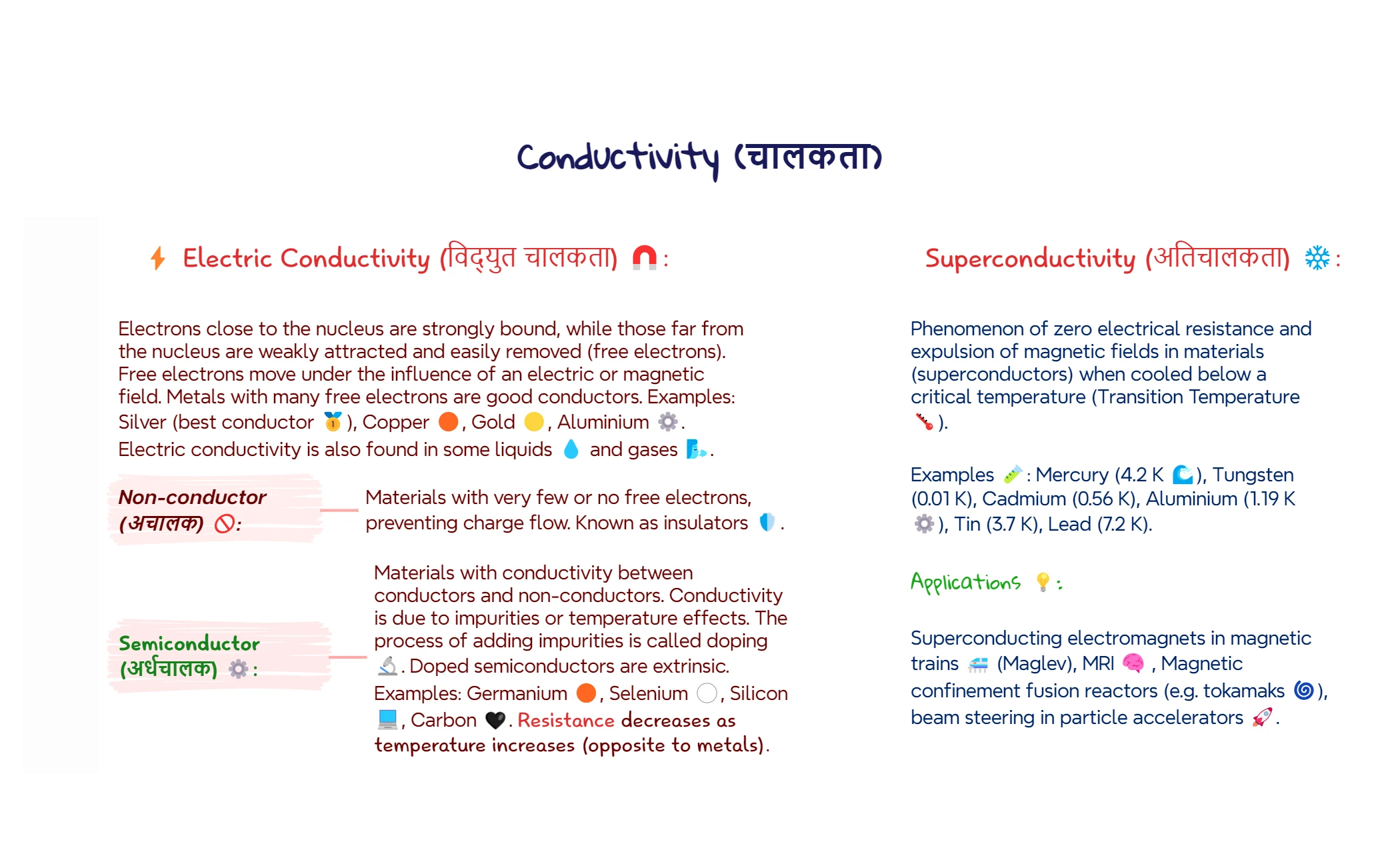
Conductivity (चालकता)
Conductivity (चालकता)
⚡ Electric Conductivity (विद्युत चालकता) 🧲:
Electrons close to the nucleus are strongly bound, while those far from the nucleus are weakly attracted and easily removed (free electrons). Free electrons move under the influence of an electric or magnetic field. Metals with many free electrons are good conductors. Examples: Silver (best conductor 🥇), Copper 🟠, Gold 🟡, Aluminium ⚙️. Electric conductivity is also found in some liquids 💧 and gases 🌬️.
Non-conductor (अचालक) 🚫:
Materials with very few or no free electrons, preventing charge flow. Known as insulators 🛡️.
Semiconductor (अर्धचालक) ⚙️:
Materials with conductivity between conductors and non-conductors. Conductivity is due to impurities or temperature effects. The process of adding impurities is called doping 🔬. Doped semiconductors are extrinsic. Examples: Germanium 🟠, Selenium ⚪, Silicon 💻, Carbon 🖤. Resistance decreases as temperature increases (opposite to metals).
Study map
Superconductivity (अतिचालकता) ❄️:
Phenomenon of zero electrical resistance and expulsion of magnetic fields in materials (superconductors) when cooled below a critical temperature (Transition Temperature 🌡️).
Examples 🧪: Mercury (4.2 K 🌊), Tungsten (0.01 K), Cadmium (0.56 K), Aluminium (1.19 K ⚙️), Tin (3.7 K), Lead (7.2 K).
Applications 💡:
Superconducting electromagnets in magnetic trains 🚄 (Maglev), MRI 🧠 , Magnetic confinement fusion reactors (e.g. tokamaks 🌀), beam steering in particle accelerators 🚀.