Mind Mapsमाइंड मैप्स › Modern Historyआधुनिक इतिहास
East India Company and Nawabs of Bengal — mind mapमाइंड मैप
Original study maps by Rishabh Singh. Read dated facts in their exam-year context. Sources & corrections.ऋषभ सिंह के मूल अध्ययन मानचित्र। पुराने तथ्यों को संबंधित परीक्षा वर्ष के संदर्भ में पढ़ें। स्रोत और सुधार।
17 branches and entriesशाखाएँ और बिंदु · 1 sheet(s)शीट
See the original map layoutमूल मानचित्र का स्वरूप देखें
Tap the image to open its full preview. Read individual branches below for comfortable revision.पूरा पूर्वावलोकन खोलने के लिए चित्र पर टैप करें। आसानी से पढ़ने के लिए नीचे शाखाएँ देखें।
Read the branchesशाखाएँ पढ़ें
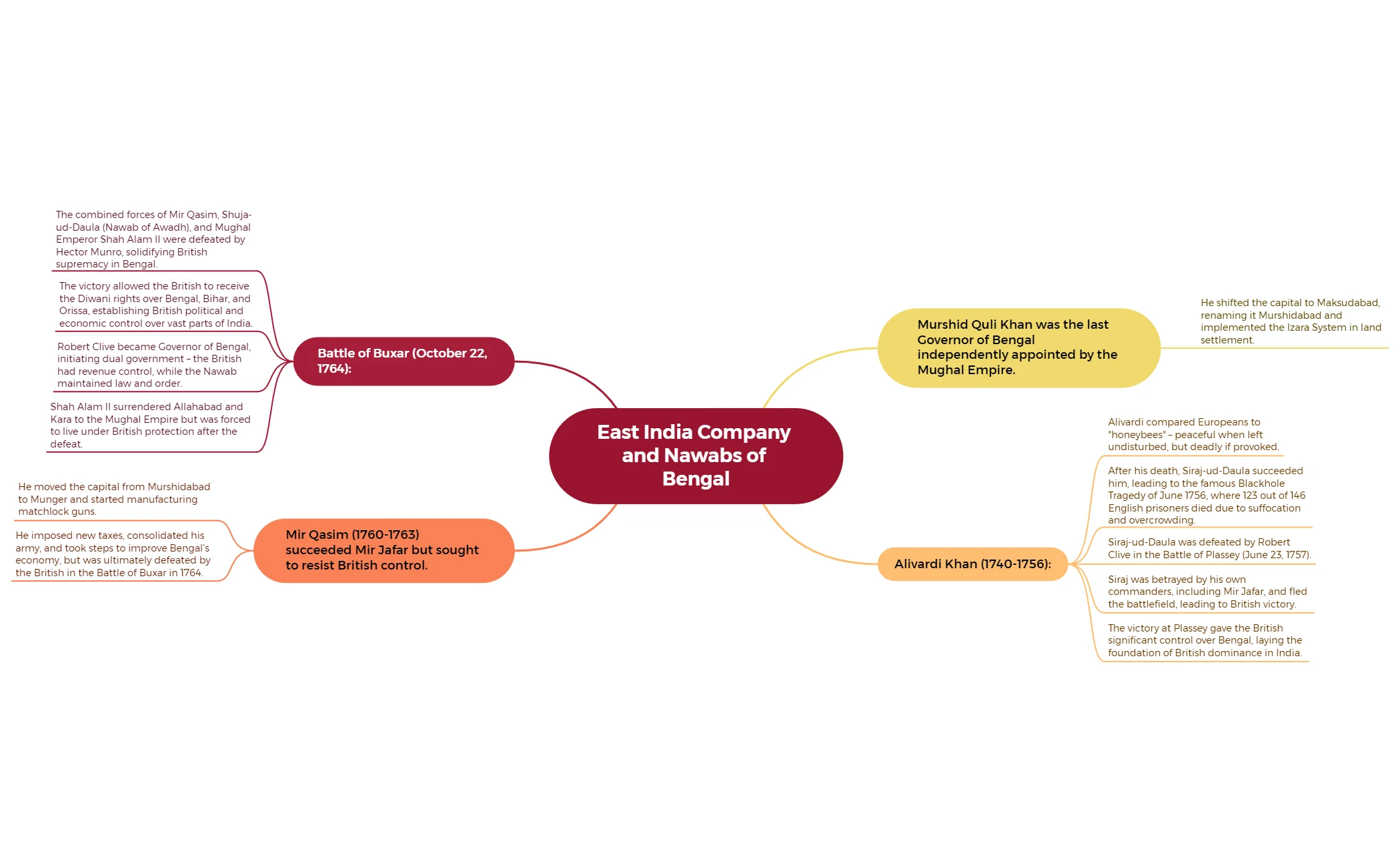
East India Company and Nawabs of Bengal
East India Company and Nawabs of Bengal
Murshid Quli Khan was the last Governor of Bengal independently appointed by the Mughal Empire.
He shifted the capital to Maksudabad, renaming it Murshidabad and implemented the Izara System in land settlement.
Alivardi Khan (1740-1756):
Alivardi compared Europeans to "honeybees" – peaceful when left undisturbed, but deadly if provoked.
After his death, Siraj-ud-Daula succeeded him, leading to the famous Blackhole Tragedy of June 1756, where 123 out of 146 English prisoners died due to suffocation and overcrowding.
Siraj-ud-Daula was defeated by Robert Clive in the Battle of Plassey (June 23, 1757).
Siraj was betrayed by his own commanders, including Mir Jafar, and fled the battlefield, leading to British victory.
The victory at Plassey gave the British significant control over Bengal, laying the foundation of British dominance in India.
Mir Qasim (1760-1763) succeeded Mir Jafar but sought to resist British control.
He moved the capital from Murshidabad to Munger and started manufacturing matchlock guns.
He imposed new taxes, consolidated his army, and took steps to improve Bengal’s economy, but was ultimately defeated by the British in the Battle of Buxar in 1764.
Battle of Buxar (October 22, 1764):
The combined forces of Mir Qasim, Shuja-ud-Daula (Nawab of Awadh), and Mughal Emperor Shah Alam II were defeated by Hector Munro, solidifying British supremacy in Bengal.
The victory allowed the British to receive the Diwani rights over Bengal, Bihar, and Orissa, establishing British political and economic control over vast parts of India.
Robert Clive became Governor of Bengal, initiating dual government – the British had revenue control, while the Nawab maintained law and order.
Shah Alam II surrendered Allahabad and Kara to the Mughal Empire but was forced to live under British protection after the defeat.