Mind Mapsमाइंड मैप्स › Modern Historyआधुनिक इतिहास
The Advent of European Companies — mind mapमाइंड मैप
Original study maps by Rishabh Singh. Read dated facts in their exam-year context. Sources & corrections.ऋषभ सिंह के मूल अध्ययन मानचित्र। पुराने तथ्यों को संबंधित परीक्षा वर्ष के संदर्भ में पढ़ें। स्रोत और सुधार।
25 branches and entriesशाखाएँ और बिंदु · 1 sheet(s)शीट
See the original map layoutमूल मानचित्र का स्वरूप देखें
Tap the image to open its full preview. Read individual branches below for comfortable revision.पूरा पूर्वावलोकन खोलने के लिए चित्र पर टैप करें। आसानी से पढ़ने के लिए नीचे शाखाएँ देखें।
Read the branchesशाखाएँ पढ़ें
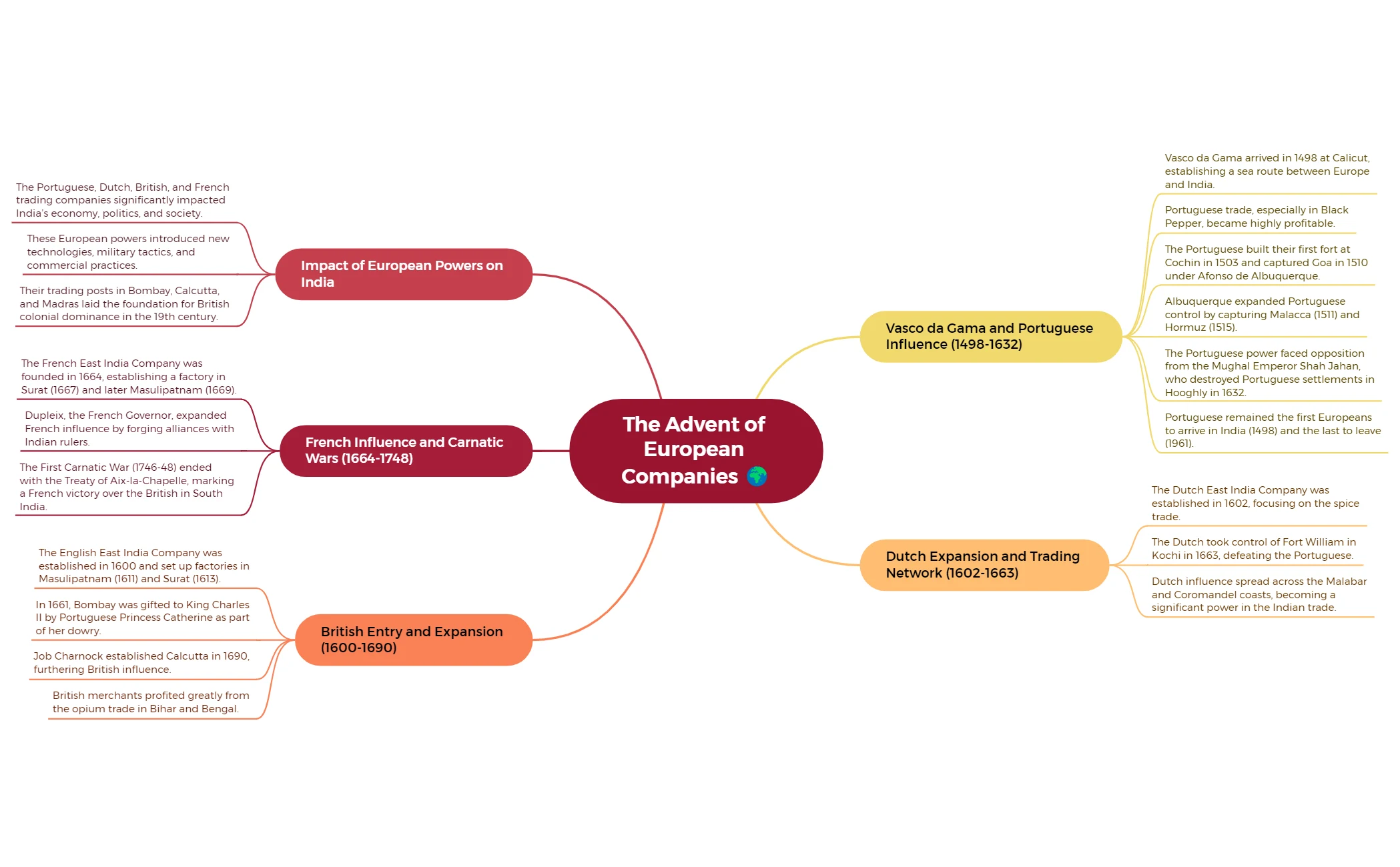
The Advent of European Companies 🌍
The Advent of European Companies 🌍
Vasco da Gama and Portuguese Influence (1498-1632)
Vasco da Gama arrived in 1498 at Calicut, establishing a sea route between Europe and India.
Portuguese trade, especially in Black Pepper, became highly profitable.
The Portuguese built their first fort at Cochin in 1503 and captured Goa in 1510 under Afonso de Albuquerque.
Albuquerque expanded Portuguese control by capturing Malacca (1511) and Hormuz (1515).
The Portuguese power faced opposition from the Mughal Emperor Shah Jahan, who destroyed Portuguese settlements in Hooghly in 1632.
Portuguese remained the first Europeans to arrive in India (1498) and the last to leave (1961).
Dutch Expansion and Trading Network (1602-1663)
The Dutch East India Company was established in 1602, focusing on the spice trade.
The Dutch took control of Fort William in Kochi in 1663, defeating the Portuguese.
Dutch influence spread across the Malabar and Coromandel coasts, becoming a significant power in the Indian trade.
British Entry and Expansion (1600-1690)
The English East India Company was established in 1600 and set up factories in Masulipatnam (1611) and Surat (1613).
In 1661, Bombay was gifted to King Charles II by Portuguese Princess Catherine as part of her dowry.
Job Charnock established Calcutta in 1690, furthering British influence.
British merchants profited greatly from the opium trade in Bihar and Bengal.
French Influence and Carnatic Wars (1664-1748)
The French East India Company was founded in 1664, establishing a factory in Surat (1667) and later Masulipatnam (1669).
Dupleix, the French Governor, expanded French influence by forging alliances with Indian rulers.
The First Carnatic War (1746-48) ended with the Treaty of Aix-la-Chapelle, marking a French victory over the British in South India.
Impact of European Powers on India
The Portuguese, Dutch, British, and French trading companies significantly impacted India’s economy, politics, and society.
These European powers introduced new technologies, military tactics, and commercial practices.
Their trading posts in Bombay, Calcutta, and Madras laid the foundation for British colonial dominance in the 19th century.