Mind Mapsमाइंड मैप्स › Medieval Historyमध्यकालीन इतिहास
Tughluq Dynasty Ruled from 1320 AD to 1412 AD — mind mapमाइंड मैप
Original study maps by Rishabh Singh. Read dated facts in their exam-year context. Sources & corrections.ऋषभ सिंह के मूल अध्ययन मानचित्र। पुराने तथ्यों को संबंधित परीक्षा वर्ष के संदर्भ में पढ़ें। स्रोत और सुधार।
34 branches and entriesशाखाएँ और बिंदु · 1 sheet(s)शीट
See the original map layoutमूल मानचित्र का स्वरूप देखें
Tap the image to open its full preview. Read individual branches below for comfortable revision.पूरा पूर्वावलोकन खोलने के लिए चित्र पर टैप करें। आसानी से पढ़ने के लिए नीचे शाखाएँ देखें।
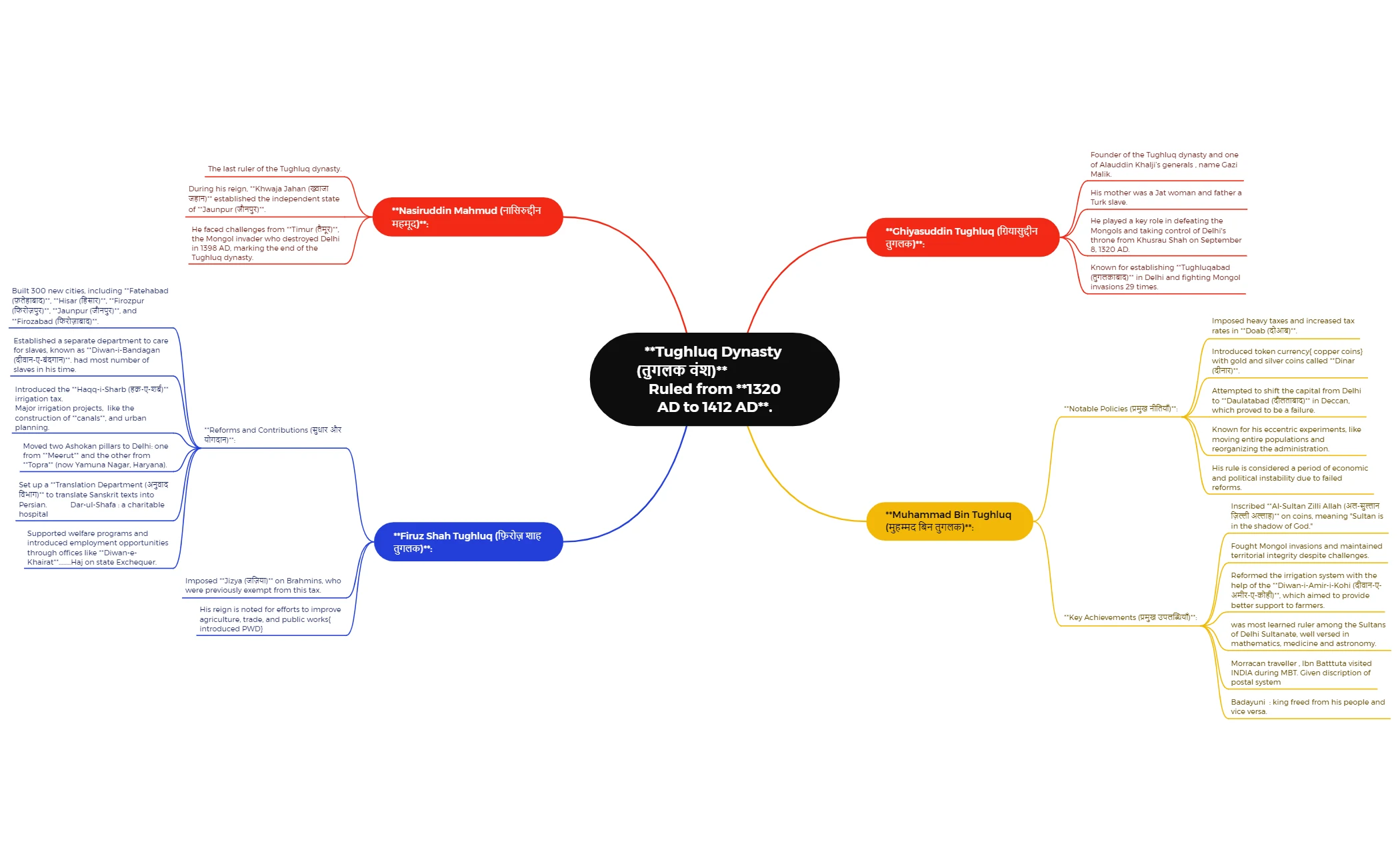
Read the branchesशाखाएँ पढ़ें
Tughluq Dynasty (तुगलक वंश) Ruled from 1320 AD to 1412 AD.
Tughluq Dynasty (तुगलक वंश) Ruled from 1320 AD to 1412 AD.
Ghiyasuddin Tughluq (ग़ियासुद्दीन तुगलक):
Founder of the Tughluq dynasty and one of Alauddin Khalji’s generals , name Gazi Malik.
His mother was a Jat woman and father a Turk slave.
He played a key role in defeating the Mongols and taking control of Delhi's throne from Khusrau Shah on September 8, 1320 AD.
Known for establishing Tughluqabad (तुगलकाबाद) in Delhi and fighting Mongol invasions 29 times.
Muhammad Bin Tughluq (मुहम्मद बिन तुगलक):
Notable Policies (प्रमुख नीतियाँ):
Imposed heavy taxes and increased tax rates in Doab (दोआब).
Introduced token currency{ copper coins} with gold and silver coins called Dinar (दीनार).
Attempted to shift the capital from Delhi to Daulatabad (दौलताबाद) in Deccan, which proved to be a failure.
Known for his eccentric experiments, like moving entire populations and reorganizing the administration.
His rule is considered a period of economic and political instability due to failed reforms.
Key Achievements (प्रमुख उपलब्धियाँ):
Inscribed Al-Sultan Zilli Allah (अल-सुल्तान ज़िल्ली अल्लाह) on coins, meaning "Sultan is in the shadow of God."
Fought Mongol invasions and maintained territorial integrity despite challenges.
Reformed the irrigation system with the help of the Diwan-i-Amir-i-Kohi (दीवान-ए-अमीर-ए-कोही), which aimed to provide better support to farmers.
was most learned ruler among the Sultans of Delhi Sultanate, well versed in mathematics, medicine and astronomy.
Morracan traveller , Ibn Batttuta visited INDIA during MBT. Given discription of postal system
Badayuni : king freed from his people and vice versa.
Firuz Shah Tughluq (फ़िरोज़ शाह तुगलक):
Reforms and Contributions (सुधार और योगदान):
Built 300 new cities, including Fatehabad (फ़तेहाबाद), Hisar (हिसार), Firozpur (फिरोज़पुर), Jaunpur (जौनपुर), and Firozabad (फिरोज़ाबाद).
Established a separate department to care for slaves, known as Diwan-i-Bandagan (दीवान-ए-बंदगान). had most number of slaves in his time.
Introduced the Haqq-i-Sharb (हक़-ए-शर्ब) irrigation tax. Major irrigation projects, like the construction of canals, and urban planning.
Moved two Ashokan pillars to Delhi: one from Meerut and the other from Topra (now Yamuna Nagar, Haryana).
Set up a Translation Department (अनुवाद विभाग) to translate Sanskrit texts into Persian. Dar-ul-Shafa : a charitable hospital
Supported welfare programs and introduced employment opportunities through offices like Diwan-e-Khairat........Haj on state Exchequer.
Imposed Jizya (जज़िया) on Brahmins, who were previously exempt from this tax.
His reign is noted for efforts to improve agriculture, trade, and public works{ introduced PWD}
Nasiruddin Mahmud (नासिरुद्दीन महमूद):
The last ruler of the Tughluq dynasty.
During his reign, Khwaja Jahan (ख्वाजा जहान) established the independent state of Jaunpur (जौनपुर).
He faced challenges from Timur (तैमूर), the Mongol invader who destroyed Delhi in 1398 AD, marking the end of the Tughluq dynasty.
← More Medieval History mapsमध्यकालीन इतिहास के अन्य मानचित्र