Mind Mapsमाइंड मैप्स › Medieval Historyमध्यकालीन इतिहास
Delhi Sultanate: Administration — mind mapमाइंड मैप
Original study maps by Rishabh Singh. Read dated facts in their exam-year context. Sources & corrections.ऋषभ सिंह के मूल अध्ययन मानचित्र। पुराने तथ्यों को संबंधित परीक्षा वर्ष के संदर्भ में पढ़ें। स्रोत और सुधार।
30 branches and entriesशाखाएँ और बिंदु · 1 sheet(s)शीट
See the original map layoutमूल मानचित्र का स्वरूप देखें
Tap the image to open its full preview. Read individual branches below for comfortable revision.पूरा पूर्वावलोकन खोलने के लिए चित्र पर टैप करें। आसानी से पढ़ने के लिए नीचे शाखाएँ देखें।
Read the branchesशाखाएँ पढ़ें
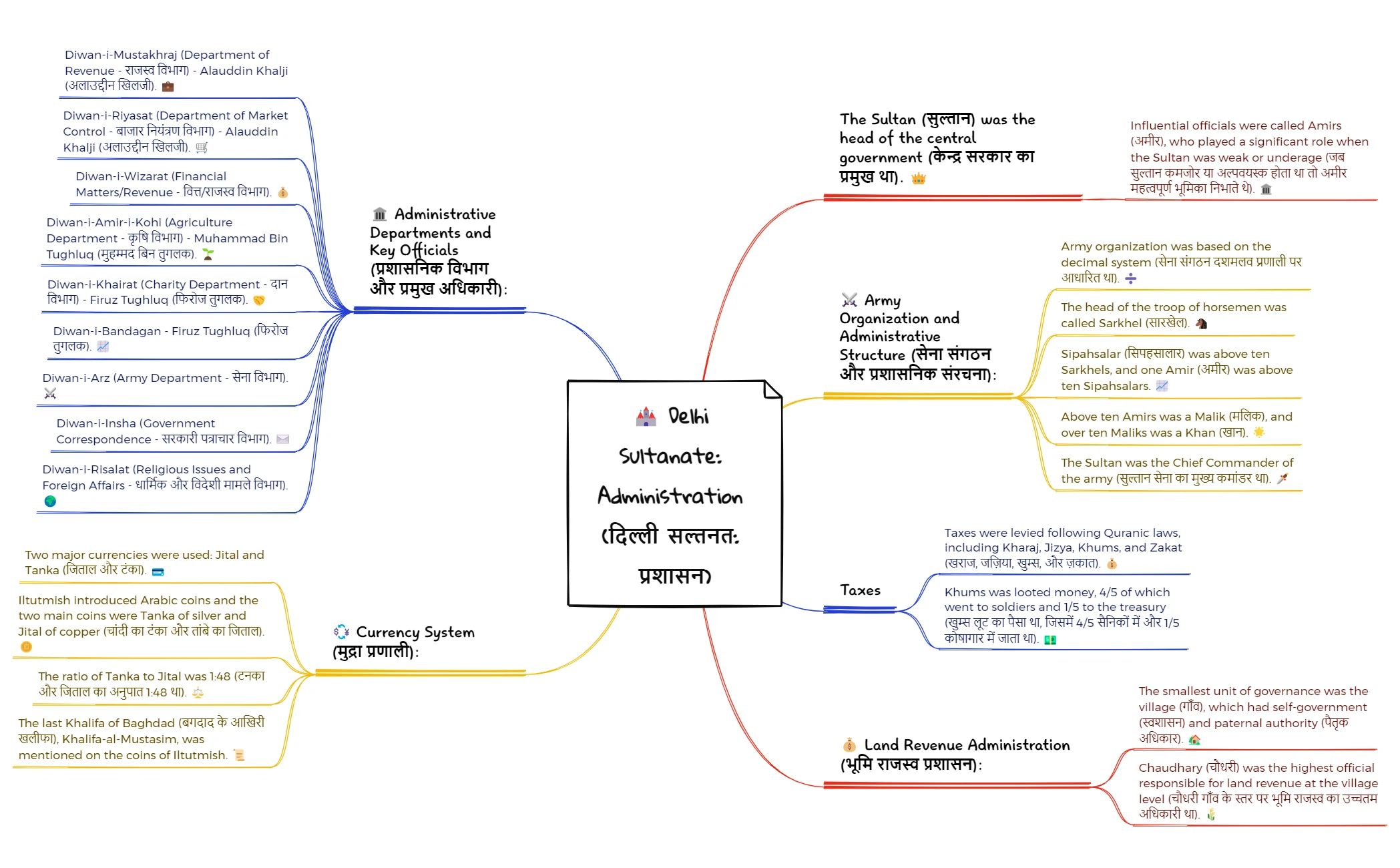
🏰 Delhi Sultanate: Administration (दिल्ली सल्तनत: प्रशासन)
🏰 Delhi Sultanate: Administration (दिल्ली सल्तनत: प्रशासन)
The Sultan (सुल्तान) was the head of the central government (केन्द्र सरकार का प्रमुख था). 👑
Influential officials were called Amirs (अमीर), who played a significant role when the Sultan was weak or underage (जब सुल्तान कमजोर या अल्पवयस्क होता था तो अमीर महत्वपूर्ण भूमिका निभाते थे). 🏛️
⚔️ Army Organization and Administrative Structure (सेना संगठन और प्रशासनिक संरचना):
Army organization was based on the decimal system (सेना संगठन दशमलव प्रणाली पर आधारित था). ➗
The head of the troop of horsemen was called Sarkhel (सारखेल). 🐴
Sipahsalar (सिपहसालार) was above ten Sarkhels, and one Amir (अमीर) was above ten Sipahsalars. 📈
Above ten Amirs was a Malik (मलिक), and over ten Maliks was a Khan (खान). 🌟
The Sultan was the Chief Commander of the army (सुल्तान सेना का मुख्य कमांडर था). 🗡️
Taxes
Taxes were levied following Quranic laws, including Kharaj, Jizya, Khums, and Zakat (खराज, जज़िया, खुम्स, और ज़कात). 💰
Khums was looted money, 4/5 of which went to soldiers and 1/5 to the treasury (खुम्स लूट का पैसा था, जिसमें 4/5 सैनिकों में और 1/5 कोषागार में जाता था). 💵
💰 Land Revenue Administration (भूमि राजस्व प्रशासन):
The smallest unit of governance was the village (गाँव), which had self-government (स्वशासन) and paternal authority (पैतृक अधिकार). 🏡
Chaudhary (चौधरी) was the highest official responsible for land revenue at the village level (चौधरी गाँव के स्तर पर भूमि राजस्व का उच्चतम अधिकारी था). 🌾
💱 Currency System (मुद्रा प्रणाली):
Two major currencies were used: Jital and Tanka (जिताल और टंका). 💳
Iltutmish introduced Arabic coins and the two main coins were Tanka of silver and Jital of copper (चांदी का टंका और तांबे का जिताल). 🪙
The ratio of Tanka to Jital was 1:48 (टनका और जिताल का अनुपात 1:48 था). ⚖️
The last Khalifa of Baghdad (बगदाद के आखिरी खलीफा), Khalifa-al-Mustasim, was mentioned on the coins of Iltutmish. 📜
🏛️ Administrative Departments and Key Officials (प्रशासनिक विभाग और प्रमुख अधिकारी):
Diwan-i-Mustakhraj (Department of Revenue - राजस्व विभाग) - Alauddin Khalji (अलाउद्दीन खिलजी). 💼
Diwan-i-Riyasat (Department of Market Control - बाजार नियंत्रण विभाग) - Alauddin Khalji (अलाउद्दीन खिलजी). 🛒
Diwan-i-Wizarat (Financial Matters/Revenue - वित्त/राजस्व विभाग). 💰
Diwan-i-Amir-i-Kohi (Agriculture Department - कृषि विभाग) - Muhammad Bin Tughluq (मुहम्मद बिन तुगलक). 🌱
Diwan-i-Khairat (Charity Department - दान विभाग) - Firuz Tughluq (फिरोज तुगलक). 🤝
Diwan-i-Bandagan - Firuz Tughluq (फिरोज तुगलक). 📈
Diwan-i-Arz (Army Department - सेना विभाग). ⚔️
Diwan-i-Insha (Government Correspondence - सरकारी पत्राचार विभाग). ✉️
Diwan-i-Risalat (Religious Issues and Foreign Affairs - धार्मिक और विदेशी मामले विभाग). 🌍
← More Medieval History mapsमध्यकालीन इतिहास के अन्य मानचित्र