Mind Mapsमाइंड मैप्स › Geographyभूगोल
The Universe — mind mapमाइंड मैप
Original study maps by Rishabh Singh. Read dated facts in their exam-year context. Sources & corrections.ऋषभ सिंह के मूल अध्ययन मानचित्र। पुराने तथ्यों को संबंधित परीक्षा वर्ष के संदर्भ में पढ़ें। स्रोत और सुधार।
56 branches and entriesशाखाएँ और बिंदु · 1 sheet(s)शीट
See the original map layoutमूल मानचित्र का स्वरूप देखें
Tap the image to open its full preview. Read individual branches below for comfortable revision.पूरा पूर्वावलोकन खोलने के लिए चित्र पर टैप करें। आसानी से पढ़ने के लिए नीचे शाखाएँ देखें।
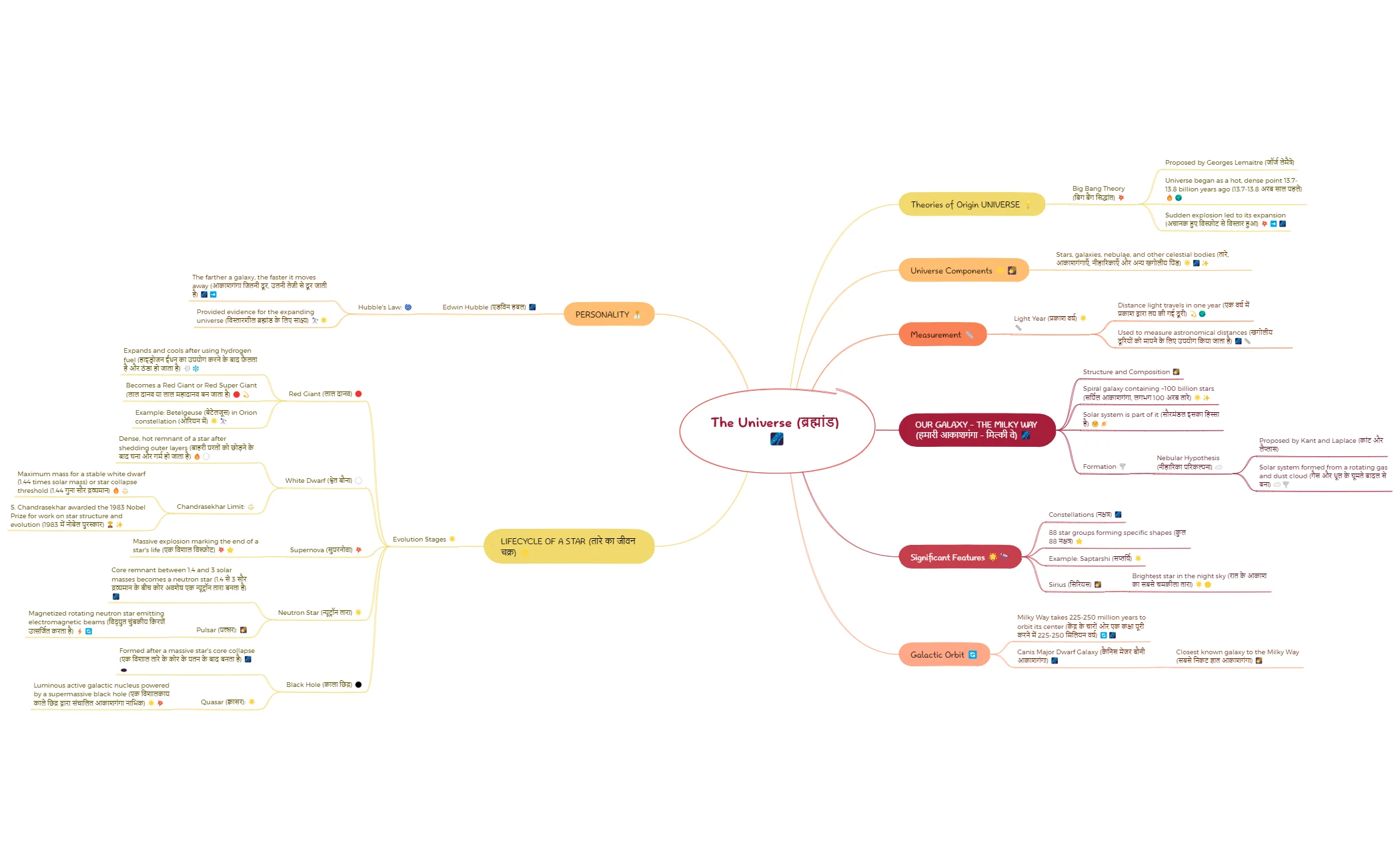
Read the branchesशाखाएँ पढ़ें
The Universe (ब्रह्मांड) 🌌
The Universe (ब्रह्मांड) 🌌
Theories of Origin UNIVERSE 💡
Big Bang Theory (बिग बैंग सिद्धांत) 💥
Proposed by Georges Lemaitre (जॉर्ज लेमैत्रे)
Universe began as a hot, dense point 13.7-13.8 billion years ago (13.7-13.8 अरब साल पहले) 🔥🌍
Sudden explosion led to its expansion (अचानक हुए विस्फोट से विस्तार हुआ) 💥➡️🌌
Universe Components 🌟🌠
Stars, galaxies, nebulae, and other celestial bodies (तारे, आकाशगंगाएँ, नीहारिकाएँ और अन्य खगोलीय पिंड) 🌟🌌✨
Measurement 📏
Light Year (प्रकाश वर्ष) 🌟📏
Distance light travels in one year (एक वर्ष में प्रकाश द्वारा तय की गई दूरी) 💫🌍
Used to measure astronomical distances (खगोलीय दूरियों को मापने के लिए उपयोग किया जाता है) 🌌📏
OUR GALAXY - THE MILKY WAY (हमारी आकाशगंगा - मिल्की वे) 🌌
Structure and Composition 🌠
Spiral galaxy containing ~100 billion stars (सर्पिल आकाशगंगा, लगभग 100 अरब तारे) 🌟✨
Solar system is part of it (सौरमंडल इसका हिस्सा है) 🌞🪐
Formation 🌪️
Nebular Hypothesis (नीहारिका परिकल्पना) ☁️
Proposed by Kant and Laplace (कांट और लैप्लास)
Solar system formed from a rotating gas and dust cloud (गैस और धूल के घूमते बादल से बना) ☁️🌪️
Significant Features 🌟🔭
Constellations (नक्षत्र) 🌌
88 star groups forming specific shapes (कुल 88 नक्षत्र) ⭐
Example: Saptarshi (सप्तर्षि) 🌟
Sirius (सिरियस) 🌠
Brightest star in the night sky (रात के आकाश का सबसे चमकीला तारा) 🌟🌕
Galactic Orbit 🔄
Milky Way takes 225-250 million years to orbit its center (केंद्र के चारों ओर एक कक्षा पूरी करने में 225-250 मिलियन वर्ष) 🔄🌌
Canis Major Dwarf Galaxy (कैनिस मेजर बौनी आकाशगंगा) 🌌
Closest known galaxy to the Milky Way (सबसे निकट ज्ञात आकाशगंगा) 🌠
LIFECYCLE OF A STAR (तारे का जीवन चक्र) ⭐
Evolution Stages 🌟
Red Giant (लाल दानव) 🔴
Expands and cools after using hydrogen fuel (हाइड्रोजन ईंधन का उपयोग करने के बाद फैलता है और ठंडा हो जाता है) 💨❄️
Becomes a Red Giant or Red Super Giant (लाल दानव या लाल महादानव बन जाता है) 🔴💫
Example: Betelgeuse (बेटेलजूस) in Orion constellation (ओरियन में) 🌟🔭
White Dwarf (श्वेत बौना) ⚪
Dense, hot remnant of a star after shedding outer layers (बाहरी परतों को छोड़ने के बाद घना और गर्म हो जाता है) 🔥⚪
Chandrasekhar Limit: ⚖️
Maximum mass for a stable white dwarf (1.44 times solar mass) or star collapse threshold (1.44 गुना सौर द्रव्यमान) 🔥⚖️
S. Chandrasekhar awarded the 1983 Nobel Prize for work on star structure and evolution (1983 में नोबेल पुरस्कार) 🏆✨
Supernova (सुपरनोवा) 💥
Massive explosion marking the end of a star's life (एक विशाल विस्फोट) 💥⭐
Neutron Star (न्यूट्रॉन तारा) 🌟
Core remnant between 1.4 and 3 solar masses becomes a neutron star (1.4 से 3 सौर द्रव्यमान के बीच कोर अवशेष एक न्यूट्रॉन तारा बनता है) 🌌
Pulsar (पल्सर): 🌠
Magnetized rotating neutron star emitting electromagnetic beams (विद्युत चुंबकीय किरणें उत्सर्जित करता है) ⚡🔄
Black Hole (काला छिद्र) ⚫
Formed after a massive star's core collapse (एक विशाल तारे के कोर के पतन के बाद बनता है) 🌌🕳️
Quasar (क्वासर): 🌟
Luminous active galactic nucleus powered by a supermassive black hole (एक विशालकाय काले छिद्र द्वारा संचालित आकाशगंगा नाभिक) 🌟💥
PERSONALITY 👨🔬
Edwin Hubble (एडविन हबल) 🌌
Hubble's Law: 🌀
The farther a galaxy, the faster it moves away (आकाशगंगा जितनी दूर, उतनी तेजी से दूर जाती है) 🌌➡️
Provided evidence for the expanding universe (विस्तारशील ब्रह्मांड के लिए साक्ष्य) 🔭🌟