Mind Mapsमाइंड मैप्स › Geographyभूगोल
The Solar System — mind mapमाइंड मैप
Original study maps by Rishabh Singh. Read dated facts in their exam-year context. Sources & corrections.ऋषभ सिंह के मूल अध्ययन मानचित्र। पुराने तथ्यों को संबंधित परीक्षा वर्ष के संदर्भ में पढ़ें। स्रोत और सुधार।
68 branches and entriesशाखाएँ और बिंदु · 1 sheet(s)शीट
See the original map layoutमूल मानचित्र का स्वरूप देखें
Tap the image to open its full preview. Read individual branches below for comfortable revision.पूरा पूर्वावलोकन खोलने के लिए चित्र पर टैप करें। आसानी से पढ़ने के लिए नीचे शाखाएँ देखें।
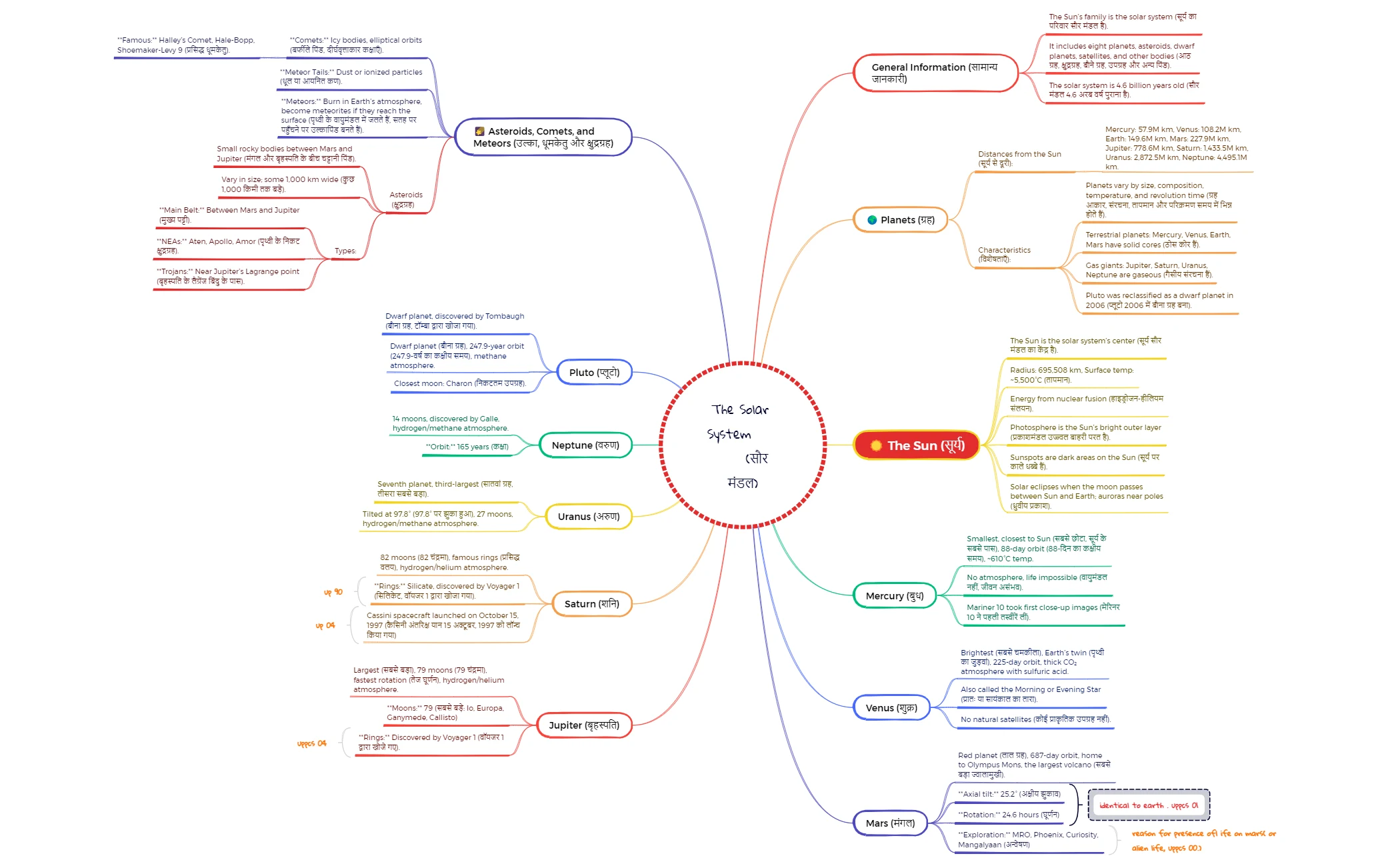
Read the branchesशाखाएँ पढ़ें
The Solar System (सौर मंडल)
The Solar System (सौर मंडल)
General Information (सामान्य जानकारी)
The Sun’s family is the solar system (सूर्य का परिवार सौर मंडल है).
It includes eight planets, asteroids, dwarf planets, satellites, and other bodies (आठ ग्रह, क्षुद्रग्रह, बौने ग्रह, उपग्रह और अन्य पिंड).
The solar system is 4.6 billion years old (सौर मंडल 4.6 अरब वर्ष पुराना है).
🌍 Planets (ग्रह)
Distances from the Sun (सूर्य से दूरी):
Mercury: 57.9M km, Venus: 108.2M km, Earth: 149.6M km, Mars: 227.9M km, Jupiter: 778.6M km, Saturn: 1,433.5M km, Uranus: 2,872.5M km, Neptune: 4,495.1M km.
Characteristics (विशेषताएँ):
Planets vary by size, composition, temperature, and revolution time (ग्रह आकार, संरचना, तापमान और परिक्रमण समय में भिन्न होते हैं).
Terrestrial planets: Mercury, Venus, Earth, Mars have solid cores (ठोस कोर हैं).
Gas giants: Jupiter, Saturn, Uranus, Neptune are gaseous (गैसीय संरचना हैं).
Pluto was reclassified as a dwarf planet in 2006 (प्लूटो 2006 में बौना ग्रह बना).
☀️ The Sun (सूर्य)
The Sun is the solar system’s center (सूर्य सौर मंडल का केंद्र है).
Radius: 695,508 km, Surface temp: ~5,500°C (तापमान).
Energy from nuclear fusion (हाइड्रोजन-हीलियम संलयन).
Photosphere is the Sun’s bright outer layer (प्रकाशमंडल उज्ज्वल बाहरी परत है).
Sunspots are dark areas on the Sun (सूर्य पर काले धब्बे हैं).
Solar eclipses when the moon passes between Sun and Earth; auroras near poles (ध्रुवीय प्रकाश).
Mercury (बुध)
Smallest, closest to Sun (सबसे छोटा, सूर्य के सबसे पास), 88-day orbit (88-दिन का कक्षीय समय), ~610°C temp.
No atmosphere, life impossible (वायुमंडल नहीं, जीवन असंभव).
Mariner 10 took first close-up images (मेरिनर 10 ने पहली तस्वीरें लीं).
Venus (शुक्र)
Brightest (सबसे चमकीला), Earth’s twin (पृथ्वी का जुड़वां), 225-day orbit, thick CO₂ atmosphere with sulfuric acid.
Also called the Morning or Evening Star (प्रातः या सायंकाल का तारा).
No natural satellites (कोई प्राकृतिक उपग्रह नहीं).
Mars (मंगल)
Red planet (लाल ग्रह), 687-day orbit, home to Olympus Mons, the largest volcano (सबसे बड़ा ज्वालामुखी).
Axial tilt: 25.2° (अक्षीय झुकाव)
Rotation: 24.6 hours (घूर्णन)
Exploration: MRO, Phoenix, Curiosity, Mangalyaan (अन्वेषण)
identical to earth . uppcs 01
reason for presence ofl ife on mars( or alien life, uppcs 00.)
Jupiter (बृहस्पति)
Largest (सबसे बड़ा), 79 moons (79 चंद्रमा), fastest rotation (तेज घूर्णन), hydrogen/helium atmosphere.
Moons: 79 (सबसे बड़े: Io, Europa, Ganymede, Callisto)
Rings: Discovered by Voyager 1 (वॉयजर 1 द्वारा खोजे गए).
uppcs 04
Saturn (शनि)
82 moons (82 चंद्रमा), famous rings (प्रसिद्ध वलय), hydrogen/helium atmosphere.
Rings: Silicate, discovered by Voyager 1 (सिलिकेट, वॉयजर 1 द्वारा खोजा गया).
Cassini spacecraft launched on October 15, 1997 (कैसिनी अंतरिक्ष यान 15 अक्टूबर, 1997 को लॉन्च किया गया)
up 04
up 90
Uranus (अरुण)
Seventh planet, third-largest (सातवां ग्रह, तीसरा सबसे बड़ा).
Tilted at 97.8° (97.8° पर झुका हुआ), 27 moons, hydrogen/methane atmosphere.
Neptune (वरुण)
14 moons, discovered by Galle, hydrogen/methane atmosphere.
Orbit: 165 years (कक्षा)
Pluto (प्लूटो)
Dwarf planet, discovered by Tombaugh (बौना ग्रह, टॉम्बा द्वारा खोजा गया).
Dwarf planet (बौना ग्रह), 247.9-year orbit (247.9-वर्ष का कक्षीय समय), methane atmosphere.
Closest moon: Charon (निकटतम उपग्रह).
🌠 Asteroids, Comets, and Meteors (उल्का, धूमकेतु और क्षुद्रग्रह)
Comets: Icy bodies, elliptical orbits (बर्फीले पिंड, दीर्घवृत्ताकार कक्षाएँ).
Famous: Halley’s Comet, Hale-Bopp, Shoemaker-Levy 9 (प्रसिद्ध धूमकेतु).
Meteor Tails: Dust or ionized particles (धूल या आयनित कण).
Meteors: Burn in Earth’s atmosphere, become meteorites if they reach the surface (पृथ्वी के वायुमंडल में जलते हैं, सतह पर पहुँचने पर उल्कापिंड बनते हैं).
Asteroids (क्षुद्रग्रह)
Small rocky bodies between Mars and Jupiter (मंगल और बृहस्पति के बीच चट्टानी पिंड).
Vary in size; some 1,000 km wide (कुछ 1,000 किमी तक बड़े).
Types:
Main Belt: Between Mars and Jupiter (मुख्य पट्टी).
NEAs: Aten, Apollo, Amor (पृथ्वी के निकट क्षुद्रग्रह).
Trojans: Near Jupiter’s Lagrange point (बृहस्पति के लैग्रेंज बिंदु के पास).