Mind Mapsमाइंड मैप्स › Geographyभूगोल
River Drainage System/Lakes/Waterfalls — mind mapमाइंड मैप
Original study maps by Rishabh Singh. Read dated facts in their exam-year context. Sources & corrections.ऋषभ सिंह के मूल अध्ययन मानचित्र। पुराने तथ्यों को संबंधित परीक्षा वर्ष के संदर्भ में पढ़ें। स्रोत और सुधार।
205 branches and entriesशाखाएँ और बिंदु · 1 sheet(s)शीट
See the original map layoutमूल मानचित्र का स्वरूप देखें
Tap the image to open its full preview. Read individual branches below for comfortable revision.पूरा पूर्वावलोकन खोलने के लिए चित्र पर टैप करें। आसानी से पढ़ने के लिए नीचे शाखाएँ देखें।
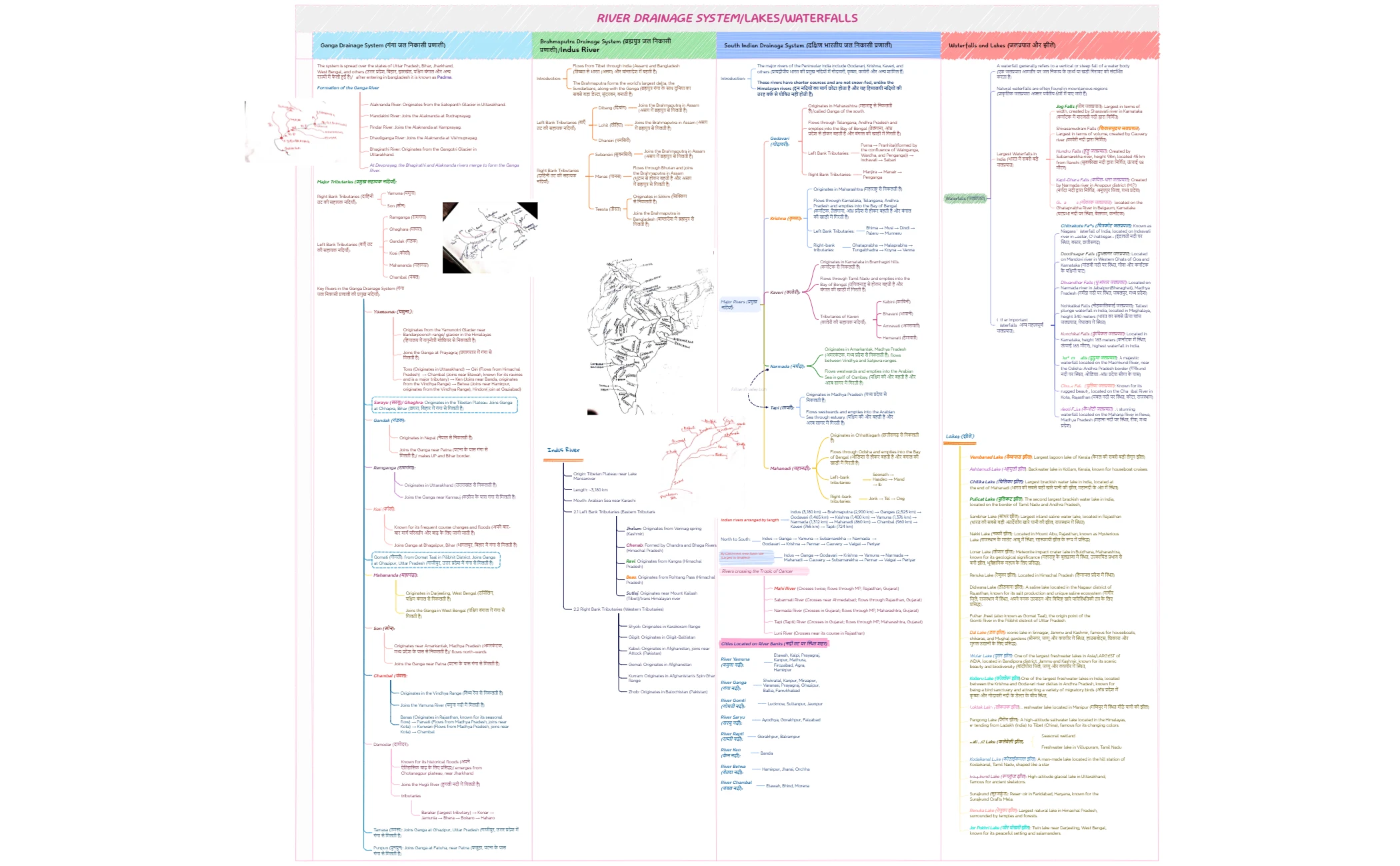
Read the branchesशाखाएँ पढ़ें
RIVER DRAINAGE SYSTEM/LAKES/WATERFALLS
RIVER DRAINAGE SYSTEM/LAKES/WATERFALLS
Ganga Drainage System (गंगा जल निकासी प्रणाली)
The system is spread over the states of Uttar Pradesh, Bihar, Jharkhand, West Bengal, and others (उत्तर प्रदेश, बिहार, झारखंड, पश्चिम बंगाल और अन्य राज्यों में फैली हुई है)/ after entering in bangladesh it is known as Padma.
Formation of the Ganga River
Alaknanda River: Originates from the Satopanth Glacier in Uttarakhand.
Mandakini River: Joins the Alaknanda at Rudraprayag.
Pindar River: Joins the Alaknanda at Karnprayag.
Dhauliganga River: Joins the Alaknanda at Vishnuprayag.
Bhagirathi River: Originates from the Gangotri Glacier in Uttarakhand.
At Devprayag, the Bhagirathi and Alaknanda rivers merge to form the Ganga River.
Major Tributaries (प्रमुख सहायक नदियाँ):
Right Bank Tributaries (दाहिनी तट की सहायक नदियाँ):
Yamuna (यमुना)
Son (सोन)
Left Bank Tributaries (बाएँ तट की सहायक नदियाँ):
Ramganga (रामगंगा)
Ghaghara (घाघरा)
Gandak (गंडक)
Kosi (कोसी)
Mahananda (महानंदा)
Chambal (चंबल)
Key Rivers in the Ganga Drainage System (गंगा जल निकासी प्रणाली की प्रमुख नदियाँ):
Yamuna (यमुना):
Originates from the Yamunotri Glacier near Bandarpoonch range/ glacier in the Himalayas (हिमालय में यमुनोत्री ग्लेशियर से निकलती है)
Joins the Ganga at Prayagraj (प्रयागराज में गंगा से मिलती है)
Tons (Originates in Uttarakhand) → Giri (Flows from Himachal Pradesh) → Chambal (Joins near Etawah, known for its ravines and is a major tributary) → Ken (Joins near Banda, originates from the Vindhya Range) → Betwa (Joins near Hamirpur, originates from the Vindhya Range), Hindon{ join at Gaziabad}
Sarayu (सरयू)/ Ghaghra: Originates in the Tibetan Plateau. Joins Ganga at Chhapra, Bihar (छपरा, बिहार में गंगा से मिलती है)
Gandak (गंडक):
Originates in Nepal (नेपाल से निकलती है)
Joins the Ganga near Patna (पटना के पास गंगा से मिलती है)/ makes UP and Bihar border.
Ramganga (रामगंगा):
Originates in Uttarakhand (उत्तराखंड से निकलती है)
Joins the Ganga near Kannauj (कन्नौज के पास गंगा से मिलती है)
Kosi (कोसी):
Known for its frequent course changes and floods (अपने बार-बार मार्ग परिवर्तन और बाढ़ के लिए जानी जाती है)
Joins Ganga at Bhagalpur, Bihar (भागलपुर, बिहार में गंगा से मिलती है)
Gomati (गोमती): from Gomat Taal in Pilibhit District. Joins Ganga at Ghazipur, Uttar Pradesh (गाजीपुर, उत्तर प्रदेश में गंगा से मिलती है)
Mahananda (महानंदा):
Originates in Darjeeling, West Bengal (दर्जिलिंग, पश्चिम बंगाल से निकलती है)
Joins the Ganga in West Bengal (पश्चिम बंगाल में गंगा से मिलती है)
Son (सोन):
Originates near Amarkantak, Madhya Pradesh (अमरकंटक, मध्य प्रदेश के पास से निकलती है)/ flows north-wards
Joins the Ganga near Patna (पटना के पास गंगा से मिलती है)
Chambal (चंबल):
Originates in the Vindhya Range (विंध्य रेंज से निकलती है)
Joins the Yamuna River (यमुना नदी में मिलती है)
Banas (Originates in Rajasthan, known for its seasonal flow) → Parvati (Flows from Madhya Pradesh, joins near Kota) → Kunwari (Flows from Madhya Pradesh, joins near Kota) → Chambal
Damodar (दामोदर):
Known for its historical floods (अपने ऐतिहासिक बाढ़ के लिए प्रसिद्ध)/ emerges from Chotanagpur plateau, near Jharkhand
Joins the Hugli River (हुगली नदी में मिलती है)
tributaries
Barakar (largest tributary) → Konar → Jamunia → Bhera → Bokaro → Haharo
Tamasa (तमसा): Joins Ganga at Ghazipur, Uttar Pradesh (गाजीपुर, उत्तर प्रदेश में गंगा से मिलती है)
Punpun (पुनपुन): Joins Ganga at Fatuha, near Patna (फतुहा, पटना के पास गंगा से मिलती है)
Brahmaputra Drainage System (ब्रह्मपुत्र जल निकासी प्रणाली)/Indus River
Introduction:
Flows from Tibet through India (Assam) and Bangladesh (तिब्बत से भारत (असम) और बांग्लादेश में बहती है)
The Brahmaputra forms the world's largest delta, the Sundarbans, along with the Ganga (ब्रह्मपुत्र गंगा के साथ दुनिया का सबसे बड़ा डेल्टा, सुंदरबन, बनाती है)
Left Bank Tributaries (बाएँ तट की सहायक नदियाँ):
Dibang (दिबांग)
Joins the Brahmaputra in Assam (असम में ब्रह्मपुत्र से मिलती है)
Lohit (लोहित)
Joins the Brahmaputra in Assam (असम में ब्रह्मपुत्र से मिलती है)
Dhansiri (धनसिरी)
Right Bank Tributaries (दाहिनी तट की सहायक नदियाँ):
Subansiri (सुबनसिरी)
Joins the Brahmaputra in Assam (असम में ब्रह्मपुत्र से मिलती है)
Manas (मानस)
Flows through Bhutan and joins the Brahmaputra in Assam (भूटान से होकर बहती है और असम में ब्रह्मपुत्र से मिलती है)
Teesta (तीस्ता)
Originates in Sikkim (सिक्किम से निकलती है)
Joins the Brahmaputra in Bangladesh (बांग्लादेश में ब्रह्मपुत्र से मिलती है)
South Indian Drainage System (दक्षिण भारतीय जल निकासी प्रणाली)
Introduction:
The major rivers of the Peninsular India include Godavari, Krishna, Kaveri, and others (प्रायद्वीपीय भारत की प्रमुख नदियों में गोदावरी, कृष्णा, कावेरी और अन्य शामिल हैं)
These rivers have shorter courses and are not snow-fed, unlike the Himalayan rivers (इन नदियों का मार्ग छोटा होता है और यह हिमालयी नदियों की तरह बर्फ से पोषित नहीं होती हैं)
Major Rivers (प्रमुख नदियाँ):
Godavari (गोदावरी):
Originates in Maharashtra (महाराष्ट्र से निकलती है)/called Ganga of the south.
Flows through Telangana, Andhra Pradesh and empties into the Bay of Bengal (तेलंगाना, आंध्र प्रदेश से होकर बहती है और बंगाल की खाड़ी में गिरती है)
Left Bank Tributaries:
Purna → Pranhita{(formed by the confluence of Wainganga, Wardha, and Penganga)} → Indravati → Sabari
Right Bank Tributaries:
Manjira → Manair → Penganga
Krishna (कृष्णा):
Originates in Maharashtra (महाराष्ट्र से निकलती है)
Flows through Karnataka, Telangana, Andhra Pradesh and empties into the Bay of Bengal (कर्नाटक, तेलंगाना, आंध्र प्रदेश से होकर बहती है और बंगाल की खाड़ी में गिरती है)
Left Bank Tributaries:
Bhima → Musi → Dindi → Paleru → Munneru
Right-bank tributaries:
Ghataprabha → Malaprabha → Tungabhadra → Koyna → Venna
Kaveri (कावेरी):
Originates in Karnataka in Bramhagiri hills. (कर्नाटक से निकलती है)
Flows through Tamil Nadu and empties into the Bay of Bengal (तमिलनाडु से होकर बहती है और बंगाल की खाड़ी में गिरती है)
Tributaries of Kaveri (कावेरी की सहायक नदियाँ):
Kabini (काबिनी)
Bhavani (भावानी)
Amravati (अमरावती)
Hemavati (हेमावती)
Narmada (नर्मदा):
Originates in Amarkantak, Madhya Pradesh (अमरकंटक, मध्य प्रदेश से निकलती है). flows between Vindhya and Satpura ranges.
Flows westwards and empties into the Arabian Sea in gulf of Cambay. (पश्चिम की ओर बहती है और अरब सागर में गिरती है)
Tapi (ताप्ती):
Originates in Madhya Pradesh (मध्य प्रदेश से निकलती है)
Flows westwards and empties into the Arabian Sea through estuary. (पश्चिम की ओर बहती है और अरब सागर में गिरती है)
Mahanadi (महानदी):
Originates in Chhattisgarh (छत्तीसगढ़ से निकलती है)
Flows through Odisha and empties into the Bay of Bengal (ओडिशा से होकर बहती है और बंगाल की खाड़ी में गिरती है)
Left-bank tributaries:
Seonath → Hasdeo → Mand → Ib
Right-bank tributaries:
Jonk → Tel → Ong
Indian rivers arranged by length
Indus (3,180 km) → Brahmaputra (2,900 km) → Ganges (2,525 km) → Godavari (1,465 km) → Krishna (1,400 km) → Yamuna (1,376 km) → Narmada (1,312 km) → Mahanadi (860 km) → Chambal (960 km) → Kaveri (765 km) → Tapti (724 km)
North to South:
Indus → Ganga → Yamuna → Subarnarekha → Narmada → Godavari → Krishna → Pennar → Cauvery → Vaigai → Periyar
By Catchment Area /basin size (Largest to Smallest):
Indus → Ganga → Godavari → Krishna → Yamuna → Narmada → Mahanadi → Cauvery → Subarnarekha → Pennar → Vaigai → Periyar
Rivers crossing the Tropic of Cancer
Mahi River (Crosses twice; flows through MP, Rajasthan, Gujarat)
Sabarmati River (Crosses near Ahmedabad; flows through Rajasthan, Gujarat)
Narmada River (Crosses in Gujarat; flows through MP, Maharashtra, Gujarat)
Tapi (Tapti) River (Crosses in Gujarat; flows through MP, Maharashtra, Gujarat)
Luni River (Crosses near its course in Rajasthan)
Cities Located on River Banks (नदी तट पर स्थित शहर)
River Yamuna (यमुना नदी):
Etawah, Kalpi, Prayagraj, Kanpur, Mathura, Firozabad, Agra, Hamirpur
River Ganga (गंगा नदी):
Shukratal, Kanpur, Mirzapur, Varanasi, Prayagraj, Ghazipur, Ballia, Farrukhabad
River Gomti (गोमती नदी):
Lucknow, Sultanpur, Jaunpur
River Saryu (सरयू नदी):
Ayodhya, Gorakhpur, Faizabad
River Rapti (राप्ती नदी):
Gorakhpur, Balrampur
River Ken (केन नदी):
Banda
River Betwa (बेतवा नदी):
Hamirpur, Jhansi, Orchha
River Chambal (चंबल नदी):
Etawah, Bhind, Morena
Waterfalls and Lakes (जलप्रपात और झीलें)
Waterfalls (जलप्रपात)
A waterfall generally refers to a vertical or steep fall of a water body (एक जलप्रपात आमतौर पर जल निकाय के ऊर्ध्व या खड़ी गिरावट को संदर्भित करता है)
Natural waterfalls are often found in mountainous regions (प्राकृतिक जलप्रपात अक्सर पर्वतीय क्षेत्रों में पाए जाते हैं)
Largest Waterfalls in India (भारत में सबसे बड़े जलप्रपात)
Jog Falls (जोग जलप्रपात): Largest in terms of width, created by Sharavati river in Karnataka (कर्नाटक में शरावती नदी द्वारा निर्मित)
Shivasamudram Falls (शिवासमुद्रम जलप्रपात): Largest in terms of volume, created by Cauvery river (कावेरी नदी द्वारा निर्मित)
Hundru Falls (हुंड्रू जलप्रपात): Created by Subarnarekha river, height 98m, located 45 km from Ranchi (सुबर्णरेखा नदी द्वारा निर्मित, ऊंचाई 98 मीटर)
Kapil-Dhara Falls (कपिल-धारा जलप्रपात): Created by Narmada river in Anuppur district (M.P.) (नर्मदा नदी द्वारा निर्मित, अनूपपुर जिला, मध्य प्रदेश)
Gokak Falls (गोकाक जलप्रपात): located on the Ghataprabha River in Belgaum, Karnataka (घटप्रभा नदी पर स्थित, बेलगाम, कर्नाटक)
Other Important Waterfalls (अन्य महत्वपूर्ण जलप्रपात):
Chitrakote Falls (चित्रकोट जलप्रपात): Known as Niagara Waterfall of India, located on Indravati river in Bastar, Chhattisgarh (इंद्रावती नदी पर स्थित, बस्तर, छत्तीसगढ़)
Doodhsagar Falls (दूधसागर जलप्रपात): Located on Mandovi river in Western Ghats of Goa and Karnataka (मांडवी नदी पर स्थित, गोवा और कर्नाटक के पश्चिमी घाट)
Dhuandhar Falls (धुआंधार जलप्रपात): Located on Narmada river in Jabalpur{Bheraghat}, Madhya Pradesh (नर्मदा नदी पर स्थित, जबलपुर, मध्य प्रदेश)
Nohkalikai Falls (नोहकालिकाई जलप्रपात): Tallest plunge waterfall in India, located in Meghalaya, height 340 meters (भारत का सबसे ऊँचा प्लंज जलप्रपात, मेघालय में स्थित)
Kunchikal Falls (कुंचिकल जलप्रपात): Located in Karnataka, height 183 meters (कर्नाटक में स्थित, ऊंचाई 183 मीटर), highest waterfall in India.
Duduma Falls (दुदुमा जलप्रपात): A majestic waterfall located on the Machkund River, near the Odisha-Andhra Pradesh border (मचkund नदी पर स्थित, ओडिशा-आंध्र प्रदेश सीमा के पास)
Chulia Falls (चुलिया जलप्रपात): Known for its rugged beauty, located on the Chambal River in Kota, Rajasthan (चंबल नदी पर स्थित, कोटा, राजस्थान)
Keoti Falls (केओटी जलप्रपात): A stunning waterfall located on the Mahana River in Rewa, Madhya Pradesh (महाना नदी पर स्थित, रीवा, मध्य प्रदेश)
Lakes (झीलें)
Vembanad Lake (वेम्बनाड झील): Largest lagoon lake of Kerala (केरल की सबसे बड़ी लैगून झील)
Ashtamudi Lake (अष्टमुडी झील): Backwater lake in Kollam, Kerala, known for houseboat cruises.
Chilika Lake (चिलिका झील): Largest brackish water lake in India, located at the end of Mahanadi (भारत की सबसे बड़ी खारे पानी की झील, महानदी के अंत में स्थित)
Pulicat Lake (पुलिकट झील): The second largest brackish water lake in India, located on the border of Tamil Nadu and Andhra Pradesh,
Sambhar Lake (सांभर झील): Largest inland saline water lake, located in Rajasthan (भारत की सबसे बड़ी अंतर्देशीय खारे पानी की झील, राजस्थान में स्थित)
Nakki Lake (नक्की झील): Located in Mount Abu, Rajasthan, known as Mysterious Lake (राजस्थान के माउंट आबू में स्थित, रहस्यमयी झील के रूप में प्रसिद्ध)
Lonar Lake (लोणार झील): Meteorite impact crater lake in Buldhana, Maharashtra, known for its geological significance (महाराष्ट्र के बुलढाणा में स्थित, उल्कापिंड प्रभाव से बनी झील, भूवैज्ञानिक महत्व के लिए प्रसिद्ध).
Renuka Lake (रेणुका झील): Located in Himachal Pradesh (हिमाचल प्रदेश में स्थित)
Didwana Lake (डीडवाना झील): A saline lake located in the Nagaur district of Rajasthan, known for its salt production and unique saline ecosystem (नागौर जिले, राजस्थान में स्थित, अपने नमक उत्पादन और विशिष्ट खारे पारिस्थितिकी तंत्र के लिए प्रसिद्ध).
Fulhar Jheel (also known as Gomat Taal), the origin point of the Gomti River in the Pilibhit district of Uttar Pradesh.
Dal Lake (डल झील): Iconic lake in Srinagar, Jammu and Kashmir, famous for houseboats, shikaras, and Mughal gardens (श्रीनगर, जम्मू और कश्मीर में स्थित, हाउसबोट्स, शिकारा और मुगल उद्यानों के लिए प्रसिद्ध).
Wular Lake (वुलर झील): One of the largest freshwater lakes in Asia/LARGEST of INDIA, located in Bandipora district, Jammu and Kashmir, known for its scenic beauty and biodiversity (बांदीपोरा जिले, जम्मू और कश्मीर में स्थित,
Kolleru Lake (कोल्लेरू झील):One of the largest freshwater lakes in India, located between the Krishna and Godavari river deltas in Andhra Pradesh, known for being a bird sanctuary and attracting a variety of migratory birds (आंध्र प्रदेश में कृष्णा और गोदावरी नदी के डेल्टा के बीच स्थित,
Loktak Lake (लोकतक झील): Freshwater lake located in Manipur (मणिपुर में स्थित मीठे पानी की झील)
Pangong Lake (पैंगोंग झील): A high-altitude saltwater lake located in the Himalayas, extending from Ladakh (India) to Tibet (China), famous for its changing colors.
Kaliveli Lake (कलेवेली झील):
Seasonal wetland
Freshwater lake in Villupuram, Tamil Nadu
Kodaikanal Lake (कोडाईकनाल झील): A man-made lake located in the hill station of Kodaikanal, Tamil Nadu, shaped like a star
Roopkund Lake (रूपकुंड झील): High-altitude glacial lake in Uttarakhand, famous for ancient skeletons.
Surajkund (सूरजकुंड): Reservoir in Faridabad, Haryana, known for the Surajkund Crafts Mela.
Renuka Lake (रेणुका झील): Largest natural lake in Himachal Pradesh, surrounded by temples and forests.
Jor Pokhri Lake (जोर पोखरी झील): Twin lake near Darjeeling, West Bengal, known for its peaceful setting and salamanders.
Indus River
Origin: Tibetan Plateau near Lake Mansarovar
Length: ~3,180 km
Mouth: Arabian Sea near Karachi
2.1 Left Bank Tributaries (Eastern Tributaries)
Jhelum: Originates from Verinag spring (Kashmir)
Chenab: Formed by Chandra and Bhaga Rivers (Himachal Pradesh)
Ravi: Originates from Kangra (Himachal Pradesh)
Beas: Originates from Rohtang Pass (Himachal Pradesh)
Sutlej: Originates near Mount Kailash (Tibet)/trans Himalayan river
2.2 Right Bank Tributaries (Western Tributaries)
Shyok: Originates in Karakoram Range
Gilgit: Originates in Gilgit-Baltistan
Kabul: Originates in Afghanistan, joins near Attock (Pakistan)
Gomal: Originates in Afghanistan
Kurram: Originates in Afghanistan’s Spin Ghar Range
Zhob: Originates in Balochistan (Pakistan)
Study map
Study map
Study map
Study map
Connectionsसंबंध
- Narmada (नर्मदा): → Tapi (ताप्ती): — follow rift valley both