Mind Mapsमाइंड मैप्स › Geographyभूगोल
The Insolation — mind mapमाइंड मैप
Original study maps by Rishabh Singh. Read dated facts in their exam-year context. Sources & corrections.ऋषभ सिंह के मूल अध्ययन मानचित्र। पुराने तथ्यों को संबंधित परीक्षा वर्ष के संदर्भ में पढ़ें। स्रोत और सुधार।
17 branches and entriesशाखाएँ और बिंदु · 1 sheet(s)शीट
See the original map layoutमूल मानचित्र का स्वरूप देखें
Tap the image to open its full preview. Read individual branches below for comfortable revision.पूरा पूर्वावलोकन खोलने के लिए चित्र पर टैप करें। आसानी से पढ़ने के लिए नीचे शाखाएँ देखें।
Read the branchesशाखाएँ पढ़ें
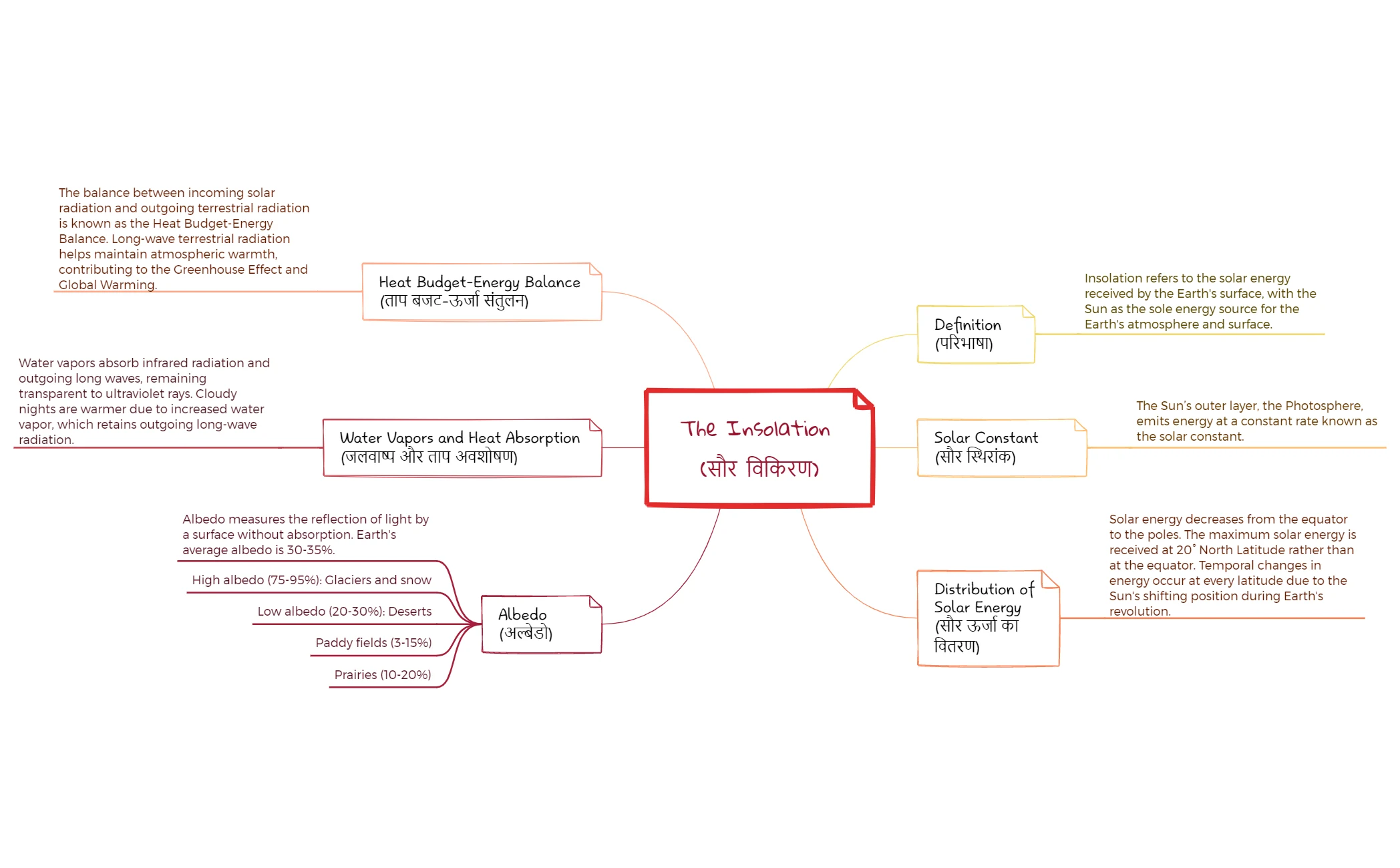
The Insolation (सौर विकिरण)
The Insolation (सौर विकिरण)
Definition (परिभाषा)
Insolation refers to the solar energy received by the Earth's surface, with the Sun as the sole energy source for the Earth's atmosphere and surface.
Solar Constant (सौर स्थिरांक)
The Sun’s outer layer, the Photosphere, emits energy at a constant rate known as the solar constant.
Distribution of Solar Energy (सौर ऊर्जा का वितरण)
Solar energy decreases from the equator to the poles. The maximum solar energy is received at 20° North Latitude rather than at the equator. Temporal changes in energy occur at every latitude due to the Sun's shifting position during Earth's revolution.
Albedo (अल्बेडो)
Albedo measures the reflection of light by a surface without absorption. Earth's average albedo is 30-35%.
High albedo (75-95%): Glaciers and snow
Low albedo (20-30%): Deserts
Paddy fields (3-15%)
Prairies (10-20%)
Water Vapors and Heat Absorption (जलवाष्प और ताप अवशोषण)
Water vapors absorb infrared radiation and outgoing long waves, remaining transparent to ultraviolet rays. Cloudy nights are warmer due to increased water vapor, which retains outgoing long-wave radiation.
Heat Budget-Energy Balance (ताप बजट-ऊर्जा संतुलन)
The balance between incoming solar radiation and outgoing terrestrial radiation is known as the Heat Budget-Energy Balance. Long-wave terrestrial radiation helps maintain atmospheric warmth, contributing to the Greenhouse Effect and Global Warming.