Mind Mapsमाइंड मैप्स › Geographyभूगोल
High Tide, Low Tide — mind mapमाइंड मैप
Original study maps by Rishabh Singh. Read dated facts in their exam-year context. Sources & corrections.ऋषभ सिंह के मूल अध्ययन मानचित्र। पुराने तथ्यों को संबंधित परीक्षा वर्ष के संदर्भ में पढ़ें। स्रोत और सुधार।
25 branches and entriesशाखाएँ और बिंदु · 1 sheet(s)शीट
See the original map layoutमूल मानचित्र का स्वरूप देखें
Tap the image to open its full preview. Read individual branches below for comfortable revision.पूरा पूर्वावलोकन खोलने के लिए चित्र पर टैप करें। आसानी से पढ़ने के लिए नीचे शाखाएँ देखें।
Read the branchesशाखाएँ पढ़ें
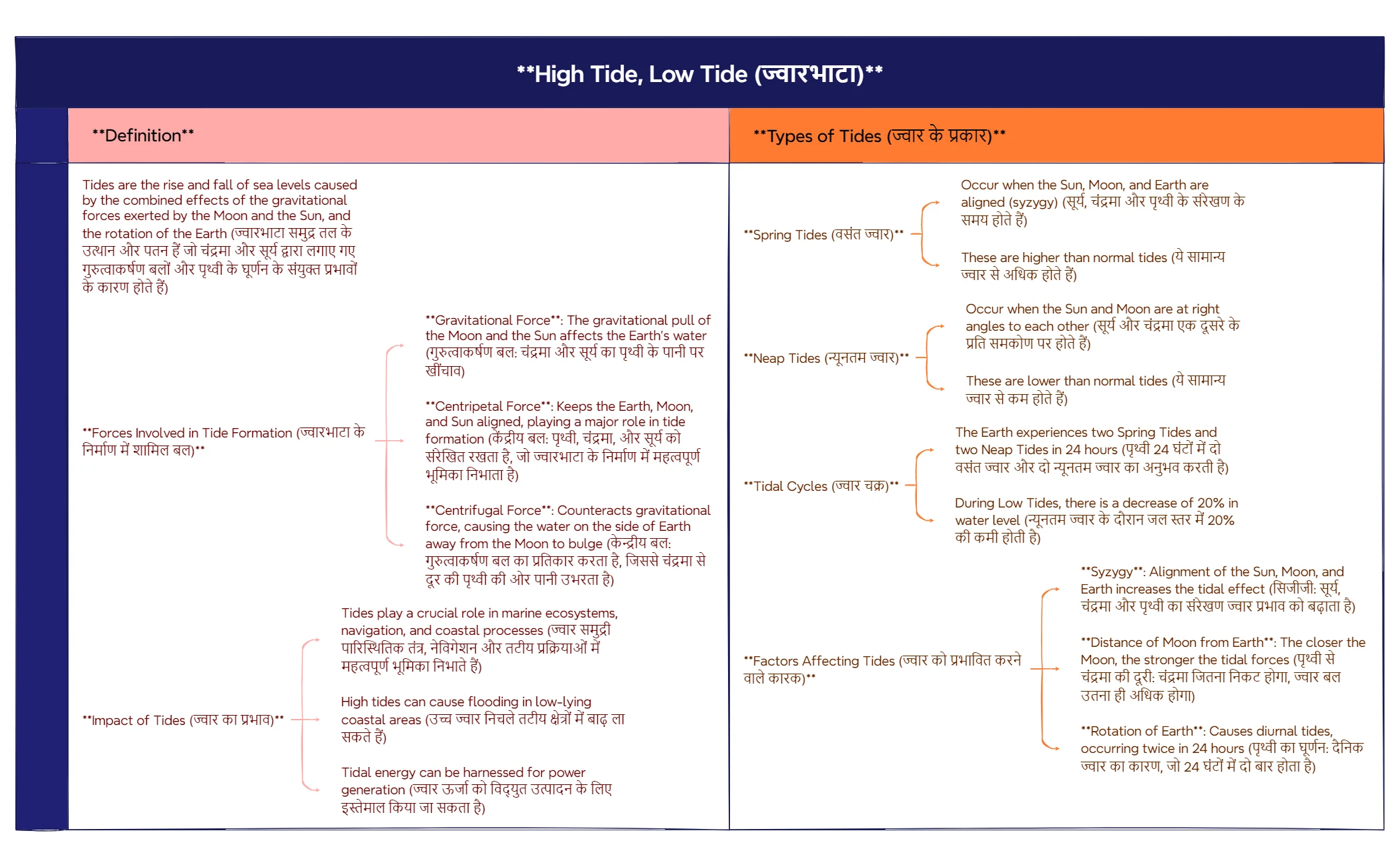
High Tide, Low Tide (ज्वारभाटा)
High Tide, Low Tide (ज्वारभाटा)
Definition
Tides are the rise and fall of sea levels caused by the combined effects of the gravitational forces exerted by the Moon and the Sun, and the rotation of the Earth (ज्वारभाटा समुद्र तल के उत्थान और पतन हैं जो चंद्रमा और सूर्य द्वारा लगाए गए गुरुत्वाकर्षण बलों और पृथ्वी के घूर्णन के संयुक्त प्रभावों के कारण होते हैं)
Forces Involved in Tide Formation (ज्वारभाटा के निर्माण में शामिल बल)
Gravitational Force: The gravitational pull of the Moon and the Sun affects the Earth's water (गुरुत्वाकर्षण बल: चंद्रमा और सूर्य का पृथ्वी के पानी पर खींचाव)
Centripetal Force: Keeps the Earth, Moon, and Sun aligned, playing a major role in tide formation (केंद्रीय बल: पृथ्वी, चंद्रमा, और सूर्य को संरेखित रखता है, जो ज्वारभाटा के निर्माण में महत्वपूर्ण भूमिका निभाता है)
Centrifugal Force: Counteracts gravitational force, causing the water on the side of Earth away from the Moon to bulge (केन्द्रीय बल: गुरुत्वाकर्षण बल का प्रतिकार करता है, जिससे चंद्रमा से दूर की पृथ्वी की ओर पानी उभरता है)
Impact of Tides (ज्वार का प्रभाव)
Tides play a crucial role in marine ecosystems, navigation, and coastal processes (ज्वार समुद्री पारिस्थितिक तंत्र, नेविगेशन और तटीय प्रक्रियाओं में महत्वपूर्ण भूमिका निभाते हैं)
High tides can cause flooding in low-lying coastal areas (उच्च ज्वार निचले तटीय क्षेत्रों में बाढ़ ला सकते हैं)
Tidal energy can be harnessed for power generation (ज्वार ऊर्जा को विद्युत उत्पादन के लिए इस्तेमाल किया जा सकता है)
Types of Tides (ज्वार के प्रकार)
Spring Tides (वसंत ज्वार)
Occur when the Sun, Moon, and Earth are aligned (syzygy) (सूर्य, चंद्रमा और पृथ्वी के संरेखण के समय होते हैं)
These are higher than normal tides (ये सामान्य ज्वार से अधिक होते हैं)
Neap Tides (न्यूनतम ज्वार)
Occur when the Sun and Moon are at right angles to each other (सूर्य और चंद्रमा एक दूसरे के प्रति समकोण पर होते हैं)
These are lower than normal tides (ये सामान्य ज्वार से कम होते हैं)
Tidal Cycles (ज्वार चक्र)
The Earth experiences two Spring Tides and two Neap Tides in 24 hours (पृथ्वी 24 घंटों में दो वसंत ज्वार और दो न्यूनतम ज्वार का अनुभव करती है)
During Low Tides, there is a decrease of 20% in water level (न्यूनतम ज्वार के दौरान जल स्तर में 20% की कमी होती है)
Factors Affecting Tides (ज्वार को प्रभावित करने वाले कारक)
Syzygy: Alignment of the Sun, Moon, and Earth increases the tidal effect (सिजीजी: सूर्य, चंद्रमा और पृथ्वी का संरेखण ज्वार प्रभाव को बढ़ाता है)
Distance of Moon from Earth: The closer the Moon, the stronger the tidal forces (पृथ्वी से चंद्रमा की दूरी: चंद्रमा जितना निकट होगा, ज्वार बल उतना ही अधिक होगा)
Rotation of Earth: Causes diurnal tides, occurring twice in 24 hours (पृथ्वी का घूर्णन: दैनिक ज्वार का कारण, जो 24 घंटों में दो बार होता है)