Mind Mapsमाइंड मैप्स › Environmentपर्यावरण
Sustainable Development — mind mapमाइंड मैप
Original study maps by Rishabh Singh. Read dated facts in their exam-year context. Sources & corrections.ऋषभ सिंह के मूल अध्ययन मानचित्र। पुराने तथ्यों को संबंधित परीक्षा वर्ष के संदर्भ में पढ़ें। स्रोत और सुधार।
83 branches and entriesशाखाएँ और बिंदु · 1 sheet(s)शीट
See the original map layoutमूल मानचित्र का स्वरूप देखें
Tap the image to open its full preview. Read individual branches below for comfortable revision.पूरा पूर्वावलोकन खोलने के लिए चित्र पर टैप करें। आसानी से पढ़ने के लिए नीचे शाखाएँ देखें।
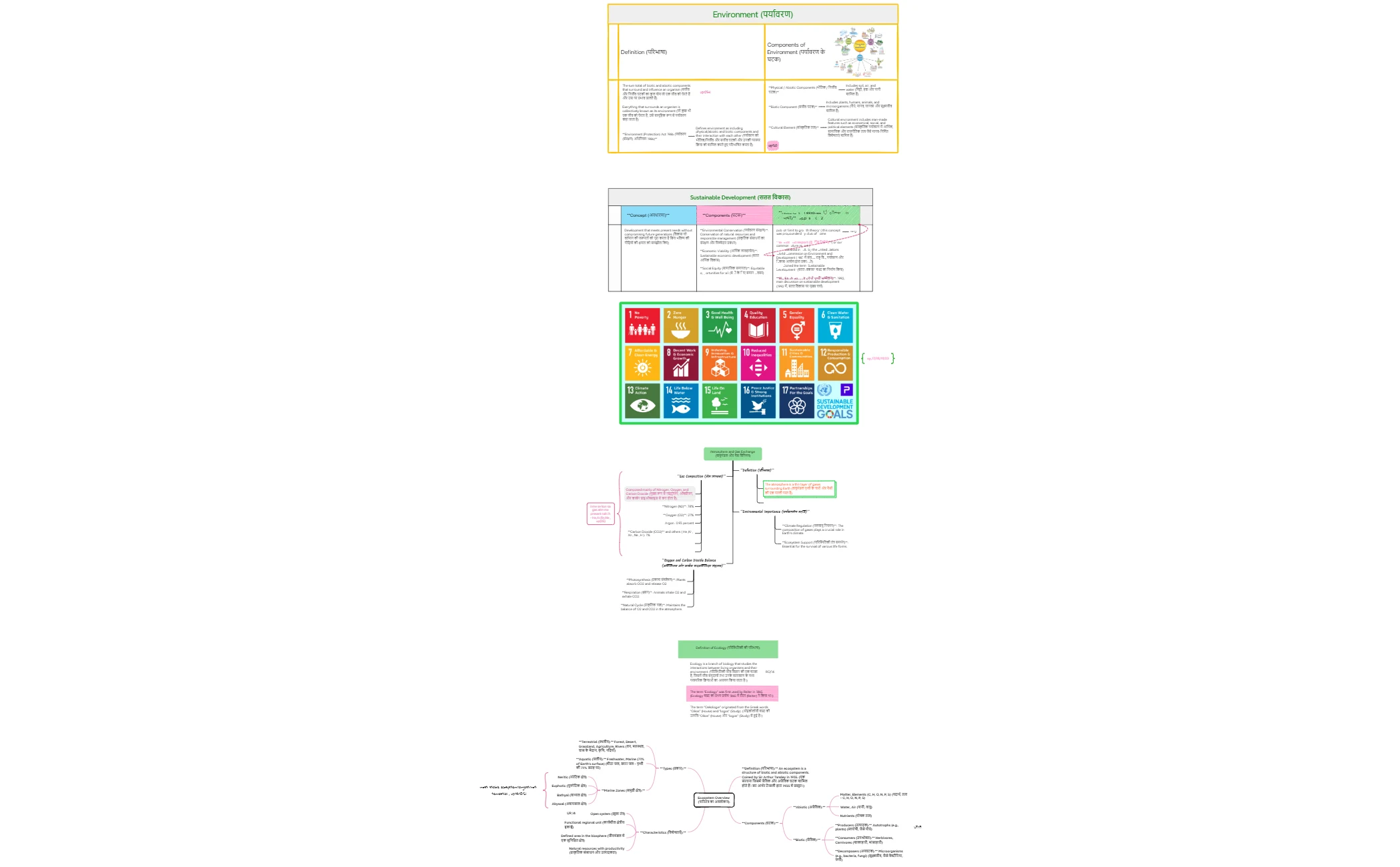
Read the branchesशाखाएँ पढ़ें
Sustainable Development (सतत विकास)
Sustainable Development (सतत विकास)
Concept (अवधारणा)
Development that meets present needs without compromising future generations (विकास जो वर्तमान की जरूरतों को पूरा करता है बिना भविष्य की पीढ़ियों की क्षमता को समझौता किए)
Components (घटक)
Environmental Conservation (पर्यावरण संरक्षण): Conservation of natural resources and responsible management (प्राकृतिक संसाधनों का संरक्षण और जिम्मेदार प्रबंधन)
Economic Viability (आर्थिक व्यवहार्यता): Sustainable economic development (सतत आर्थिक विकास)
Social Equity (सामाजिक समानता): Equitable opportunities for all (सभी के लिए समान अवसर)
Historical Milestones (ऐतिहासिक मील के पत्थर) . uppcs - 12 ,20
pub. of 'limit to growth theory' ( this concept was propounderd by club of Rome
1972
Brundtland Report (ब्रुंटलैंड रिपोर्ट)( or our common future report ) Published in 1987 by the United Nations World Commission on Environment and Development (1987 में संयुक्त राष्ट्र विश्व पर्यावरण और विकास आयोग द्वारा प्रकाशित) Coined the term "Sustainable Development" (सतत विकास" शब्द का निर्माण किया)
Rio Earth Summit (रियो पृथ्वी सम्मेलन): 1992, main discussion on sustainable development (1992 में, सतत विकास पर मुख्य चर्चा)
Study map
Study map
Environment (पर्यावरण)
Definition (परिभाषा)
The sum total of biotic and abiotic components that surround and influence an organism (सजीव और निर्जीव घटकों का कुल योग जो एक जीव को घेरते हैं और उस पर प्रभाव डालते हैं)
up/05+1
Everything that surrounds an organism is collectively known as its environment (जो कुछ भी एक जीव को घेरता है, उसे सामूहिक रूप से पर्यावरण कहा जाता है)
Environment (Protection) Act 1986 (पर्यावरण (संरक्षण) अधिनियम 1986)
Defines environment as including physical/abiotic and biotic components and their interaction with each other (पर्यावरण को भौतिक/निर्जीव और सजीव घटकों और उनकी परस्पर क्रिया को शामिल करते हुए परिभाषित करता है)
Components of Environment (पर्यावरण के घटक)
Physical / Abiotic Components (भौतिक / निर्जीव घटक)
Includes soil, air, and water (मिट्टी, हवा और पानी शामिल हैं)
Biotic Component (सजीव घटक)
Includes plants, humans, animals, and microorganisms (पौधे, मानव, जानवर और सूक्ष्मजीव शामिल हैं)
Cultural Element (सांस्कृतिक तत्व)
Cultural environment includes man-made features such as economical, social, and political elements (सांस्कृतिक पर्यावरण में आर्थिक, सामाजिक और राजनीतिक तत्व जैसे मानव-निर्मित विशेषताएं शामिल हैं)
up/20
Atmosphere and Gas Exchange (वायुमंडल और गैस विनिमय)
Definition (परिभाषा)
The atmosphere is a thin layer of gases surrounding Earth (वायुमंडल पृथ्वी के चारों ओर गैसों की एक पतली परत है).
Study map
Gas Composition (गैस संरचना)
Composed mainly of Nitrogen, Oxygen, and Carbon Dioxide (मुख्य रूप से नाइट्रोजन, ऑक्सीजन, और कार्बन डाइऑक्साइड से बना होता है).
Nitrogen (N2): 78%
Oxygen (O2): 21%
Argon : 0.93 percent
Carbon Dioxide (CO2) and others ( He ,Kr , Xn , Ne , H ): 1%
Study map
Study map
Environmental Importance (पर्यावरणीय महत्व)
Climate Regulation (जलवायु नियमन): The composition of gases plays a crucial role in Earth’s climate.
Ecosystem Support (पारिस्थितिकी तंत्र समर्थन): Essential for the survival of various life forms.
Oxygen and Carbon Dioxide Balance (ऑक्सीजन और कार्बन डाइऑक्साइड संतुलन)
Photosynthesis (प्रकाश संश्लेषण): Plants absorb CO2 and release O2.
Respiration (श्वसन): Animals inhale O2 and exhale CO2.
Natural Cycle (प्राकृतिक चक्र): Maintains the balance of O2 and CO2 in the atmosphere.
inme se kon sa gas atm me present nahi h - He,Ar,Rn,Ne , up(05)
up,17/18/19/23
Definition of Ecology (परिस्थितिकी की परिभाषा):
Study map
Ecology is a branch of biology that studies the interactions between living organisms and their environment. (परिस्थितिकी जीव विज्ञान की एक शाखा है, जिसमें जीव समुदायों तथा उनके वातावरण के मध्य परस्परिक क्रियाओं का अध्ययन किया जाता है।)
RO/14
The term "Ecology" was first used by Reiter in 1865. (Ecology शब्द का प्रथम प्रयोग 1865 में रीटर (Reiter) ने किया था।)
The term "Oekologie" originated from the Greek words "Oikos" (House) and "logos" (Study). (ओइकोलॉजी शब्द की उत्पत्ति "Oikos" (House) और "logos" (Study) से हुई है।)
Ecosystem Overview (पारितंत्र का अवलोकन):
Definition (परिभाषा): An ecosystem is a structure of biotic and abiotic components. Coined by Sir Arthur Tansley in 1935. (एक संरचना जिसमें जैविक और अजैविक घटक शामिल होते हैं। सर आर्थर टैन्सली द्वारा 1935 में प्रस्तुत।)
Components (घटक):
Abiotic (अजैविक):
Matter, Elements (C, H, O, N, P, S) (पदार्थ, तत्व - C, H, O, N, P, S)
Water, Air (पानी, वायु)
Nutrients (पोषक तत्व)
Biotic (जैविक):
Producers (उत्पादक): Autotrophs (e.g., plants) (स्वपोषी, जैसे पौधे)
UP/19
Consumers (उपभोक्ता): Herbivores, Carnivores (शाकाहारी, मांसाहारी)
Decomposers (अपघटक): Microorganisms (e.g., bacteria, fungi) (सूक्ष्मजीव, जैसे बैक्टीरिया, फंगी)
Characteristics (विशेषताएँ):
Open system (खुला तंत्र)
UP,14
Functional regional unit (कार्यशील क्षेत्रीय इकाई)
Defined area in the biosphere (जीवमंडल में एक सुनिश्चित क्षेत्र)
Natural resources with productivity (प्राकृतिक संसाधन और उत्पादकता)
Types (प्रकार):
Terrestrial (स्थलीय): Forest, Desert, Grassland, Agriculture, Rivers (वन, मरुस्थल, घास के मैदान, कृषि, नदियाँ)
Aquatic (जलीय): Freshwater, Marine (71% of Earth's surface) (मीठा जल, खारा जल - पृथ्वी की 71% सतह पर)
Marine Zones (समुद्री क्षेत्र):
Neritic (नरेटिक क्षेत्र)
Euphotic (यूफोटिक क्षेत्र)
Bathyal (बाथ्यल क्षेत्र)
Abyssal (अबायसाल क्षेत्र)
most stable ecosystem/largest/not terrestial , up/14/18/21
Connectionsसंबंध
- Historical Milestones (ऐतिहासिक मील के पत्थर) . uppcs - 12 ,20 → Brundtland Report (ब्रुंटलैंड रिपोर्ट)( or our common future report ) Published in 1987 by the United Nations World Commission on Environment and Development (1987 में संयुक्त राष्ट्र विश्व पर्यावरण और विकास आयोग द्वारा प्रकाशित) Coined the term "Sustainable Development" (सतत विकास" शब्द का निर्माण किया)