Mind Mapsमाइंड मैप्स › Environmentपर्यावरण
Pollution — mind mapमाइंड मैप
Original study maps by Rishabh Singh. Read dated facts in their exam-year context. Sources & corrections.ऋषभ सिंह के मूल अध्ययन मानचित्र। पुराने तथ्यों को संबंधित परीक्षा वर्ष के संदर्भ में पढ़ें। स्रोत और सुधार।
93 branches and entriesशाखाएँ और बिंदु · 1 sheet(s)शीट
See the original map layoutमूल मानचित्र का स्वरूप देखें
Tap the image to open its full preview. Read individual branches below for comfortable revision.पूरा पूर्वावलोकन खोलने के लिए चित्र पर टैप करें। आसानी से पढ़ने के लिए नीचे शाखाएँ देखें।
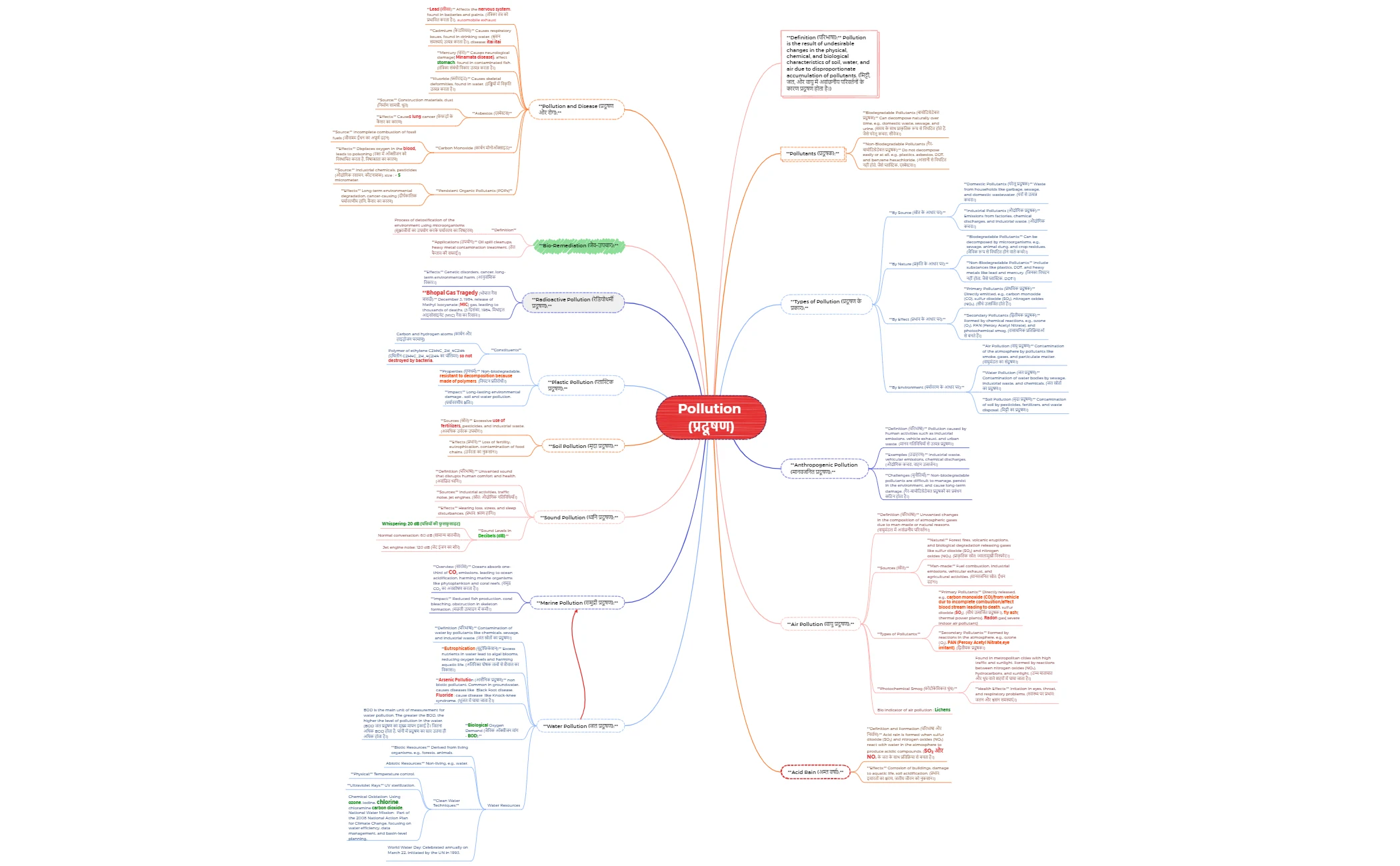
Read the branchesशाखाएँ पढ़ें
Pollution (प्रदूषण)
Pollution (प्रदूषण)
Definition (परिभाषा): Pollution is the result of undesirable changes in the physical, chemical, and biological characteristics of soil, water, and air due to disproportionate accumulation of pollutants. (मिट्टी, जल, और वायु में अवांछनीय परिवर्तनों के कारण प्रदूषण होता है।)
Pollutants (प्रदूषक):
Biodegradable Pollutants (बायोडिग्रेडेबल प्रदूषक): Can decompose naturally over time, e.g., domestic waste, sewage, and urine. (समय के साथ प्राकृतिक रूप से विघटित होते हैं, जैसे घरेलू कचरा, सीवेज।)
Non-Biodegradable Pollutants (गैर-बायोडिग्रेडेबल प्रदूषक): Do not decompose easily or at all, e.g., plastics, asbestos, DDT, and benzene hexachloride. (आसानी से विघटित नहीं होते, जैसे प्लास्टिक, एस्बेस्टस।)
Types of Pollution (प्रदूषण के प्रकार):
By Source (स्रोत के आधार पर):
Domestic Pollutants (घरेलू प्रदूषक): Waste from households like garbage, sewage, and domestic wastewater. (घरों से उत्पन्न कचरा।)
Industrial Pollutants (औद्योगिक प्रदूषक): Emissions from factories, chemical discharges, and industrial waste. (औद्योगिक कचरा।)
By Nature (प्रकृति के आधार पर):
Biodegradable Pollutants: Can be decomposed by microorganisms, e.g., sewage, animal dung, and crop residues. (जैविक रूप से विघटित होने वाले कचरे।)
Non-Biodegradable Pollutants: Include substances like plastics, DDT, and heavy metals like lead and mercury. (जिनका विघटन नहीं होता, जैसे प्लास्टिक, DDT।)
By Effect (प्रभाव के आधार पर):
Primary Pollutants (प्राथमिक प्रदूषक): Directly emitted, e.g., carbon monoxide (CO), sulfur dioxide (SO₂), nitrogen oxides (NOₓ). (सीधे उत्सर्जित होते हैं।)
Secondary Pollutants (द्वितीयक प्रदूषक): Formed by chemical reactions, e.g., ozone (O₃), PAN (Peroxy Acetyl Nitrate), and photochemical smog. (रासायनिक प्रतिक्रियाओं से बनते हैं।)
By Environment (पर्यावरण के आधार पर):
Air Pollution (वायु प्रदूषण): Contamination of the atmosphere by pollutants like smoke, gases, and particulate matter. (वायुमंडल का संदूषण।)
Water Pollution (जल प्रदूषण): Contamination of water bodies by sewage, industrial waste, and chemicals. (जल स्रोतों का प्रदूषण।)
Soil Pollution (मृदा प्रदूषण): Contamination of soil by pesticides, fertilizers, and waste disposal. (मिट्टी का प्रदूषण।)
Anthropogenic Pollution (मानवजनित प्रदूषण):
Definition (परिभाषा): Pollution caused by human activities such as industrial emissions, vehicle exhaust, and urban waste. (मानव गतिविधियों से उत्पन्न प्रदूषण।)
Examples (उदाहरण): Industrial waste, vehicular emissions, chemical discharges. (औद्योगिक कचरा, वाहन उत्सर्जन।)
Challenges (चुनौतियाँ): Non-biodegradable pollutants are difficult to manage, persist in the environment, and cause long-term damage. (गैर-बायोडिग्रेडेबल प्रदूषकों का प्रबंधन कठिन होता है।)
Air Pollution (वायु प्रदूषण):
Definition (परिभाषा): Unwanted changes in the composition of atmospheric gases due to man-made or natural reasons. (वायुमंडल में अवांछनीय परिवर्तन।)
Sources (स्रोत):
Natural: Forest fires, volcanic eruptions, and biological degradation releasing gases like sulfur dioxide (SO₂) and nitrogen oxides (NOₓ). (प्राकृतिक स्रोत: ज्वालामुखी विस्फोट।)
Man-made: Fuel combustion, industrial emissions, vehicular exhaust, and agricultural activities. (मानवजनित स्रोत: ईंधन दहन।)
Types of Pollutants:
Primary Pollutants: Directly released, e.g., carbon monoxide (CO)/from vehicle dur to incomplete combustion/affect blood stream leading to death, sulfur dioxide (SO₂). (सीधे उत्सर्जित प्रदूषक।), fly ash{ thermal power plants}, Radon gas{ severe indoor air pollutant}
Secondary Pollutants: Formed by reactions in the atmosphere, e.g., ozone (O₃), PAN (Peroxy Acetyl Nitrate,eye irritant). (द्वितीयक प्रदूषक।)
Photochemical Smog (फोटोकेमिकल धुंध):
Found in metropolitan cities with high traffic and sunlight. Formed by reactions between nitrogen oxides (NOₓ), hydrocarbons, and sunlight. (उच्च यातायात और धूप वाले शहरों में पाया जाता है।)
Health Effects: Irritation in eyes, throat, and respiratory problems. (स्वास्थ्य पर प्रभाव: जलन और श्वसन समस्याएं।)
Bio indicator of air pollution : Lichens
Acid Rain (अम्ल वर्षा):
Definition and Formation (परिभाषा और निर्माण): Acid rain is formed when sulfur dioxide (SO₂) and nitrogen oxides (NOₓ) react with water in the atmosphere to produce acidic compounds. (SO₂ और NOₓ के जल के साथ प्रतिक्रिया से बनता है।)
Effects: Corrosion of buildings, damage to aquatic life, soil acidification. (प्रभाव: इमारतों का क्षरण, जलीय जीवन को नुकसान।)
Water Pollution (जल प्रदूषण):
Definition (परिभाषा): Contamination of water by pollutants like chemicals, sewage, and industrial waste. (जल स्रोतों का प्रदूषण।)
Eutrophication (यूट्रोफिकेशन): Excess nutrients in water lead to algal blooms, reducing oxygen levels and harming aquatic life. (अतिरिक्त पोषक तत्वों से शैवाल का विकास।)
Arsenic Pollution (आर्सेनिक प्रदूषण): non biotic pollutant, Common in groundwater, causes diseases like Black Foot disease. Fluoride : cause disease like Knock-knee syndrome. (भूजल में पाया जाता है।)
Biological Oxygen Demand (जैविक ऑक्सीजन मांग - BOD):
BOD is the main unit of measurement for water pollution. The greater the BOD, the higher the level of pollution in the water. (BOD जल प्रदूषण का मुख्य मापन इकाई है। जितना अधिक BOD होता है, पानी में प्रदूषण का स्तर उतना ही अधिक होता है।)
Water Resources
Biotic Resources: Derived from living organisms, e.g., forests, animals.
Abiotic Resources: Non-living, e.g., water.
Clean Water Techniques:
Physical: Temperature control.
Ultraviolet Rays: UV sterilization.
Chemical Oxidation: Using ozone, iodine, chlorine, chloramine carbon dioxide, National Water Mission: Part of the 2008 National Action Plan for Climate Change, focusing on water efficiency, data management, and basin-level planning,
World Water Day: Celebrated annually on March 22, initiated by the UN in 1993.
Marine Pollution (समुद्री प्रदूषण):
Overview (सारांश): Oceans absorb one-third of CO₂ emissions, leading to ocean acidification, harming marine organisms like phytoplankton and coral reefs. (समुद्र CO₂ का अवशोषण करता है।)
Impact: Reduced fish production, coral bleaching, obstruction in skeleton formation. (मछली उत्पादन में कमी।)
Sound Pollution (ध्वनि प्रदूषण):
Definition (परिभाषा): Unwanted sound that disrupts human comfort and health. (अवांछित ध्वनि।)
Sources: Industrial activities, traffic noise, jet engines. (स्रोत: औद्योगिक गतिविधियाँ।)
Effects: Hearing loss, stress, and sleep disturbances. (प्रभाव: श्रवण हानि।)
Sound Levels in Decibels (dB):
Whispering: 20 dB (पत्तियों की फुसफुसाहट)
Normal conversation: 60 dB (सामान्य बातचीत)
Jet engine noise: 120 dB (जेट इंजन का शोर)
Soil Pollution (मृदा प्रदूषण):
Sources (स्रोत): Excessive use of fertilizers, pesticides, and industrial waste. (अत्यधिक उर्वरक उपयोग।)
Effects (प्रभाव): Loss of fertility, eutrophication, contamination of food chains. (उर्वरता का नुकसान।)
Plastic Pollution (प्लास्टिक प्रदूषण):
Constituents
Carbon and hydrogen atoms (कार्बन और हाइड्रोजन परमाणु)
Polymer of ethylene C2H4C_2H_4C2H4 (एथिलीन C2H4C_2H_4C2H4 का पॉलिमर) so not destroyed by bacteria.
Properties (गुणधर्म): Non-biodegradable, resistant to decomposition because made of polymers. (विघटन प्रतिरोधी।)
Impact: Long-lasting environmental damage , soil and water pollution. (पर्यावरणीय क्षति।)
Radioactive Pollution (रेडियोधर्मी प्रदूषण):
Effects: Genetic disorders, cancer, long-term environmental harm. (आनुवांशिक विकार।)
Bhopal Gas Tragedy (भोपाल गैस त्रासदी): December 3, 1984, release of Methyl Isocyanate (MIC) gas, leading to thousands of deaths. (3 दिसंबर, 1984, मिथाइल आइसोसाइनेट (MIC) गैस का रिसाव।)
Bio-Remediation (जैव-उपचार):
Definition
Process of detoxification of the environment using microorganisms (सूक्ष्मजीवों का उपयोग करके पर्यावरण का विषहरण)
Applications (उपयोग): Oil spill cleanups, heavy metal contamination treatment. (तेल फैलाव की सफाई।)
Pollution and Disease (प्रदूषण और रोग):
Lead (सीसा): Affects the nervous system, found in batteries and paints. (तंत्रिका तंत्र को प्रभावित करता है।), automobile exhaust
Cadmium (कैडमियम): Causes respiratory issues, found in drinking water. (श्वसन समस्याएं उत्पन्न करता है।), disease: itai itai
Mercury (पारा): Causes neurological damage{ Minamata disease}, affect stomach; found in contaminated fish. (तंत्रिका संबंधी विकार उत्पन्न करता है।)
Fluoride (फ्लोराइड): Causes skeletal deformities, found in water. (हड्डियों में विकृति उत्पन्न करता है।)
Asbestos (एस्बेस्टस)
Source: Construction materials, dust (निर्माण सामग्री, धूल)
Effects: Causes lung cancer (फेफड़ों के कैंसर का कारण)
Carbon Monoxide (कार्बन मोनोऑक्साइड)
Source: Incomplete combustion of fossil fuels (जीवाश्म ईंधन का अपूर्ण दहन)
Effects: Displaces oxygen in the blood, leads to poisoning (रक्त में ऑक्सीजन को विस्थापित करता है, विषाक्तता का कारण)
Persistent Organic Pollutants (POPs)
Source: Industrial chemicals, pesticides (औद्योगिक रसायन, कीटनाशक); size : < 5 micrometer.
Effects: Long-term environmental degradation, cancer-causing (दीर्घकालिक पर्यावरणीय हानि, कैंसर का कारण)
Connectionsसंबंध
- Water Pollution (जल प्रदूषण): → Marine Pollution (समुद्री प्रदूषण):