Mind Mapsमाइंड मैप्स › Environmentपर्यावरण
Pollution and Its Types — mind mapमाइंड मैप
Original study maps by Rishabh Singh. Read dated facts in their exam-year context. Sources & corrections.ऋषभ सिंह के मूल अध्ययन मानचित्र। पुराने तथ्यों को संबंधित परीक्षा वर्ष के संदर्भ में पढ़ें। स्रोत और सुधार।
233 branches and entriesशाखाएँ और बिंदु · 1 sheet(s)शीट
See the original map layoutमूल मानचित्र का स्वरूप देखें
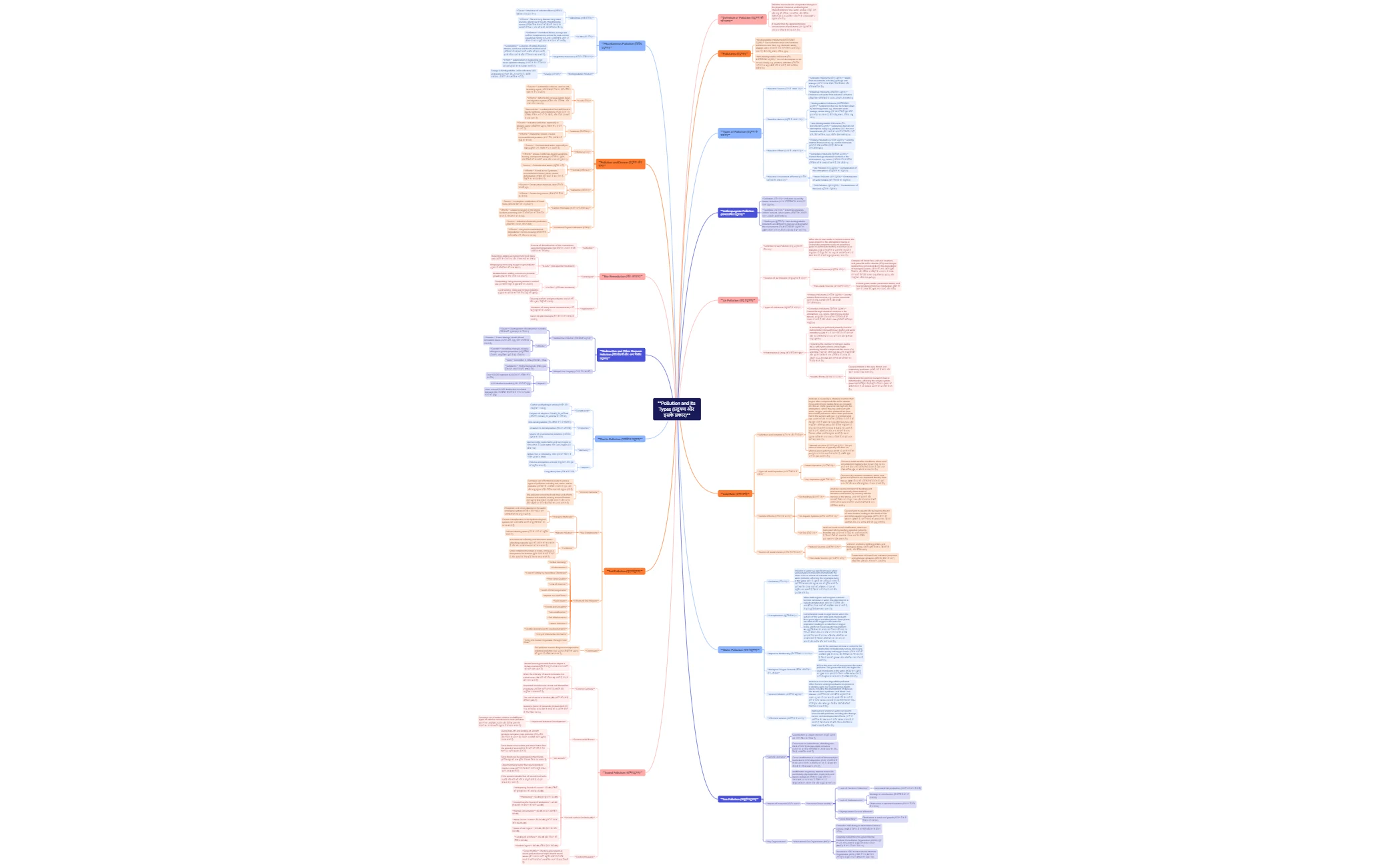
Tap the image to open its full preview. Read individual branches below for comfortable revision.पूरा पूर्वावलोकन खोलने के लिए चित्र पर टैप करें। आसानी से पढ़ने के लिए नीचे शाखाएँ देखें।
Read the branchesशाखाएँ पढ़ें
Pollution and Its Types (प्रदूषण और इसके प्रकार)
Pollution and Its Types (प्रदूषण और इसके प्रकार)
Definition of Pollution (प्रदूषण की परिभाषा)
Pollution occurs due to unexpected changes in the physical, chemical, and biological characteristics of soil, water, and air. (मिट्टी, जल, और वायु की भौतिक, रासायनिक, और जैविक विशेषताओं में अप्रत्याशित परिवर्तन के परिणामस्वरूप प्रदूषण होता है।)
It results from the disproportionate accumulation of pollutants. (यह प्रदूषकों के असमान्य संचय के कारण होता है।)
Pollutants (प्रदूषक)
Biodegradable Pollutants (बायोडिग्रेडेबल प्रदूषक): Can be broken down into harmless substances over time, e.g., domestic waste, sewage, urine. (समय के साथ हानिरहित पदार्थों में टूट सकते हैं, जैसे घरेलू कचरा, सीवेज, मूत्र।)
Non-Biodegradable Pollutants (गैर-बायोडिग्रेडेबल प्रदूषक): Do not decompose or do so very slowly, e.g., plastics, asbestos. (विघटित नहीं होते या बहुत धीमी गति से होते हैं, जैसे प्लास्टिक, एस्बेस्टस।)
Types of Pollution (प्रदूषण के प्रकार)
Based on Source (स्रोत के आधार पर):
Domestic Pollutants (घरेलू प्रदूषक): Waste from households, including garbage and sewage. (घरों से उत्पन्न कचरा, जिसमें कचरा और सीवेज शामिल हैं।)
Industrial Pollutants (औद्योगिक प्रदूषक): Emissions and waste from industrial activities. (औद्योगिक गतिविधियों से उत्पन्न उत्सर्जन और कचरा।)
Based on Nature (प्रकृति के आधार पर):
Biodegradable Pollutants (बायोडिग्रेडेबल प्रदूषक): Substances that can be broken down by microorganisms, e.g., domestic waste, sewage, animal dung. (ऐसे पदार्थ जिन्हें सूक्ष्मजीवों द्वारा तोड़ा जा सकता है, जैसे घरेलू कचरा, सीवेज, पशु मल।)
Non-Biodegradable Pollutants (गैर-बायोडिग्रेडेबल प्रदूषक): Substances that do not decompose easily, e.g., plastics, DDT, Benzene hexachloride. (ऐसे पदार्थ जो आसानी से विघटित नहीं होते, जैसे प्लास्टिक, DDT, बेंजीन हेक्साक्लोराइड।)
Based on Effect (प्रभाव के आधार पर):
Primary Pollutants (प्राथमिक प्रदूषक): Directly emitted from sources, e.g., carbon monoxide. (स्रोतों से सीधे उत्सर्जित होते हैं, जैसे कार्बन मोनोऑक्साइड।)
Secondary Pollutants (द्वितीयक प्रदूषक): Formed through chemical reactions in the environment, e.g., ozone. (पर्यावरण में रासायनिक प्रतिक्रियाओं के माध्यम से बनते हैं, जैसे ओजोन।)
Based on Environment Affected (प्रभावित पर्यावरण के आधार पर):
Air Pollution (वायु प्रदूषण): Contamination of the atmosphere. (वायुमंडल का संदूषण।)
Water Pollution (जल प्रदूषण): Contamination of water bodies. (जल निकायों का संदूषण।)
Soil Pollution (मृदा प्रदूषण): Contamination of the land. (भूमि का संदूषण।)
Anthropogenic Pollution (मानवजनित प्रदूषण)
Definition (परिभाषा): Pollution caused by human activities. (मानव गतिविधियों के कारण होने वाला प्रदूषण।)
Examples (उदाहरण): Industrial emissions, vehicle exhaust, urban waste. (औद्योगिक उत्सर्जन, वाहन उत्सर्जन, शहरी कचरा।)
Challenges (चुनौतियाँ): Non-biodegradable pollutants are difficult to manage and persist in the environment. (गैर-बायोडिग्रेडेबल प्रदूषकों का प्रबंधन कठिन होता है और वे पर्यावरण में बने रहते हैं।)
Air Pollution (वायु प्रदूषण)
Definition of Air Pollution (वायु प्रदूषण की परिभाषा)
When due to man-made or natural reasons, the gases present in the atmosphere change in undesirable proportions (due to poisonous gases or particulate matter), it is known as air pollution. (जब मानवजनित या प्राकृतिक कारणों से वायुमंडल में मौजूद गैसों का अनुपात अवांछनीय रूप से बदल जाता है, तो इसे वायु प्रदूषण कहा जाता है।)
Sources of Air Pollution (वायु प्रदूषण के स्रोत)
Natural Sources (प्राकृतिक स्रोत):
Comprise of forest fires, volcanic eruptions, and gases like sulfur dioxide (SO₂) and nitrogen oxides (NOₓ) generated due to the degradation of biological wastes. (जंगल की आग, ज्वालामुखी विस्फोट, और जैविक अपशिष्टों के अपघटन से उत्पन्न होने वाली गैसें जैसे सल्फर डाइऑक्साइड (SO₂) और नाइट्रोजन ऑक्साइड (NOₓ)।)
Man-made Sources (मानवजनित स्रोत):
Include gases, smoke, particulate matter, and heat produced from fuel combustion. (ईंधन के दहन से उत्पन्न गैसें, धुआं, कण पदार्थ, और गर्मी।)
Types of Pollutants (प्रदूषकों के प्रकार)
Primary Pollutants (प्राथमिक प्रदूषक): Directly emitted from sources, e.g., carbon monoxide. (स्रोतों से सीधे उत्सर्जित होते हैं, जैसे कार्बन मोनोऑक्साइड।)
Secondary Pollutants (द्वितीयक प्रदूषक): Formed through chemical reactions in the atmosphere, e.g., ozone, PAN (Peroxy Acetyl Nitrate). (वायुमंडल में रासायनिक प्रतिक्रियाओं के माध्यम से बनते हैं, जैसे ओजोन, PAN (पेरॉक्सी एसीटाइल नाइट्रेट)।)
Photochemical Smog (फोटोकेमिकल धुंध)
A secondary air pollutant primarily found in metropolitan cities with heavy traffic and warm conditions. (मुख्य रूप से महानगरों में भारी यातायात और गर्म परिस्थितियों में पाया जाने वाला एक द्वितीयक वायु प्रदूषक।)
Formed by the reaction of nitrogen oxides (NOₓ) with hydrocarbons and sunlight, producing harmful compounds like ozone (O₃) and PAN. (नाइट्रोजन ऑक्साइड (NOₓ) के हाइड्रोकार्बन और सूर्य के प्रकाश के साथ प्रतिक्रिया से उत्पन्न, जो ओजोन (O₃) और PAN जैसे हानिकारक यौगिकों का निर्माण करता है।)
Health Effects (स्वास्थ्य पर प्रभाव):
Causes irritation in the eyes, throat, and respiratory problems. (आंखों, गले में जलन और श्वसन समस्याएं पैदा करता है।)
PAN hinders the electron transport chain in mitochondria, affecting the enzyme system. (PAN माइटोकॉन्ड्रिया में इलेक्ट्रॉन परिवहन श्रृंखला को बाधित करता है, जो एंजाइम प्रणाली को प्रभावित करता है।)
Acid Rain (अम्ल वर्षा)
Definition and Formation (परिभाषा और निर्माण)
Acid rain is caused by a chemical reaction that begins when compounds like sulfur dioxide (SO₂) and nitrogen oxides (NOₓ) are released into the air. These gases can rise high into the atmosphere, where they mix and react with water, oxygen, and other chemicals to form more acidic pollutants. When these pollutants fall to the surface with rain, it is termed acid rain. (अम्ल वर्षा एक रासायनिक प्रतिक्रिया से होती है जो तब शुरू होती है जब सल्फर डाइऑक्साइड (SO₂) और नाइट्रोजन ऑक्साइड (NOₓ) जैसे यौगिक वायुमंडल में छोड़े जाते हैं। ये गैसें वातावरण में ऊँचाई तक उठती हैं, जहाँ वे पानी, ऑक्सीजन और अन्य रसायनों के साथ मिलकर अधिक अम्लीय प्रदूषक बनाती हैं। जब ये प्रदूषक बारिश के साथ सतह पर गिरते हैं, तो इसे अम्ल वर्षा कहा जाता है।)
Normal pH Value (सामान्य pH मूल्य): The pH value of acid rain is typically less than 5.6, whereas pure water has a pH of 7.0. (अम्ल वर्षा का pH मूल्य सामान्यतः 5.6 से कम होता है, जबकि शुद्ध पानी का pH 7.0 होता है।)
Types of Acid Deposition (अम्ल निक्षेपण के प्रकार)
Moist Deposition (नम निक्षेपण):
Occurs in moist weather conditions, where acid accumulation happens due to rain, fog, or ice. (नमी वाले मौसम की परिस्थितियों में होता है, जहाँ अम्ल संचय बारिश, धुंध, या बर्फ के कारण होता है।)
Dry Deposition (शुष्क निक्षेपण):
Occurs in dry weather conditions, where acid gases and particles are deposited directly from the air. (शुष्क मौसम की परिस्थितियों में होता है, जहाँ अम्ल गैसें और कण सीधे वायुमंडल से जमा हो जाते हैं।)
Harmful Effects (हानिकारक प्रभाव)
On Buildings (इमारतों पर):
Acid rain causes corrosion of buildings and monuments, especially those made of limestone and marble, by reacting with the minerals in the stones. (अम्ल वर्षा इमारतों और स्मारकों, विशेष रूप से चूना पत्थर और संगमरमर से बनी संरचनाओं का क्षरण करती है, पत्थरों में खनिजों के साथ प्रतिक्रिया करके।)
On Aquatic Systems (जलीय प्रणालियों पर):
Causes harm to aquatic life by lowering the pH of water bodies, leading to the death of fish and other aquatic organisms. (जलीय जीवन को नुकसान पहुंचाती है, जल निकायों का pH घटाकर, जिससे मछलियों और अन्य जलीय जीवों की मृत्यु होती है।)
On Soil (मिट्टी पर):
Acid rain leads to soil acidification, which can harm plant life by leaching essential nutrients from the soil. (अम्ल वर्षा से मिट्टी का अम्लीकरण होता है, जिससे पौधों को आवश्यक पोषक तत्वों के लीचिंग द्वारा नुकसान पहुँच सकता है।)
Sources of Acidic Gases (अम्लीय गैसों के स्रोत)
Natural Sources (प्राकृतिक स्रोत):
Volcanic eruptions, lightning strikes, and biological decay. (ज्वालामुखी विस्फोट, बिजली के झटके, और जैविक क्षय।)
Man-made Sources (मानवजनित स्रोत):
Combustion of fossil fuels, industrial processes, and vehicular emissions. (जीवाश्म ईंधन का दहन, औद्योगिक प्रक्रियाएँ, और वाहन उत्सर्जन।)
Water Pollution (जल प्रदूषण)
Definition (परिभाषा):
Pollution in water is a significant issue where various types of pollutants contaminate the water. Even an excess of nutrients can lead to water pollution, affecting the organisms living in the water. (जल में प्रदूषण एक महत्वपूर्ण समस्या है, जहाँ विभिन्न प्रकार के प्रदूषक जल को दूषित करते हैं। यहाँ तक कि पोषक तत्वों की अधिकता भी जल को प्रदूषित कर सकती है, जिससे पानी में रहने वाले जीव प्रभावित होते हैं।)
Eutrophication (यूट्रोफिकेशन):
When both organic and inorganic nutrients become excessive in water, this phenomenon is called eutrophication. (जब जल में जैविक और अकार्बनिक पोषक तत्वों की अत्यधिक मात्रा हो जाती है, तो इसे यूट्रोफिकेशन कहा जाता है।)
Eutrophication leads to algal bloom, where the surface of the water body gets covered with blue-green algae and other plants. These plants use most of the oxygen in the water for respiration, leading to a reduction in oxygen levels, which can cause aquatic organisms to die. (यूट्रोफिकेशन के कारण जल निकाय की सतह पर नीले-हरे शैवाल और अन्य पौधे पनपने लगते हैं। ये पौधे श्वसन के लिए जल में उपलब्ध अधिकांश ऑक्सीजन का उपयोग करते हैं, जिससे ऑक्सीजन का स्तर कम हो जाता है और जलीय जीव मरने लगते हैं।)
Impact on Biodiversity (जैव विविधता पर प्रभाव):
Due to the excessive increase in nutrients, the destruction of biodiversity occurs, decreasing water quality and oxygen levels. (पोषक तत्वों की अत्यधिक वृद्धि के कारण, जैव विविधता का विनाश होता है, जिससे जल की गुणवत्ता और ऑक्सीजन स्तर में कमी आती है।)
Biological Oxygen Demand (जैविक ऑक्सीजन मांग - BOD):
BOD is the main unit of measurement for water pollution. The greater the BOD, the higher the level of pollution in the water. (BOD जल प्रदूषण का मुख्य मापन इकाई है। जितना अधिक BOD होता है, पानी में प्रदूषण का स्तर उतना ही अधिक होता है।)
Arsenic Pollution (आर्सेनिक प्रदूषण):
Arsenic is a non-bio-degradable pollutant often found in underground water. Its presence in drinking water can lead to serious health issues, including the development of diseases like 'Knock-knee syndrome' and 'Black Foot disease.' (आर्सेनिक एक अकार्बनिक प्रदूषक है जो अक्सर भू-जल में पाया जाता है। इसके पीने के पानी में होने से गंभीर स्वास्थ्य समस्याएँ हो सकती हैं, जिनमें 'नॉक-नी सिंड्रोम' और 'ब्लैक फुट डिजीज' जैसी बीमारियाँ विकसित हो सकती हैं।)
Effects of Arsenic (आर्सेनिक के प्रभाव):
High levels of arsenic in water can lead to severe health problems, including skin damage, cancer, and developmental effects. (पानी में आर्सेनिक के उच्च स्तर से गंभीर स्वास्थ्य समस्याएँ हो सकती हैं, जिनमें त्वचा की क्षति, कैंसर और विकास संबंधी समस्याएँ शामिल हैं।)
Sea Pollution (समुद्री प्रदूषण)
General Overview
Sea pollution is a major concern (समुद्री प्रदूषण एक गंभीर चिंता का विषय है)
Oceans act as a storehouse, absorbing one-third of CO2 from man-made activities (महासागर मानवीय गतिविधियों से उत्पन्न CO2 का एक-तिहाई अवशोषित करते हैं)
Ocean acidification is a result of decreased pH levels due to CO2 absorption (CO2 अवशोषण के कारण महासागर का अम्लीकरण हो रहा है, जो pH स्तर में कमी के परिणामस्वरूप होता है)
Acidification negatively impacts marine life, particularly phytoplankton, coral reefs, and marine animals (अम्लीकरण समुद्री जीवन पर नकारात्मक प्रभाव डालता है, विशेष रूप से फाइटोप्लांकटन, कोरल रीफ और समुद्री जानवरों पर)
Impact of Increased CO2 Levels
Increased Ocean Acidity
Lack of Plankton Production
Decreased fish production (मछली उत्पादन में कमी)
Lack of Carbonate Ions
Blockage in calcification (कैल्सीफिकेशन में रुकावट)
Obstruction in skeleton formation (कंकाल निर्माण में रुकावट)
Phytoplankton Survival Affected
Coral Bleaching
Obstruction in coral reef growth (कोरल रीफ के विकास में रुकावट)
Key Organizations
International Sea Organization (IMO)
Formed in 1948 during an international meet in Geneva (1948 में जिनेवा में अंतर्राष्ट्रीय बैठक के दौरान गठित)
Originally called the Inter-governmental Maritime Consultative Organization (IMCO) (मूल रूप से अंतर-सरकारी समुद्री सलाहकार संगठन (IMCO) के रूप में जाना जाता था)
Renamed in 1982 to International Maritime Organization (IMO) (1982 में नाम बदलकर अंतर्राष्ट्रीय समुद्री संगठन (IMO) कर दिया गया)
Sound Pollution (ध्वनि प्रदूषण)
General Overview
Normal sound generated from an object is known as sound (किसी वस्तु से उत्पन्न सामान्य ध्वनि को ध्वनि कहा जाता है)
When the intensity of sound increases, it is called noise (जब ध्वनि की तीव्रता बढ़ जाती है, तो इसे शोर कहा जाता है)
Unwanted sound causes unrest and discomfort in humans (अवांछित ध्वनि मानवों में अशांति और असुविधा उत्पन्न करती है)
The unit of sound is Decibel (dB) (ध्वनि की इकाई डेसिबल (dB) है)
Named in honor of Alexander Graham Bell (यह नाम अलेक्जेंडर ग्राहम बेल के कार्यों को सम्मानित करने के लिए दिया गया था)
Sources and Effects
Unplanned Industrial Development
Excessive use of motor vehicles and different types of vehicles contributes to noise pollution (वाहनों का अत्यधिक उपयोग और विभिन्न प्रकार के वाहनों का उपयोग ध्वनि प्रदूषण में योगदान करता है)
Jet Aircraft
During take-off and landing, jet aircraft produce excessive noise pollution (टेक-ऑफ और लैंडिंग के दौरान जेट विमान अत्यधिक ध्वनि प्रदूषण उत्पन्न करते हैं)
Sonic boom occurs when jets move faster than the speed of sound (जेट्स के ध्वनि की गति से तेज़ चलने पर ध्वनि धमाका होता है)
Sonic Boom can be expressed in Mach Units (सोनिक बूम को माच यूनिट में व्यक्त किया जा सकता है)
Objects moving faster than sound produce Mach-1 noise (ध्वनि से तेज़ चलने वाली वस्तुएँ माच-1 ध्वनि उत्पन्न करती हैं)
If the speed is double that of sound, it is Mach-2 (यदि गति ध्वनि की गति से दोगुनी होती है, तो इसे माच-2 कहा जाता है)
Sound Levels in Decibels (dB)
Whispering Sound of Leaves: 20 dB (पत्तियों की फुसफुसाहट की आवाज़: 20 dB)
Murmuring: 30 dB (फुसफुसाना: 30 dB)
Room/Peaceful Sound of Workplace: 40 dB (कक्ष/शांत कार्यस्थल की ध्वनि: 40 dB)
Normal Conversation: 60 dB (सामान्य बातचीत: 60 dB)
Noise Due to Trucks: 80-85 dB (ट्रकों से उत्पन्न शोर: 80-85 dB)
Noise of Jet Engine: 120 dB (जेट इंजन का शोर: 120 dB)
Landing of Jet Plane: 150 dB (जेट विमान की लैंडिंग: 150 dB)
Rocket Engine: 180 dB (रॉकेट इंजन: 180 dB)
Control Measures
Green Muffler: Planting green plants in sound-polluted areas helps absorb sound waves (ग्रीन मफलर: ध्वनि प्रदूषित क्षेत्रों में हरे पौधे लगाने से ध्वनि तरंगों को अवशोषित करने में मदद मिलती है)
Soil Pollution (मृदा प्रदूषण)
General Overview
Excessive use of fertilizers leads to various types of pollution including soil, water, and air pollution (उर्वरकों के अत्यधिक उपयोग से मृदा, जल और वायु प्रदूषण सहित विभिन्न प्रकार के प्रदूषण होते हैं)
This pollution enters the food chain and affects humans and animals, causing serious illnesses (यह प्रदूषण खाद्य श्रृंखला में प्रवेश करता है और मानव और पशुओं पर गंभीर बीमारियों का प्रभाव डालता है)
Key Components
Inorganic Materials
Phosphate and nitrate dissolve in the water ecological system (फॉस्फेट और नाइट्रेट जल पारिस्थितिकी तंत्र में घुल जाते हैं)
Causes eutrophication in the hydroecological system (जल पर्यावरणीय प्रणाली में यूट्रोफिकेशन का कारण बनते हैं)
Nitrate Pollution
Pollutes drinking water (पीने के पानी को प्रदूषित करता है)
Fertilizers
Increases soil infertility and decreases water-absorbing capacity (मृदा की उर्वरता को कम करता है और जल अवशोषण क्षमता को कम करता है)
Some components remain in crops, acting as a slow poison for humans (कुछ घटक फसलों में रहते हैं और मनुष्यों के लिए धीमे विष का काम करते हैं)
Effects of Soil Pollution
Global Warming
Deforestation
Loss of Fertility by Hazardous Chemicals
Poor Crop Quality
Loss of Revenue
Death of Microorganisms
Impact on Food Chain
Soil Erosion
Floods and Droughts
Soil Acidification
Soil Alkalinization
Water Pollution
Deadly Diseases Due to Lead and Arsenic
Entry of Pollutants into Plants
Entry into Human Organisms Through Food Chain
Conclusion
Soil pollution is more dangerous compared to industrial pollution (मृदा प्रदूषण औद्योगिक प्रदूषण की तुलना में अधिक खतरनाक है)
Plastic Pollution (प्लास्टिक प्रदूषण)
Constituents
Carbon and hydrogen atoms (कार्बन और हाइड्रोजन परमाणु)
Polymer of ethylene C2H4C_2H_4C2H4 (एथिलीन C2H4C_2H_4C2H4 का पॉलिमर)
Properties
Non-biodegradable (गैर-जैविक रूप से विघटित)
Resistant to decomposition (विघटन प्रतिरोधी)
Source of environmental pollution (पर्यावरण प्रदूषण का स्रोत)
Discovery
Discovered by Giulio Natta and Carl Zeigler in 1953 (1953 में Giulio Natta और Carl Zeigler द्वारा खोजा गया)
Nobel Prize in Chemistry, 1963 (रसायन विज्ञान में नोबेल पुरस्कार, 1963)
Impact
Pollutes atmosphere and soil (वायुमंडल और मृदा को प्रदूषित करता है)
Long decay time (लंबा क्षय समय)
Radioactive and Other Gaseous Pollution (रेडियोधर्मी और अन्य गैसीय प्रदूषण)
Radioactive Pollution (रेडियोधर्मी प्रदूषण)
Cause: Disintegration of radioactive nuclides (रेडियोधर्मी न्यूक्लाइड्स का विघटन)
Effects:
Somatic: Tissue damage, death, blood circulation issues (ऊतक क्षति, मृत्यु, रक्त परिसंचरण समस्याएं)
Genetic: Hereditary changes, massive changes in genetic properties (आनुवांशिक परिवर्तन, आनुवंशिक गुणों में बड़े परिवर्तन)
Bhopal Gas Tragedy (भोपाल गैस त्रासदी)
Date: December 3, 1984 (3 दिसंबर, 1984)
Substance: Methyl Isocyanate (MIC) gas (मिथाइल आइसोसाइनेट (MIC) गैस)
Impact:
Over 500,000 exposed (5,00,000 से अधिक लोग प्रभावित)
3,787 deaths recorded (3,787 लोगों की मृत्यु)
Later, around 25,000 deaths due to related diseases (बाद में संबंधित बीमारियों से लगभग 25,000 लोगों की मृत्यु)
Bio-Remediation (जैव-उपचार)
Definition
Process of detoxification of the environment using microorganisms (सूक्ष्मजीवों का उपयोग करके पर्यावरण का विषहरण)
Techniques
In-Situ (Site-specific treatment)
Bioventing: Adding air/nutrients to treat deep soil (जमीन के भीतर हवा और पोषक तत्वों का संचार)
Biosparging: Increasing oxygen in groundwater (भूजल में ऑक्सीजन की मात्रा बढ़ाना)
Biostimulation: Adding nutrients to promote growth (वृद्धि के लिए पोषक तत्व जोड़ना)
Ex-Situ (Off-site treatment)
Composting: Using microorganisms in treated soil (उपचारित मिट्टी में सूक्ष्मजीवों का उपयोग)
Land farming: Tilling soil to treat pollution (प्रदूषण का इलाज करने के लिए मिट्टी की जुताई)
Application
Cleaning surface and groundwater, soil (सतही और भूजल, मिट्टी की सफाई)
Treatment of heavy metal contaminants (भारी धातु संदूषकों का उपचार)
Use in oil spill cleanups (तेल फैलाव की सफाई में उपयोग)
Pollution and Disease (प्रदूषण और रोग)
Lead (सीसा)
Source: Automobile exhaust, used as anti-knocking agent (ऑटोमोबाइल निकास, एंटी-नॉकिंग एजेंट के रूप में प्रयोग)
Effects: Affects the nervous system, brain, and digestive system (तंत्रिका तंत्र, मस्तिष्क, और पाचन तंत्र पर प्रभाव)
Banned Use: Leaded petrol, but still found in paints, batteries, and cosmetics (लीडेड पेट्रोल पर प्रतिबंध, लेकिन अभी भी पेंट, बैटरी, और सौंदर्य प्रसाधनों में पाया जाता है)
Cadmium (कैडमियम)
Source: Industrial pollution, especially in drinking water (औद्योगिक प्रदूषण, विशेष रूप से पीने के पानी में)
Effects: Respiratory poison, causes increased blood pressure (श्वसन विष, रक्तचाप में वृद्धि का कारण)
Mercury (पारा)
Source: Contaminated water, especially in fish (प्रदूषित पानी, विशेष रूप से मछली में)
Effects: Ataxia, numbness, muscle weakness, hearing, and speech damage (अटैक्सिया, सुन्नता, मांसपेशियों की कमजोरी, श्रवण और भाषण को नुकसान)
Fluoride (फ्लोराइड)
Source: Contaminated water (प्रदूषित पानी)
Effects: "Knock-Knee Syndrome," accumulates in bones, joints, causes deformation (हड्डियों और जोड़ों में जमा होता है, विकृति का कारण बनता है)
Asbestos (एस्बेस्टस)
Source: Construction materials, dust (निर्माण सामग्री, धूल)
Effects: Causes lung cancer (फेफड़ों के कैंसर का कारण)
Carbon Monoxide (कार्बन मोनोऑक्साइड)
Source: Incomplete combustion of fossil fuels (जीवाश्म ईंधन का अपूर्ण दहन)
Effects: Displaces oxygen in the blood, leads to poisoning (रक्त में ऑक्सीजन को विस्थापित करता है, विषाक्तता का कारण)
Persistent Organic Pollutants (POPs)
Source: Industrial chemicals, pesticides (औद्योगिक रसायन, कीटनाशक)
Effects: Long-term environmental degradation, cancer-causing (दीर्घकालिक पर्यावरणीय हानि, कैंसर का कारण)
Miscellaneous Pollution (विविध प्रदूषण)
Asbestosis (एस्बेस्टोसिस)
Cause: Inhalation of asbestos fibers (एस्बेस्टस रेशों का साँस द्वारा लेना)
Effects: Chronic lung disease, lung tissue scarring, shortness of breath, Mesothelioma cancer (दीर्घकालिक फेफड़ों की बीमारी, फेफड़े के ऊतकों में निशान, सांस की कमी, मेसोथेलियोमा कैंसर)
La Niña (ला नीना)
Definition: Periods of below-average sea surface temperatures across the east-central equatorial Pacific (पूर्व-मध्य भूमध्यरेखीय प्रशांत में औसत से कम समुद्री सतह के तापमान की अवधि)
Argemone mexicana (आर्गेमोन मेक्सिकाना)
Description: A species of poppy found in Mexico, seeds can adulterate mustard seed (मेक्सिको में पाई जाने वाली अफीम की एक प्रजाति, इसके बीज सरसों के बीज में मिलावट कर सकते हैं)
Effect: Adulteration in mustard oil can cause epidemic dropsy (सरसों के तेल में मिलावट महामारी ड्रॉप्सी का कारण बन सकती है)
Biodegradable Pollutant
Sewage (मलजल)
Sewage is biodegradable, unlike asbestos, DDT, and plastic (मलजल जैव-अपघटनीय है, जबकि एस्बेस्टस, डीडीटी और प्लास्टिक नहीं हैं)