Mind Mapsमाइंड मैप्स › Environmentपर्यावरण
Ozone Layer — mind mapमाइंड मैप
Original study maps by Rishabh Singh. Read dated facts in their exam-year context. Sources & corrections.ऋषभ सिंह के मूल अध्ययन मानचित्र। पुराने तथ्यों को संबंधित परीक्षा वर्ष के संदर्भ में पढ़ें। स्रोत और सुधार।
64 branches and entriesशाखाएँ और बिंदु · 1 sheet(s)शीट
See the original map layoutमूल मानचित्र का स्वरूप देखें
Tap the image to open its full preview. Read individual branches below for comfortable revision.पूरा पूर्वावलोकन खोलने के लिए चित्र पर टैप करें। आसानी से पढ़ने के लिए नीचे शाखाएँ देखें।
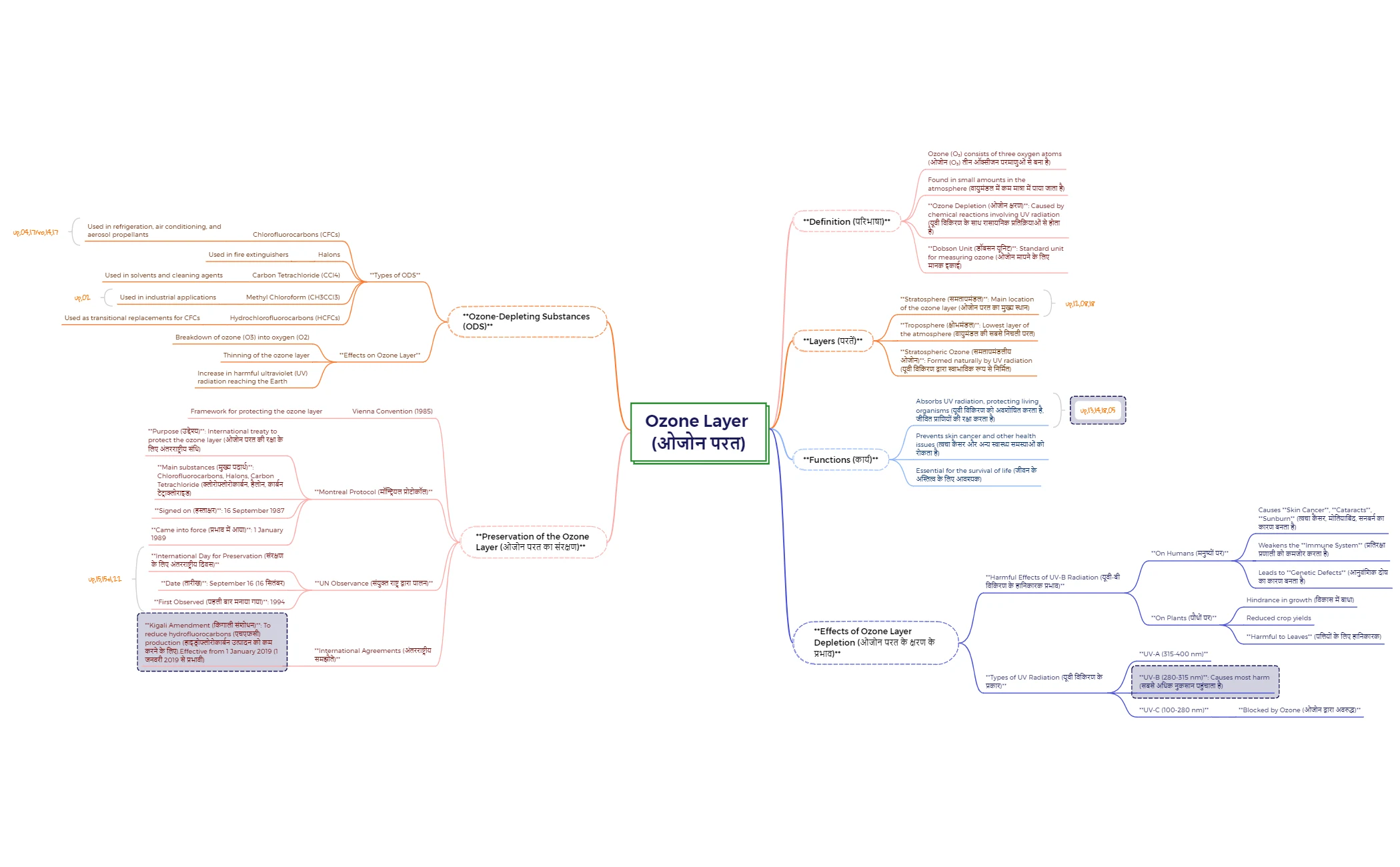
Read the branchesशाखाएँ पढ़ें
Ozone Layer (ओजोन परत)
Ozone Layer (ओजोन परत)
Definition (परिभाषा)
Ozone (O₃) consists of three oxygen atoms (ओजोन (O₃) तीन ऑक्सीजन परमाणुओं से बना है)
Found in small amounts in the atmosphere (वायुमंडल में कम मात्रा में पाया जाता है)
Ozone Depletion (ओजोन क्षरण): Caused by chemical reactions involving UV radiation (यूवी विकिरण के साथ रासायनिक प्रतिक्रियाओं से होता है)
Dobson Unit (डॉबसन यूनिट): Standard unit for measuring ozone (ओजोन मापने के लिए मानक इकाई)
Layers (परतें)
Stratosphere (समतापमंडल): Main location of the ozone layer (ओजोन परत का मुख्य स्थान)
Troposphere (क्षोभमंडल): Lowest layer of the atmosphere (वायुमंडल की सबसे निचली परत)
Stratospheric Ozone (समतापमंडलीय ओजोन): Formed naturally by UV radiation (यूवी विकिरण द्वारा स्वाभाविक रूप से निर्मित)
up,12,08,18
Functions (कार्य)
Absorbs UV radiation, protecting living organisms (यूवी विकिरण को अवशोषित करता है, जीवित प्राणियों की रक्षा करता है)
Prevents skin cancer and other health issues (त्वचा कैंसर और अन्य स्वास्थ्य समस्याओं को रोकता है)
Essential for the survival of life (जीवन के अस्तित्व के लिए आवश्यक)
up,13,14,18,05
Effects of Ozone Layer Depletion (ओजोन परत के क्षरण के प्रभाव)
Harmful Effects of UV-B Radiation (यूवी-बी विकिरण के हानिकारक प्रभाव)
On Humans (मनुष्यों पर)
Causes Skin Cancer, Cataracts, Sunburn (त्वचा कैंसर, मोतियाबिंद, सनबर्न का कारण बनता है)
Weakens the Immune System (प्रतिरक्षा प्रणाली को कमजोर करता है)
Leads to Genetic Defects (आनुवंशिक दोष का कारण बनता है)
On Plants (पौधों पर)
Hindrance in growth (विकास में बाधा)
Reduced crop yields
Harmful to Leaves (पत्तियों के लिए हानिकारक)
Types of UV Radiation (यूवी विकिरण के प्रकार)
UV-A (315-400 nm)
UV-B (280-315 nm): Causes most harm (सबसे अधिक नुकसान पहुंचाता है)
UV-C (100-280 nm)
Blocked by Ozone (ओजोन द्वारा अवरुद्ध)
Preservation of the Ozone Layer (ओजोन परत का संरक्षण)
Vienna Convention (1985)
Framework for protecting the ozone layer
Montreal Protocol (मॉन्ट्रियल प्रोटोकॉल)
Purpose (उद्देश्य): International treaty to protect the ozone layer (ओजोन परत की रक्षा के लिए अंतरराष्ट्रीय संधि)
Main substances (मुख्य पदार्थ): Chlorofluorocarbons, Halons, Carbon Tetrachloride (क्लोरोफ्लोरोकार्बन, हैलोन, कार्बन टेट्राक्लोराइड)
Signed on (हस्ताक्षर): 16 September 1987
Came into force (प्रभाव में आया): 1 January 1989
UN Observance (संयुक्त राष्ट्र द्वारा पालन)
International Day for Preservation (संरक्षण के लिए अंतरराष्ट्रीय दिवस)
Date (तारीख): September 16 (16 सितंबर)
First Observed (पहली बार मनाया गया): 1994
International Agreements (अंतरराष्ट्रीय समझौते)
Kigali Amendment (किगाली संशोधन): To reduce hydrofluorocarbons (एचएफसी) production (हाइड्रोफ्लोरोकार्बन उत्पादन को कम करने के लिए).Effective from 1 January 2019 (1 जनवरी 2019 से प्रभावी)
up,15,15+1,22
Ozone-Depleting Substances (ODS)
Types of ODS
Chlorofluorocarbons (CFCs)
Used in refrigeration, air conditioning, and aerosol propellants
Halons
Used in fire extinguishers
Carbon Tetrachloride (CCl4)
Used in solvents and cleaning agents
Methyl Chloroform (CH3CCl3)
Used in industrial applications
up,02
Hydrochlorofluorocarbons (HCFCs)
Used as transitional replacements for CFCs
up,04,17/ro,14,17
Effects on Ozone Layer
Breakdown of ozone (O3) into oxygen (O2)
Thinning of the ozone layer
Increase in harmful ultraviolet (UV) radiation reaching the Earth