Mind Mapsमाइंड मैप्स › Environmentपर्यावरण
Non-Conventional Energy — mind mapमाइंड मैप
Original study maps by Rishabh Singh. Read dated facts in their exam-year context. Sources & corrections.ऋषभ सिंह के मूल अध्ययन मानचित्र। पुराने तथ्यों को संबंधित परीक्षा वर्ष के संदर्भ में पढ़ें। स्रोत और सुधार।
137 branches and entriesशाखाएँ और बिंदु · 1 sheet(s)शीट
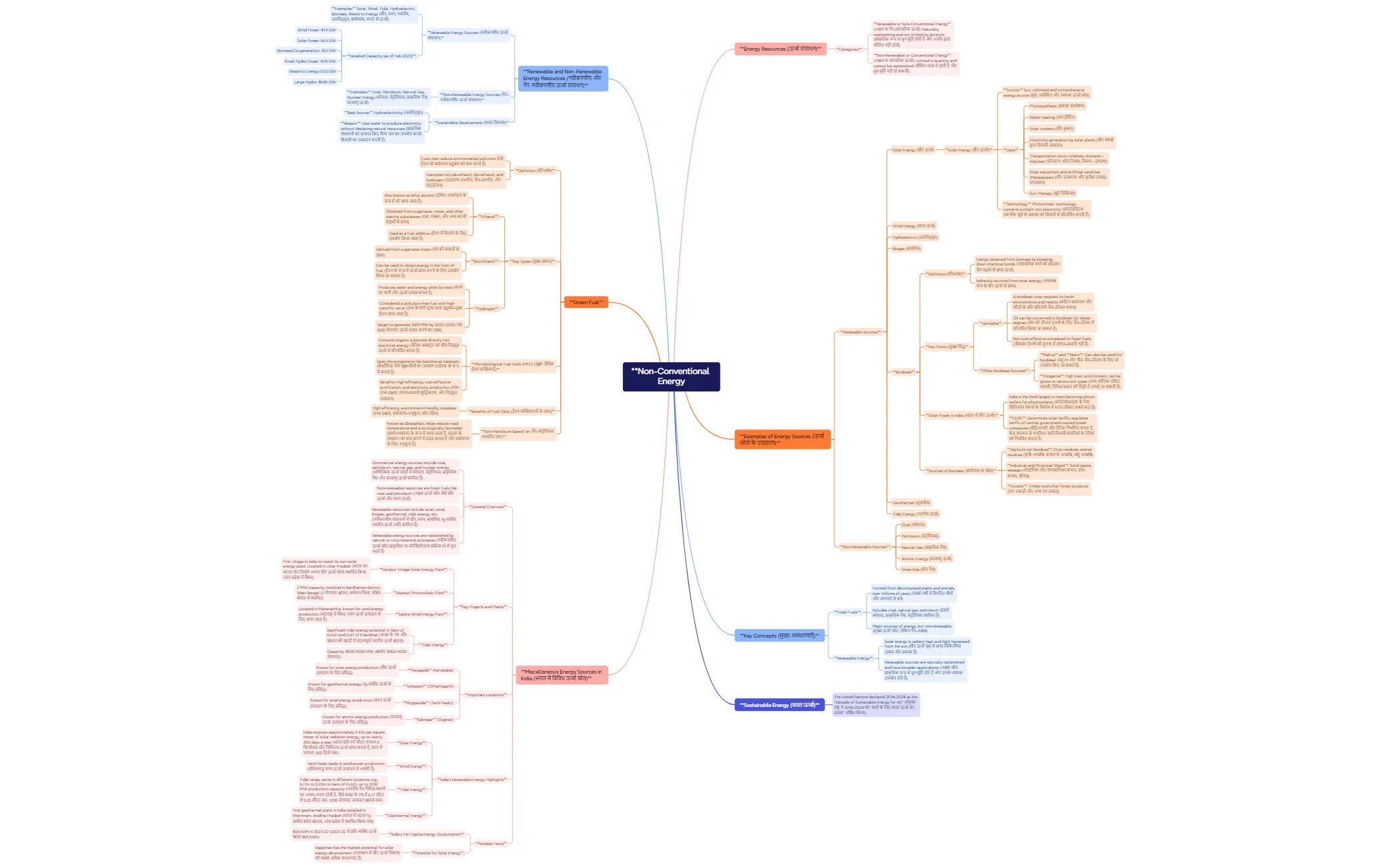
See the original map layoutमूल मानचित्र का स्वरूप देखें
Tap the image to open its full preview. Read individual branches below for comfortable revision.पूरा पूर्वावलोकन खोलने के लिए चित्र पर टैप करें। आसानी से पढ़ने के लिए नीचे शाखाएँ देखें।
Read the branchesशाखाएँ पढ़ें
Non-Conventional Energy
Non-Conventional Energy
Energy Resources (ऊर्जा संसाधन)
Categories:
Renewable or Non-Conventional Energy (अक्षय या गैर-पारंपरिक ऊर्जा): Naturally replenishing and not limited by duration (प्राकृतिक रूप से पुनःपूर्ति होती है और अवधि द्वारा सीमित नहीं होती)
Non-Renewable or Conventional Energy (अक्षय या पारंपरिक ऊर्जा): Limited in quantity and cannot be replenished (सीमित मात्रा में होती है और पुनःपूर्ति नहीं हो सकती)
Examples of Energy Sources (ऊर्जा स्रोतों के उदाहरण)
Renewable Sources:
Solar Energy (सौर ऊर्जा)
Solar Energy (सौर ऊर्जा)
Source: Sun, unlimited and comprehensive energy source (सूर्य, असीमित और व्यापक ऊर्जा स्रोत)
Uses:
Photosynthesis (प्रकाश संश्लेषण)
Water heating (जल हीटिंग)
Solar cookers (सौर कुकर)
Electricity generation by solar plants (सौर संयंत्रों द्वारा बिजली उत्पादन)
Transportation (Auto rickshaw, Airplane - Impulse) (परिवहन: ऑटो रिक्शा, विमान - इम्पल्स)
Solar equipment and Artificial satellites (Mangalyaan) (सौर उपकरण और कृत्रिम उपग्रह: मंगलयान)
Sun Therapy (सूर्य चिकित्सा)
Technology: Photovoltaic technology converts sunlight into electricity (फोटोवोल्टिक तकनीक सूर्य के प्रकाश को बिजली में परिवर्तित करती है)
Wind Energy (पवन ऊर्जा)
Hydroelectric (जलविद्युत)
Biogas (बायोगैस)
Biodiesel
Definition (परिभाषा)
Energy obtained from biomass by breaking down chemical bonds (रासायनिक बंधों को तोड़कर जैव पदार्थ से प्राप्त ऊर्जा)
Indirectly sourced from solar energy (अप्रत्यक्ष रूप से सौर ऊर्जा से प्राप्त)
Key Points (मुख्य बिंदु)
Jatropha:
A biodiesel crop resistant to harsh environments and insects (कठिन पर्यावरण और कीड़ों के प्रति प्रतिरोधी जैव-डीजल फसल)
Oil can be converted to biodiesel for diesel engines (तेल को डीजल इंजनों के लिए जैव-डीजल में परिवर्तित किया जा सकता है)
Not cost-effective compared to fossil fuels (जीवाश्म ईंधनों की तुलना में लागत-प्रभावी नहीं है)
Other Biodiesel Sources:
Mahua and Neem: Can also be used for biodiesel (महुआ और नीम: जैव-डीजल के लिए भी उपयोग किए जा सकते हैं)
Pongamia: High oleic acid content, can be grown in various soil types (उच्च ओलिक एसिड सामग्री, विभिन्न प्रकार की मिट्टी में उगाई जा सकती है)
Solar Power in India (भारत में सौर ऊर्जा)
India is the third largest in manufacturing silicon wafers for photovoltaics (फोटोवोल्टाइक के लिए सिलिकॉन वेफर्स के निर्माण में भारत तीसरा सबसे बड़ा है)
CERC: Determines solar tariffs, regulates tariffs of central government-owned power companies (सीईआरसी: सौर टैरिफ निर्धारित करता है, केंद्र सरकार के स्वामित्व वाली बिजली कंपनियों के टैरिफ को नियंत्रित करता है)
Sources of Biomass (बायोमास के स्रोत)
Agricultural Residues: Crop residues, animal residues (कृषि अवशेष: फसल के अवशेष, पशु अवशेष)
Industrial and Municipal Waste: Solid waste, sewage (औद्योगिक और नगरपालिका कचरा: ठोस कचरा, सीवेज)
Forests: Timber and other forest products (वन: लकड़ी और अन्य वन उत्पाद)
Geothermal (भूतापीय)
Tidal Energy (ज्वारीय ऊर्जा)
Non-Renewable Sources:
Coal (कोयला)
Petroleum (पेट्रोलियम)
Natural Gas (प्राकृतिक गैस)
Atomic Energy (परमाणु ऊर्जा)
Shale Gas (शेल गैस)
Key Concepts (मुख्य अवधारणाएँ)
Fossil Fuels:
Formed from decomposed plants and animals over millions of years (लाखों वर्षों में विघटित पौधों और जानवरों से बने)
Includes coal, natural gas, petroleum (इसमें कोयला, प्राकृतिक गैस, पेट्रोलियम शामिल हैं)
Major sources of energy, but non-renewable (मुख्य ऊर्जा स्रोत, लेकिन गैर-अक्षय)
Renewable Energy:
Solar energy is radiant heat and light harnessed from the sun (सौर ऊर्जा सूर्य से प्राप्त विकिरणित ऊष्मा और प्रकाश है)
Renewable sources are naturally replenished and have broader applications (अक्षय स्रोत प्राकृतिक रूप से पुनःपूर्ति होते हैं और उनके व्यापक उपयोग होते हैं)
Sustainable Energy (सतत ऊर्जा)
The United Nations declared 2014-2024 as the "Decade of Sustainable Energy for All" (संयुक्त राष्ट्र ने 2014-2024 को "सभी के लिए सतत ऊर्जा का दशक" घोषित किया)
Miscellaneous Energy Sources in India (भारत में विविध ऊर्जा स्रोत)
General Overview
Commercial energy sources include coal, petroleum, natural gas, and nuclear energy (वाणिज्यिक ऊर्जा स्रोतों में कोयला, पेट्रोलियम, प्राकृतिक गैस और परमाणु ऊर्जा शामिल हैं)
Non-renewable resources are fossil fuels like coal and petroleum (अक्षय ऊर्जा स्रोत जैसे सौर ऊर्जा और पवन ऊर्जा)
Renewable resources include solar, wind, biogas, geothermal, tidal energy, etc. (नवीकरणीय संसाधनों में सौर, पवन, बायोगैस, भू-तापीय, ज्वारीय ऊर्जा आदि शामिल हैं)
Renewable energy sources are replenished by natural or circumstantial processes (नवीकरणीय ऊर्जा स्रोत प्राकृतिक या परिस्थितिजन्य प्रक्रियाओं से पुनः भरते हैं)
Key Projects and Plants
Rampur Village Solar Energy Plant:
First village in India to install its own solar energy plant, located in Uttar Pradesh (भारत का पहला गांव जिसने अपना सौर ऊर्जा संयंत्र स्थापित किया, उत्तर प्रदेश में स्थित)
Asansol Photovoltaic Plant:
2 MW capacity, installed in Bardhaman district, West Bengal (2 मेगावाट क्षमता, बर्धमान जिला, पश्चिम बंगाल में स्थापित)
Satara Wind Energy Plant:
Located in Maharashtra, known for wind energy production (महाराष्ट्र में स्थित, पवन ऊर्जा उत्पादन के लिए जाना जाता है)
Tidal Energy:
Significant tidal energy potential in Rann of Kutch and Gulf of Khambhat (कच्छ के रण और खंभात की खाड़ी में महत्वपूर्ण ज्वारीय ऊर्जा क्षमता)
Capacity: 8000-9000 MW (क्षमता: 8000-9000 मेगावाट)
Important Locations
Pavagada (Karnataka):
Known for solar energy production (सौर ऊर्जा उत्पादन के लिए प्रसिद्ध)
Tattapani (Chhattisgarh):
Known for geothermal energy (भू-तापीय ऊर्जा के लिए प्रसिद्ध)
Muppandal (Tamil Nadu):
Known for wind energy production (पवन ऊर्जा उत्पादन के लिए प्रसिद्ध)
Kakrapar (Gujarat):
Known for atomic energy production (परमाणु ऊर्जा उत्पादन के लिए प्रसिद्ध)
India's Renewable Energy Highlights
Solar Energy:
India receives approximately 5 kW per square meter of solar radiation energy, up to nearly 300 days a year (भारत प्रति वर्ग मीटर लगभग 5 किलोवाट सौर विकिरण ऊर्जा प्राप्त करता है, साल में लगभग 300 दिनों तक)
Wind Energy:
Tamil Nadu leads in wind power production (तमिलनाडु पवन ऊर्जा उत्पादन में अग्रणी है)
Tidal Energy:
Tidal range varies in different locations, e.g., 6.77m to 5.23m in Rann of Kutch, up to 1200 MW production capacity (ज्वारीय रेंज विभिन्न स्थानों पर अलग-अलग होती है, जैसे कच्छ के रण में 6.77 मीटर से 5.23 मीटर तक, 1200 मेगावाट उत्पादन क्षमता तक)
Geothermal Energy:
First geothermal plant in India installed in Khammam, Andhra Pradesh (भारत में पहला भू-तापीय संयंत्र खम्मम, आंध्र प्रदेश में स्थापित किया गया)
Notable Facts
India's Per Capita Energy Consumption:
805 kWh in 2021-22 (2021-22 में प्रति व्यक्ति ऊर्जा खपत 805 kWh)
Potential for Solar Energy:
Rajasthan has the highest potential for solar energy development (राजस्थान में सौर ऊर्जा विकास की सबसे अधिक संभावनाएं हैं)
Green Fuel
Definition (परिभाषा)
Fuels that reduce environmental pollution (ऐसे ईंधन जो पर्यावरण प्रदूषण को कम करते हैं)
Examples include ethanol, bio-ethanol, and hydrogen (उदाहरण: एथनॉल, जैव-एथनॉल, और हाइड्रोजन)
Key Types (मुख्य प्रकार)
Ethanol:
Also known as ethyl alcohol (एथिल अल्कोहल के रूप में भी जाना जाता है)
Obtained from sugarcane, maize, and other starchy substances (गन्ना, मक्का, और अन्य स्टार्ची पदार्थों से प्राप्त)
Used as a fuel additive (ईंधन में मिलाने के लिए उपयोग किया जाता है)
Bio-Ethanol:
Derived from sugarcane crops (गन्ने की फसलों से प्राप्त)
Can be used to obtain energy in the form of fuel (ईंधन के रूप में ऊर्जा प्राप्त करने के लिए उपयोग किया जा सकता है)
Hydrogen:
Produces water and energy when burned (जलने पर पानी और ऊर्जा उत्पन्न करता है)
Considered a pollution-free fuel with high calorific value (उच्च कैलोरी मूल्य वाला प्रदूषण-मुक्त ईंधन माना जाता है)
Target to generate 1000 MW by 2020 (2020 तक 1000 मेगावाट ऊर्जा उत्पन्न करने का लक्ष्य)
Microbiological Fuel Cells (MFC) (सूक्ष्म जैविक ईंधन कोशिकाएँ)
Converts organic substrate directly into electrical energy (जैविक सब्सट्रेट को सीधे विद्युत ऊर्जा में परिवर्तित करता है)
Uses microorganisms like bacteria as catalysts (बैक्टीरिया जैसे सूक्ष्मजीवों का उपयोग उत्प्रेरक के रूप में करता है)
Benefits: High efficiency, cost-effective purification, and electricity production (लाभ: उच्च दक्षता, लागत-प्रभावी शुद्धिकरण, और विद्युत उत्पादन)
Benefits of Fuel Cells (ईंधन कोशिकाओं के लाभ)
High efficiency, environment-friendly, noiseless (उच्च दक्षता, पर्यावरण-अनुकूल, शोर रहित)
Non-Petroleum Based Tar (गैर-पेट्रोलियम आधारित तार)
Known as Bioasphalt, helps reduce road temperature and is ecologically favorable (बायोअस्फाल्ट के रूप में जाना जाता है, सड़क के तापमान को कम करने में मदद करता है और पर्यावरण के लिए अनुकूल है)
Renewable and Non-Renewable Energy Resources (नवीकरणीय और गैर-नवीकरणीय ऊर्जा संसाधन)
Renewable Energy Sources (नवीकरणीय ऊर्जा संसाधन)
Examples: Solar, Wind, Tidal, Hydroelectric, Biomass, Waste to Energy (सौर, पवन, ज्वारीय, जलविद्युत, बायोमास, कचरे से ऊर्जा)
Installed Capacity (as of Feb 2023):
Wind Power: 41.9 GW
Solar Power: 63.3 GW
Biomass/Co-generation: 10.2 GW
Small Hydro Power: 4.93 GW
Waste to Energy: 0.52 GW
Large Hydro: 46.85 GW
Non-Renewable Energy Sources (गैर-नवीकरणीय ऊर्जा संसाधन)
Examples: Coal, Petroleum, Natural Gas, Nuclear Energy (कोयला, पेट्रोलियम, प्राकृतिक गैस, परमाणु ऊर्जा)
Sustainable Development (सतत विकास)
Best Source: Hydroelectricity (जलविद्युत)
Reason: Uses water to produce electricity without depleting natural resources (प्राकृतिक संसाधनों को समाप्त किए बिना जल का उपयोग करके बिजली का उत्पादन करती है)