Mind Mapsमाइंड मैप्स › Environmentपर्यावरण
Forests and Conservation — mind mapमाइंड मैप
Original study maps by Rishabh Singh. Read dated facts in their exam-year context. Sources & corrections.ऋषभ सिंह के मूल अध्ययन मानचित्र। पुराने तथ्यों को संबंधित परीक्षा वर्ष के संदर्भ में पढ़ें। स्रोत और सुधार।
31 branches and entriesशाखाएँ और बिंदु · 1 sheet(s)शीट
See the original map layoutमूल मानचित्र का स्वरूप देखें
Tap the image to open its full preview. Read individual branches below for comfortable revision.पूरा पूर्वावलोकन खोलने के लिए चित्र पर टैप करें। आसानी से पढ़ने के लिए नीचे शाखाएँ देखें।
Read the branchesशाखाएँ पढ़ें
Forests and Conservation
Forests and Conservation
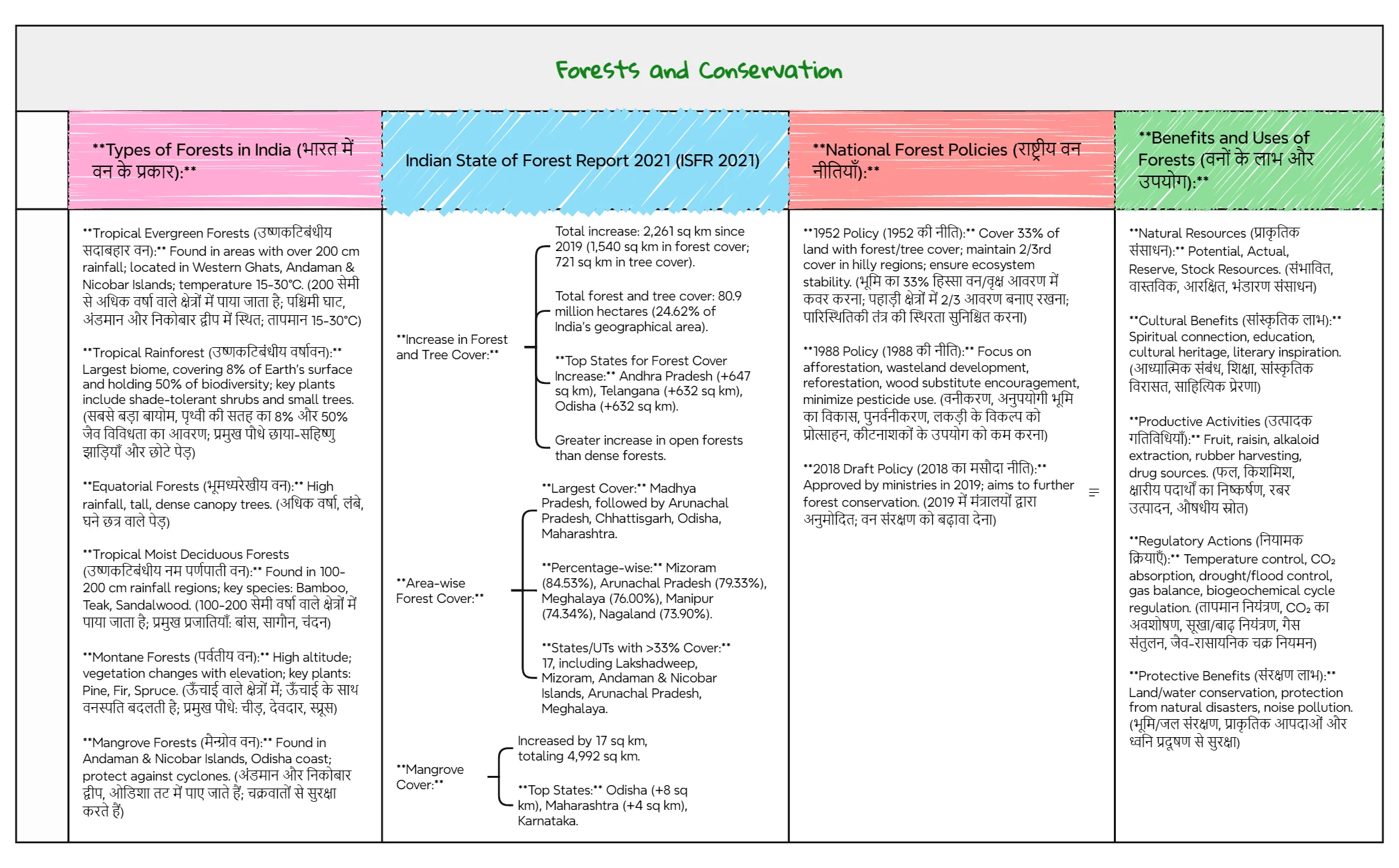
Types of Forests in India (भारत में वन के प्रकार):
Tropical Evergreen Forests (उष्णकटिबंधीय सदाबहार वन): Found in areas with over 200 cm rainfall; located in Western Ghats, Andaman & Nicobar Islands; temperature 15-30°C. (200 सेमी से अधिक वर्षा वाले क्षेत्रों में पाया जाता है; पश्चिमी घाट, अंडमान और निकोबार द्वीप में स्थित; तापमान 15-30°C)
Tropical Rainforest (उष्णकटिबंधीय वर्षावन): Largest biome, covering 8% of Earth's surface and holding 50% of biodiversity; key plants include shade-tolerant shrubs and small trees. (सबसे बड़ा बायोम, पृथ्वी की सतह का 8% और 50% जैव विविधता का आवरण; प्रमुख पौधे छाया-सहिष्णु झाड़ियाँ और छोटे पेड़)
Equatorial Forests (भूमध्यरेखीय वन): High rainfall, tall, dense canopy trees. (अधिक वर्षा, लंबे, घने छत्र वाले पेड़)
Tropical Moist Deciduous Forests (उष्णकटिबंधीय नम पर्णपाती वन): Found in 100-200 cm rainfall regions; key species: Bamboo, Teak, Sandalwood. (100-200 सेमी वर्षा वाले क्षेत्रों में पाया जाता है; प्रमुख प्रजातियाँ: बांस, सागौन, चंदन)
Montane Forests (पर्वतीय वन): High altitude; vegetation changes with elevation; key plants: Pine, Fir, Spruce. (ऊँचाई वाले क्षेत्रों में; ऊँचाई के साथ वनस्पति बदलती है; प्रमुख पौधे: चीड़, देवदार, स्प्रूस)
Mangrove Forests (मैन्ग्रोव वन): Found in Andaman & Nicobar Islands, Odisha coast; protect against cyclones. (अंडमान और निकोबार द्वीप, ओडिशा तट में पाए जाते हैं; चक्रवातों से सुरक्षा करते हैं)
Indian State of Forest Report 2021 (ISFR 2021)
Increase in Forest and Tree Cover:
Total increase: 2,261 sq km since 2019 (1,540 sq km in forest cover; 721 sq km in tree cover).
Total forest and tree cover: 80.9 million hectares (24.62% of India's geographical area).
Top States for Forest Cover Increase: Andhra Pradesh (+647 sq km), Telangana (+632 sq km), Odisha (+632 sq km).
Greater increase in open forests than dense forests.
Area-wise Forest Cover:
Largest Cover: Madhya Pradesh, followed by Arunachal Pradesh, Chhattisgarh, Odisha, Maharashtra.
Percentage-wise: Mizoram (84.53%), Arunachal Pradesh (79.33%), Meghalaya (76.00%), Manipur (74.34%), Nagaland (73.90%).
States/UTs with >33% Cover: 17, including Lakshadweep, Mizoram, Andaman & Nicobar Islands, Arunachal Pradesh, Meghalaya.
Mangrove Cover:
Increased by 17 sq km, totaling 4,992 sq km.
Top States: Odisha (+8 sq km), Maharashtra (+4 sq km), Karnataka.
National Forest Policies (राष्ट्रीय वन नीतियाँ):
1952 Policy (1952 की नीति): Cover 33% of land with forest/tree cover; maintain 2/3rd cover in hilly regions; ensure ecosystem stability. (भूमि का 33% हिस्सा वन/वृक्ष आवरण में कवर करना; पहाड़ी क्षेत्रों में 2/3 आवरण बनाए रखना; पारिस्थितिकी तंत्र की स्थिरता सुनिश्चित करना)
1988 Policy (1988 की नीति): Focus on afforestation, wasteland development, reforestation, wood substitute encouragement, minimize pesticide use. (वनीकरण, अनुपयोगी भूमि का विकास, पुनर्वनीकरण, लकड़ी के विकल्प को प्रोत्साहन, कीटनाशकों के उपयोग को कम करना)
2018 Draft Policy (2018 का मसौदा नीति): Approved by ministries in 2019; aims to further forest conservation. (2019 में मंत्रालयों द्वारा अनुमोदित; वन संरक्षण को बढ़ावा देना)
4o<br>
Benefits and Uses of Forests (वनों के लाभ और उपयोग):
Natural Resources (प्राकृतिक संसाधन): Potential, Actual, Reserve, Stock Resources. (संभावित, वास्तविक, आरक्षित, भंडारण संसाधन)
Cultural Benefits (सांस्कृतिक लाभ): Spiritual connection, education, cultural heritage, literary inspiration. (आध्यात्मिक संबंध, शिक्षा, सांस्कृतिक विरासत, साहित्यिक प्रेरणा)
Productive Activities (उत्पादक गतिविधियाँ): Fruit, raisin, alkaloid extraction, rubber harvesting, drug sources. (फल, किशमिश, क्षारीय पदार्थों का निष्कर्षण, रबर उत्पादन, औषधीय स्रोत)
Regulatory Actions (नियामक क्रियाएँ): Temperature control, CO₂ absorption, drought/flood control, gas balance, biogeochemical cycle regulation. (तापमान नियंत्रण, CO₂ का अवशोषण, सूखा/बाढ़ नियंत्रण, गैस संतुलन, जैव-रासायनिक चक्र नियमन)
Protective Benefits (संरक्षण लाभ): Land/water conservation, protection from natural disasters, noise pollution. (भूमि/जल संरक्षण, प्राकृतिक आपदाओं और ध्वनि प्रदूषण से सुरक्षा)