Mind Mapsमाइंड मैप्स › Environmentपर्यावरण
Climate /Rainfall — mind mapमाइंड मैप
Original study maps by Rishabh Singh. Read dated facts in their exam-year context. Sources & corrections.ऋषभ सिंह के मूल अध्ययन मानचित्र। पुराने तथ्यों को संबंधित परीक्षा वर्ष के संदर्भ में पढ़ें। स्रोत और सुधार।
88 branches and entriesशाखाएँ और बिंदु · 1 sheet(s)शीट
See the original map layoutमूल मानचित्र का स्वरूप देखें
Tap the image to open its full preview. Read individual branches below for comfortable revision.पूरा पूर्वावलोकन खोलने के लिए चित्र पर टैप करें। आसानी से पढ़ने के लिए नीचे शाखाएँ देखें।
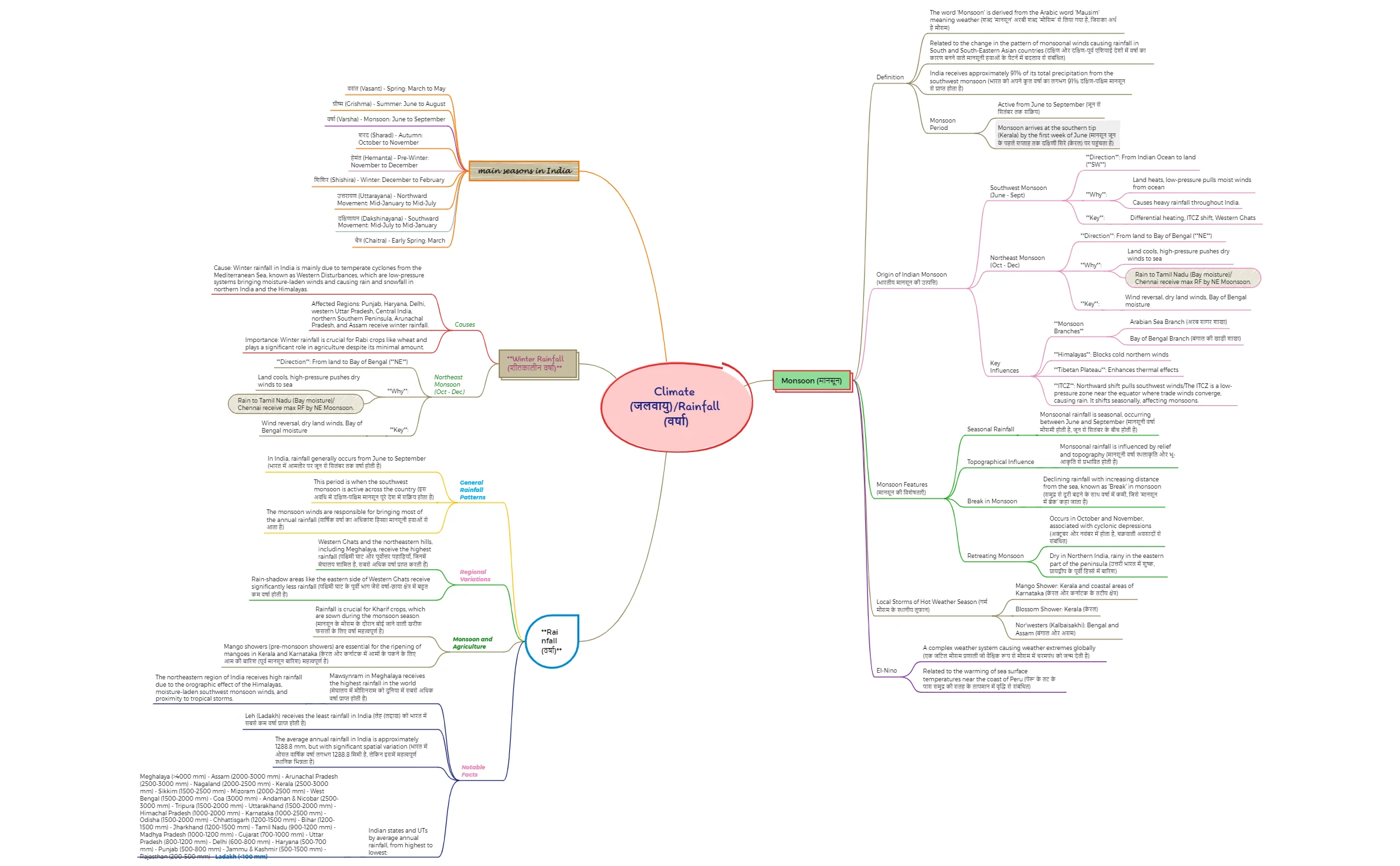
Read the branchesशाखाएँ पढ़ें
Climate (जलवायु)/Rainfall (वर्षा)
Climate (जलवायु)/Rainfall (वर्षा)
Monsoon (मानसून)
Definition
The word 'Monsoon' is derived from the Arabic word 'Mausim' meaning weather (शब्द 'मानसून' अरबी शब्द 'मौसिम' से लिया गया है, जिसका अर्थ है मौसम)
Related to the change in the pattern of monsoonal winds causing rainfall in South and South-Eastern Asian countries (दक्षिण और दक्षिण-पूर्व एशियाई देशों में वर्षा का कारण बनने वाले मानसूनी हवाओं के पैटर्न में बदलाव से संबंधित)
India receives approximately 91% of its total precipitation from the southwest monsoon (भारत को अपने कुल वर्षा का लगभग 91% दक्षिण-पश्चिम मानसून से प्राप्त होता है)
Monsoon Period
Active from June to September (जून से सितंबर तक सक्रिय)
Monsoon arrives at the southern tip (Kerala) by the first week of June (मानसून जून के पहले सप्ताह तक दक्षिणी सिरे (केरल) पर पहुंचता है)
Origin of Indian Monsoon (भारतीय मानसून की उत्पत्ति)
Southwest Monsoon (June - Sept)
Direction: From Indian Ocean to land (SW)
Why:
Land heats, low-pressure pulls moist winds from ocean
Causes heavy rainfall throughout India.
Key:
Differential heating, ITCZ shift, Western Ghats
Northeast Monsoon (Oct - Dec)
Direction: From land to Bay of Bengal (NE)
Why:
Land cools, high-pressure pushes dry winds to sea
Rain to Tamil Nadu (Bay moisture)/ Chennai receive max RF by NE Moonsoon.
Key:
Wind reversal, dry land winds, Bay of Bengal moisture
Key Influences
Monsoon Branches
Arabian Sea Branch (अरब सागर शाखा)
Bay of Bengal Branch (बंगाल की खाड़ी शाखा)
Himalayas: Blocks cold northern winds
Tibetan Plateau: Enhances thermal effects
ITCZ: Northward shift pulls southwest winds/The ITCZ is a low-pressure zone near the equator where trade winds converge, causing rain. It shifts seasonally, affecting monsoons.
Monsoon Features (मानसून की विशेषताएँ)
Seasonal Rainfall
Monsoonal rainfall is seasonal, occurring between June and September (मानसूनी वर्षा मौसमी होती है, जून से सितंबर के बीच होती है)
Topographical Influence
Monsoonal rainfall is influenced by relief and topography (मानसूनी वर्षा स्थलाकृति और भू-आकृति से प्रभावित होती है)
Break in Monsoon
Declining rainfall with increasing distance from the sea, known as 'Break' in monsoon (समुद्र से दूरी बढ़ने के साथ वर्षा में कमी, जिसे 'मानसून में ब्रेक' कहा जाता है)
Retreating Monsoon
Occurs in October and November, associated with cyclonic depressions (अक्टूबर और नवंबर में होता है, चक्रवाती अवसादों से संबंधित)
Dry in Northern India, rainy in the eastern part of the peninsula (उत्तरी भारत में शुष्क, प्रायद्वीप के पूर्वी हिस्से में बारिश)
Local Storms of Hot Weather Season (गर्म मौसम के स्थानीय तूफान)
Mango Shower: Kerala and coastal areas of Karnataka (केरल और कर्नाटक के तटीय क्षेत्र)
Blossom Shower: Kerala (केरल)
Nor'westers (Kalbaisakhi): Bengal and Assam (बंगाल और असम)
El-Nino
A complex weather system causing weather extremes globally (एक जटिल मौसम प्रणाली जो वैश्विक रूप से मौसम में चरमपंथ को जन्म देती है)
Related to the warming of sea surface temperatures near the coast of Peru (पेरू के तट के पास समुद्र की सतह के तापमान में वृद्धि से संबंधित)
Rainfall (वर्षा)
General Rainfall Patterns
In India, rainfall generally occurs from June to September (भारत में आमतौर पर जून से सितंबर तक वर्षा होती है)
This period is when the southwest monsoon is active across the country (इस अवधि में दक्षिण-पश्चिम मानसून पूरे देश में सक्रिय होता है)
The monsoon winds are responsible for bringing most of the annual rainfall (वार्षिक वर्षा का अधिकांश हिस्सा मानसूनी हवाओं से आता है)
Regional Variations
Western Ghats and the northeastern hills, including Meghalaya, receive the highest rainfall (पश्चिमी घाट और पूर्वोत्तर पहाड़ियाँ, जिनमें मेघालय शामिल है, सबसे अधिक वर्षा प्राप्त करती हैं)
Rain-shadow areas like the eastern side of Western Ghats receive significantly less rainfall (पश्चिमी घाट के पूर्वी भाग जैसे वर्षा-छाया क्षेत्र में बहुत कम वर्षा होती है)
Monsoon and Agriculture
Rainfall is crucial for Kharif crops, which are sown during the monsoon season (मानसून के मौसम के दौरान बोई जाने वाली खरीफ फसलों के लिए वर्षा महत्वपूर्ण है)
Mango showers (pre-monsoon showers) are essential for the ripening of mangoes in Kerala and Karnataka (केरल और कर्नाटक में आमों के पकने के लिए आम की बारिश (पूर्व मानसून बारिश) महत्वपूर्ण है)
Notable Facts
Mawsynram in Meghalaya receives the highest rainfall in the world (मेघालय में मौसिनराम को दुनिया में सबसे अधिक वर्षा प्राप्त होती है)
The northeastern region of India receives high rainfall due to the orographic effect of the Himalayas, moisture-laden southwest monsoon winds, and proximity to tropical storms.
Leh (Ladakh) receives the least rainfall in India (लेह (लद्दाख) को भारत में सबसे कम वर्षा प्राप्त होती है)
The average annual rainfall in India is approximately 1288.8 mm, but with significant spatial variation (भारत में औसत वार्षिक वर्षा लगभग 1288.8 मिमी है, लेकिन इसमें महत्वपूर्ण स्थानिक भिन्नता है)
Indian states and UTs by average annual rainfall, from highest to lowest:
Meghalaya (>4000 mm) - Assam (2000-3000 mm) - Arunachal Pradesh (2500-3000 mm) - Nagaland (2000-2500 mm) - Kerala (2500-3000 mm) - Sikkim (1500-2500 mm) - Mizoram (2000-2500 mm) - West Bengal (1500-2000 mm) - Goa (3000 mm) - Andaman & Nicobar (2500-3000 mm) - Tripura (1500-2000 mm) - Uttarakhand (1500-2000 mm) - Himachal Pradesh (1000-2000 mm) - Karnataka (1000-2500 mm) - Odisha (1500-2000 mm) - Chhattisgarh (1200-1500 mm) - Bihar (1200-1500 mm) - Jharkhand (1200-1500 mm) - Tamil Nadu (900-1200 mm) - Madhya Pradesh (1000-1200 mm) - Gujarat (700-1000 mm) - Uttar Pradesh (800-1200 mm) - Delhi (600-800 mm) - Haryana (500-700 mm) - Punjab (500-800 mm) - Jammu & Kashmir (500-1500 mm) - Rajasthan (200-500 mm) - Ladakh (<100 mm)
Winter Rainfall (शीतकालीन वर्षा)
Causes
Cause: Winter rainfall in India is mainly due to temperate cyclones from the Mediterranean Sea, known as Western Disturbances, which are low-pressure systems bringing moisture-laden winds and causing rain and snowfall in northern India and the Himalayas.
Affected Regions: Punjab, Haryana, Delhi, western Uttar Pradesh, Central India, northern Southern Peninsula, Arunachal Pradesh, and Assam receive winter rainfall.
Importance: Winter rainfall is crucial for Rabi crops like wheat and plays a significant role in agriculture despite its minimal amount.
Northeast Monsoon (Oct - Dec)
Direction: From land to Bay of Bengal (NE)
Why:
Land cools, high-pressure pushes dry winds to sea
Rain to Tamil Nadu (Bay moisture)/ Chennai receive max RF by NE Moonsoon.
Key:
Wind reversal, dry land winds, Bay of Bengal moisture
main seasons in India
वसंत (Vasant) - Spring: March to May
ग्रीष्म (Grishma) - Summer: June to August
वर्षा (Varsha) - Monsoon: June to September
शरद (Sharad) - Autumn: October to November
हेमंत (Hemanta) - Pre-Winter: November to December
शिशिर (Shishira) - Winter: December to February
उत्तरायण (Uttarayana) - Northward Movement: Mid-January to Mid-July
दक्षिणायन (Dakshinayana) - Southward Movement: Mid-July to Mid-January
चैत्र (Chaitra) - Early Spring: March