Mind Mapsमाइंड मैप्स › Environmentपर्यावरण
Biodiversity — mind mapमाइंड मैप
Original study maps by Rishabh Singh. Read dated facts in their exam-year context. Sources & corrections.ऋषभ सिंह के मूल अध्ययन मानचित्र। पुराने तथ्यों को संबंधित परीक्षा वर्ष के संदर्भ में पढ़ें। स्रोत और सुधार।
51 branches and entriesशाखाएँ और बिंदु · 1 sheet(s)शीट
See the original map layoutमूल मानचित्र का स्वरूप देखें
Tap the image to open its full preview. Read individual branches below for comfortable revision.पूरा पूर्वावलोकन खोलने के लिए चित्र पर टैप करें। आसानी से पढ़ने के लिए नीचे शाखाएँ देखें।
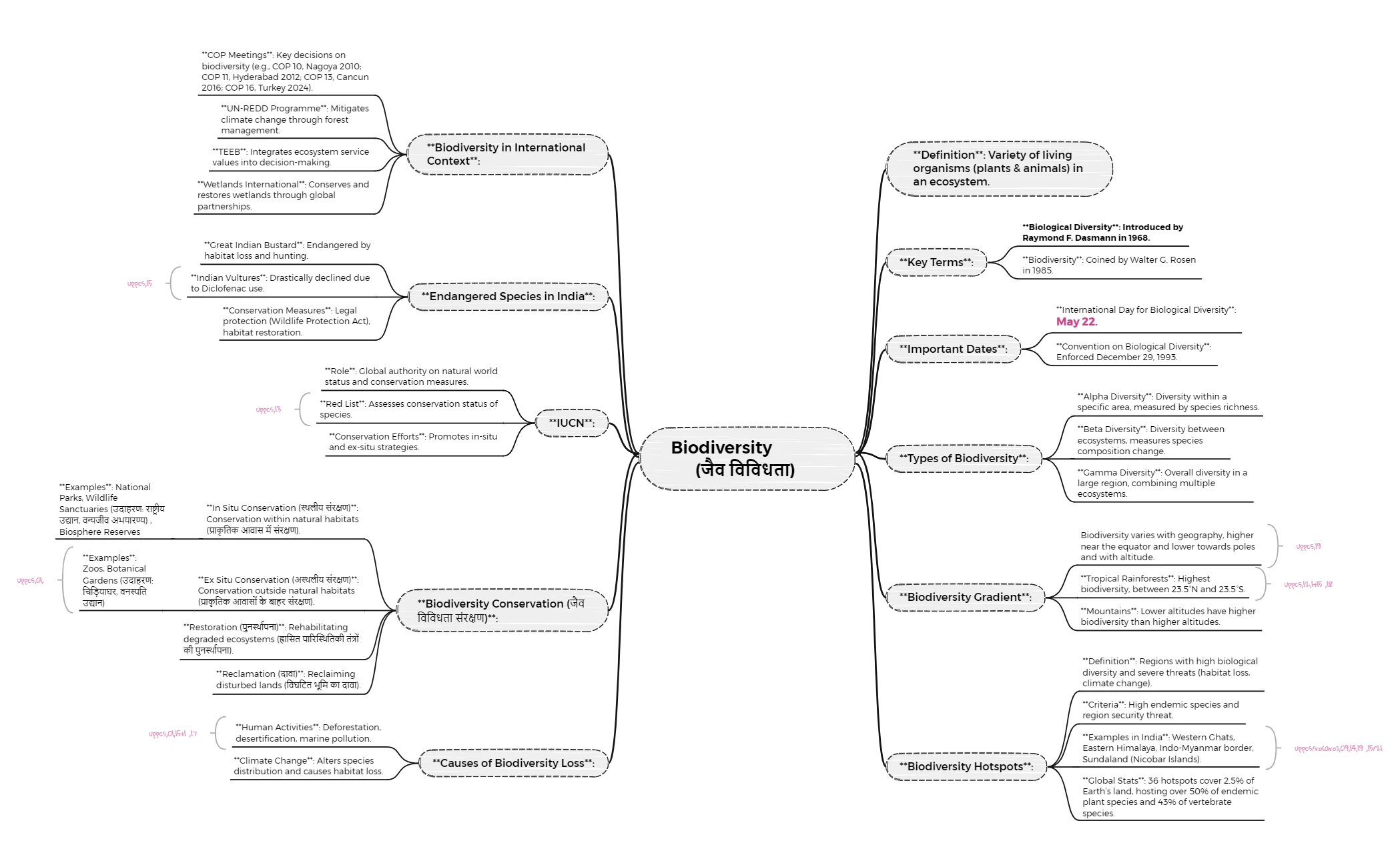
Read the branchesशाखाएँ पढ़ें
Biodiversity (जैव विविधता)
Biodiversity (जैव विविधता)
Definition: Variety of living organisms (plants & animals) in an ecosystem.
Key Terms:
Biological Diversity: Introduced by Raymond F. Dasmann in 1968.
Biodiversity: Coined by Walter G. Rosen in 1985.
Important Dates:
International Day for Biological Diversity: May 22.
Convention on Biological Diversity: Enforced December 29, 1993.
Types of Biodiversity:
Alpha Diversity: Diversity within a specific area, measured by species richness.
Beta Diversity: Diversity between ecosystems, measures species composition change.
Gamma Diversity: Overall diversity in a large region, combining multiple ecosystems.
Biodiversity Gradient:
Biodiversity varies with geography, higher near the equator and lower towards poles and with altitude.
Tropical Rainforests: Highest biodiversity, between 23.5°N and 23.5°S.
Mountains: Lower altitudes have higher biodiversity than higher altitudes.
uppcs,19
uppcs,12,1+15 ,18
Biodiversity Hotspots:
Definition: Regions with high biological diversity and severe threats (habitat loss, climate change).
Criteria: High endemic species and region security threat.
Examples in India: Western Ghats, Eastern Himalaya, Indo-Myanmar border, Sundaland (Nicobar Islands).
Global Stats: 36 hotspots cover 2.5% of Earth’s land, hosting over 50% of endemic plant species and 43% of vertebrate species.
uppcs/ro(aro),09,14,19 ,15/21
Causes of Biodiversity Loss:
Human Activities: Deforestation, desertification, marine pollution.
Climate Change: Alters species distribution and causes habitat loss.
uppcs,01,15+1 ,17
Biodiversity Conservation (जैव विविधता संरक्षण):
In Situ Conservation (स्थलीय संरक्षण): Conservation within natural habitats (प्राकृतिक आवास में संरक्षण).
Examples: National Parks, Wildlife Sanctuaries (उदाहरण: राष्ट्रीय उद्यान, वन्यजीव अभयारण्य) , Biosphere Reserves
Ex Situ Conservation (अस्थलीय संरक्षण): Conservation outside natural habitats (प्राकृतिक आवासों के बाहर संरक्षण).
Examples: Zoos, Botanical Gardens (उदाहरण: चिड़ियाघर, वनस्पति उद्यान)
uppcs,01,
Restoration (पुनर्स्थापना): Rehabilitating degraded ecosystems (ह्रासित पारिस्थितिकी तंत्रों की पुनर्स्थापना).
Reclamation (दावा): Reclaiming disturbed lands (विघटित भूमि का दावा).
IUCN:
Role: Global authority on natural world status and conservation measures.
Red List: Assesses conservation status of species.
Conservation Efforts: Promotes in-situ and ex-situ strategies.
uppcs,13
Endangered Species in India:
Great Indian Bustard: Endangered by habitat loss and hunting.
Indian Vultures: Drastically declined due to Diclofenac use.
Conservation Measures: Legal protection (Wildlife Protection Act), habitat restoration.
uppcs,15
Biodiversity in International Context:
COP Meetings: Key decisions on biodiversity (e.g., COP 10, Nagoya 2010; COP 11, Hyderabad 2012; COP 13, Cancun 2016; COP 16, Turkey 2024).
UN-REDD Programme: Mitigates climate change through forest management.
TEEB: Integrates ecosystem service values into decision-making.
Wetlands International: Conserves and restores wetlands through global partnerships.