Mind Mapsमाइंड मैप्स › Economy & Industriesअर्थव्यवस्था और उद्योग
Taxonomy — mind mapमाइंड मैप
Original study maps by Rishabh Singh. Read dated facts in their exam-year context. Sources & corrections.ऋषभ सिंह के मूल अध्ययन मानचित्र। पुराने तथ्यों को संबंधित परीक्षा वर्ष के संदर्भ में पढ़ें। स्रोत और सुधार।
55 branches and entriesशाखाएँ और बिंदु · 1 sheet(s)शीट
See the original map layoutमूल मानचित्र का स्वरूप देखें
Tap the image to open its full preview. Read individual branches below for comfortable revision.पूरा पूर्वावलोकन खोलने के लिए चित्र पर टैप करें। आसानी से पढ़ने के लिए नीचे शाखाएँ देखें।
Read the branchesशाखाएँ पढ़ें
Taxonomy
Taxonomy
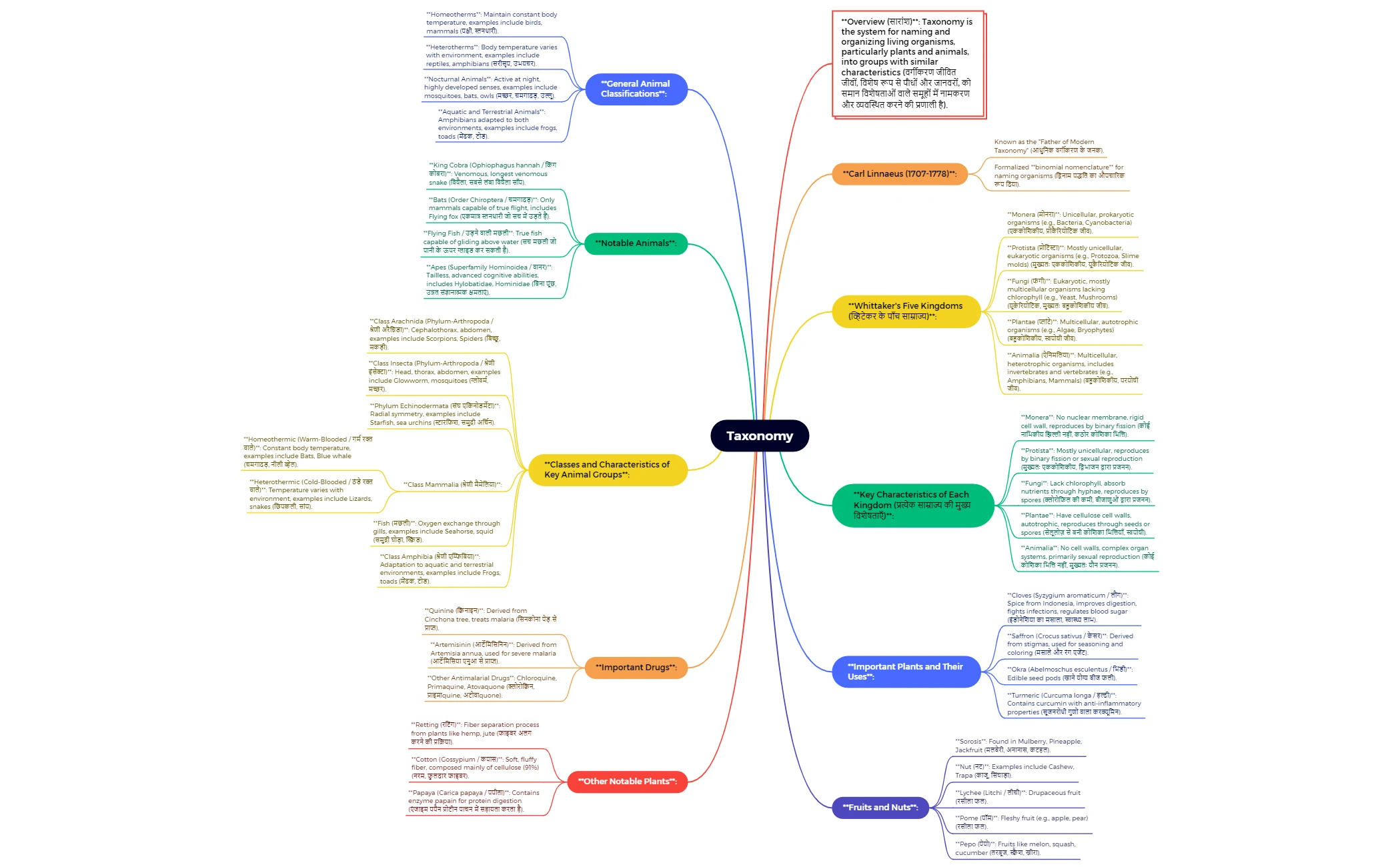
Overview (सारांश): Taxonomy is the system for naming and organizing living organisms, particularly plants and animals, into groups with similar characteristics (वर्गीकरण जीवित जीवों, विशेष रूप से पौधों और जानवरों, को समान विशेषताओं वाले समूहों में नामकरण और व्यवस्थित करने की प्रणाली है).
Carl Linnaeus (1707-1778):
Known as the "Father of Modern Taxonomy" (आधुनिक वर्गीकरण के जनक).
Formalized binomial nomenclature for naming organisms (द्विनाम पद्धति का औपचारिक रूप दिया).
Whittaker's Five Kingdoms (व्हिटेकर के पाँच साम्राज्य):
Monera (मोनरा): Unicellular, prokaryotic organisms (e.g., Bacteria, Cyanobacteria) (एककोशिकीय, प्रोकैरियोटिक जीव).
Protista (प्रोटिस्टा): Mostly unicellular, eukaryotic organisms (e.g., Protozoa, Slime molds) (मुख्यतः एककोशिकीय, यूकैरियोटिक जीव).
Fungi (फंगी): Eukaryotic, mostly multicellular organisms lacking chlorophyll (e.g., Yeast, Mushrooms) (यूकेरियोटिक, मुख्यतः बहुकोशिकीय जीव).
Plantae (प्लांटे): Multicellular, autotrophic organisms (e.g., Algae, Bryophytes) (बहुकोशिकीय, स्वपोषी जीव).
Animalia (ऐनिमलिया): Multicellular, heterotrophic organisms, includes invertebrates and vertebrates (e.g., Amphibians, Mammals) (बहुकोशिकीय, परपोषी जीव).
Key Characteristics of Each Kingdom (प्रत्येक साम्राज्य की मुख्य विशेषताएँ):
Monera: No nuclear membrane, rigid cell wall, reproduces by binary fission (कोई नाभिकीय झिल्ली नहीं, कठोर कोशिका भित्ति).
Protista: Mostly unicellular, reproduces by binary fission or sexual reproduction (मुख्यतः एककोशिकीय, द्विभाजन द्वारा प्रजनन).
Fungi: Lack chlorophyll, absorb nutrients through hyphae, reproduces by spores (क्लोरोफिल की कमी, बीजाणुओं द्वारा प्रजनन).
Plantae: Have cellulose cell walls, autotrophic, reproduces through seeds or spores (सेलूलोज़ से बनी कोशिका भित्तियाँ, स्वपोषी).
Animalia: No cell walls, complex organ systems, primarily sexual reproduction (कोई कोशिका भित्ति नहीं, मुख्यतः यौन प्रजनन).
Important Plants and Their Uses:
Cloves (Syzygium aromaticum / लौंग): Spice from Indonesia, improves digestion, fights infections, regulates blood sugar (इंडोनेशिया का मसाला, स्वास्थ्य लाभ).
Saffron (Crocus sativus / केसर): Derived from stigmas, used for seasoning and coloring (मसाले और रंग एजेंट).
Okra (Abelmoschus esculentus / भिंडी): Edible seed pods (खाने योग्य बीज फली).
Turmeric (Curcuma longa / हल्दी): Contains curcumin with anti-inflammatory properties (सूजनरोधी गुणों वाला करक्यूमिन).
Fruits and Nuts:
Sorosis: Found in Mulberry, Pineapple, Jackfruit (मलबेरी, अनानास, कटहल).
Nut (नट): Examples include Cashew, Trapa (काजू, सिंघाड़ा).
Lychee (Litchi / लीची): Drupaceous fruit (रसीला फल).
Pome (पॉम): Fleshy fruit (e.g., apple, pear) (रसीला फल).
Pepo (पेपो): Fruits like melon, squash, cucumber (तरबूज, स्क्वैश, खीरा).
Other Notable Plants:
Retting (रटिंग): Fiber separation process from plants like hemp, jute (फाइबर अलग करने की प्रक्रिया).
Cotton (Gossypium / कपास): Soft, fluffy fiber, composed mainly of cellulose (91%) (नरम, फुलदार फाइबर).
Papaya (Carica papaya / पपीता): Contains enzyme papain for protein digestion (एंजाइम पपैन प्रोटीन पाचन में सहायता करता है).
Important Drugs:
Quinine (क्विनाइन): Derived from Cinchona tree, treats malaria (सिनकोना पेड़ से प्राप्त).
Artemisinin (आर्टेमिसिनिन): Derived from Artemisia annua, used for severe malaria (आर्टेमिसिया एनुआ से प्राप्त).
Other Antimalarial Drugs: Chloroquine, Primaquine, Atovaquone (क्लोरोक्विन, प्राइमाquine, अटोवाquone).
Classes and Characteristics of Key Animal Groups:
Class Arachnida (Phylum-Arthropoda / श्रेणी अरैच्निडा): Cephalothorax, abdomen, examples include Scorpions, Spiders (बिच्छू, मकड़ी).
Class Insecta (Phylum-Arthropoda / श्रेणी इंसेक्टा): Head, thorax, abdomen, examples include Glowworm, mosquitoes (ग्लोवर्म, मच्छर).
Phylum Echinodermata (संघ एकिनोडर्मेटा): Radial symmetry, examples include Starfish, sea urchins (स्टारफिश, समुद्री अर्चिन).
Class Mammalia (श्रेणी मैमेलिया):
Homeothermic (Warm-Blooded / गर्म रक्त वाले): Constant body temperature, examples include Bats, Blue whale (चमगादड़, नीली व्हेल).
Heterothermic (Cold-Blooded / ठंडे रक्त वाले): Temperature varies with environment, examples include Lizards, snakes (छिपकली, सांप).
Fish (मछली): Oxygen exchange through gills, examples include Seahorse, squid (समुद्री घोड़ा, स्क्विड).
Class Amphibia (श्रेणी एम्फिबिया): Adaptation to aquatic and terrestrial environments, examples include Frogs, toads (मेंढक, टोड).
Notable Animals:
King Cobra (Ophiophagus hannah / किंग कोबरा): Venomous, longest venomous snake (विषैला, सबसे लंबा विषैला साँप).
Bats (Order Chiroptera / चमगादड़): Only mammals capable of true flight, includes Flying fox (एकमात्र स्तनधारी जो सच में उड़ते हैं).
Flying Fish / उड़ने वाली मछली: True fish capable of gliding above water (सच मछली जो पानी के ऊपर ग्लाइड कर सकती है).
Apes (Superfamily Hominoidea / वानर): Tailless, advanced cognitive abilities, includes Hylobatidae, Hominidae (बिना पूंछ, उन्नत संज्ञानात्मक क्षमताएं).
General Animal Classifications:
Homeotherms: Maintain constant body temperature, examples include birds, mammals (पक्षी, स्तनधारी).
Heterotherms: Body temperature varies with environment, examples include reptiles, amphibians (सरीसृप, उभयचर).
Nocturnal Animals: Active at night, highly developed senses, examples include mosquitoes, bats, owls (मच्छर, चमगादड़, उल्लू).
Aquatic and Terrestrial Animals: Amphibians adapted to both environments, examples include frogs, toads (मेंढक, टोड).
← More Economy & Industries mapsअर्थव्यवस्था और उद्योग के अन्य मानचित्र