Mind Mapsमाइंड मैप्स › Chemistryरसायन विज्ञान
Physical and Chemical Changes, Solutions — mind mapमाइंड मैप
Original study maps by Rishabh Singh. Read dated facts in their exam-year context. Sources & corrections.ऋषभ सिंह के मूल अध्ययन मानचित्र। पुराने तथ्यों को संबंधित परीक्षा वर्ष के संदर्भ में पढ़ें। स्रोत और सुधार।
21 branches and entriesशाखाएँ और बिंदु · 1 sheet(s)शीट
See the original map layoutमूल मानचित्र का स्वरूप देखें
Tap the image to open its full preview. Read individual branches below for comfortable revision.पूरा पूर्वावलोकन खोलने के लिए चित्र पर टैप करें। आसानी से पढ़ने के लिए नीचे शाखाएँ देखें।
Read the branchesशाखाएँ पढ़ें
Physical and Chemical Changes, Solutions
Physical and Chemical Changes, Solutions
Physical Changes (भौतिक परिवर्तन)
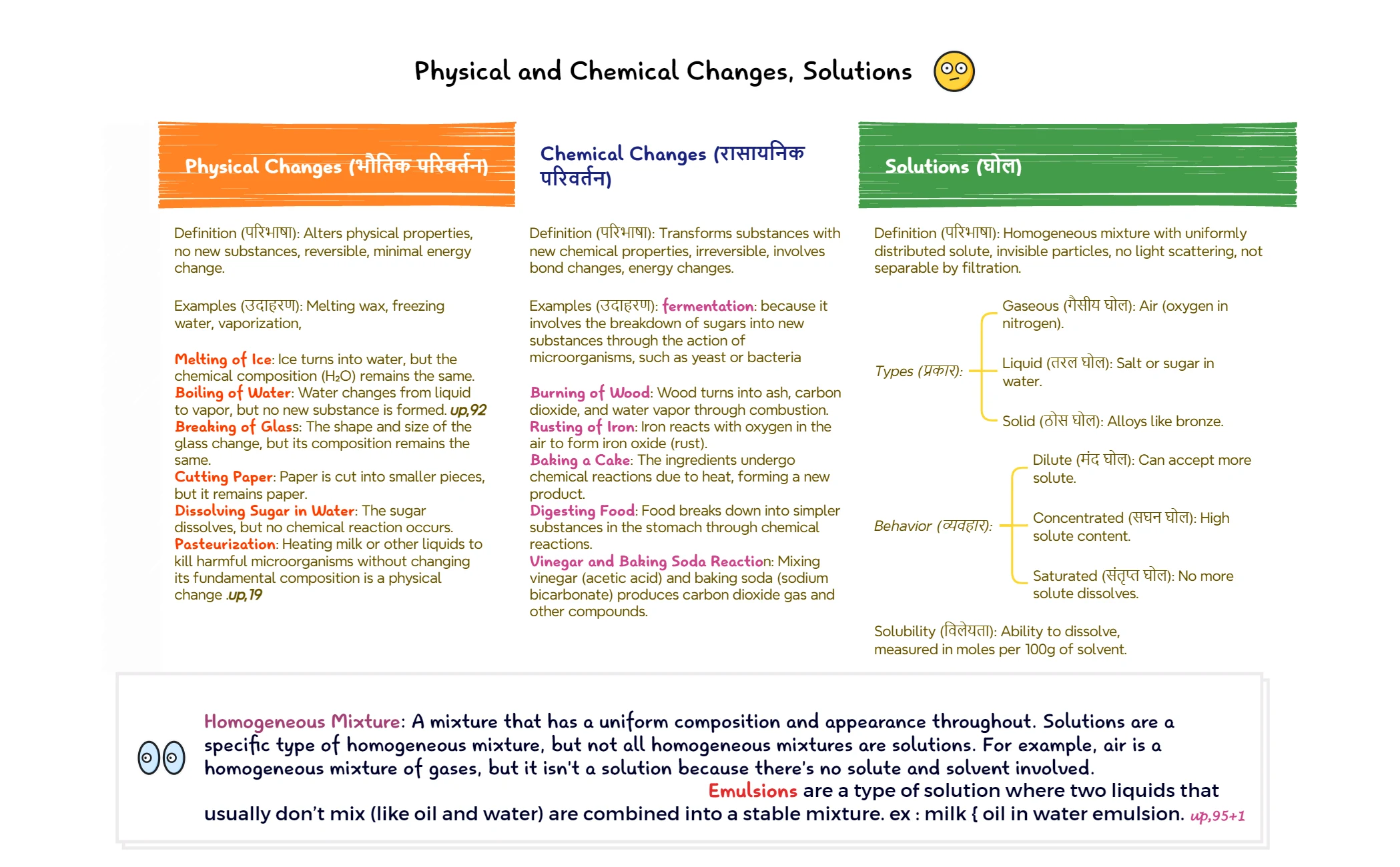
Definition (परिभाषा): Alters physical properties, no new substances, reversible, minimal energy change.
Examples (उदाहरण): Melting wax, freezing water, vaporization,
Melting of Ice: Ice turns into water, but the chemical composition (H₂O) remains the same. Boiling of Water: Water changes from liquid to vapor, but no new substance is formed. up,92 Breaking of Glass: The shape and size of the glass change, but its composition remains the same. Cutting Paper: Paper is cut into smaller pieces, but it remains paper. Dissolving Sugar in Water: The sugar dissolves, but no chemical reaction occurs. Pasteurization: Heating milk or other liquids to kill harmful microorganisms without changing its fundamental composition is a physical change .up,19
Chemical Changes (रासायनिक परिवर्तन)
Definition (परिभाषा): Transforms substances with new chemical properties, irreversible, involves bond changes, energy changes.
Examples (उदाहरण): fermentation: because it involves the breakdown of sugars into new substances through the action of microorganisms, such as yeast or bacteria
Burning of Wood: Wood turns into ash, carbon dioxide, and water vapor through combustion. Rusting of Iron: Iron reacts with oxygen in the air to form iron oxide (rust). Baking a Cake: The ingredients undergo chemical reactions due to heat, forming a new product. Digesting Food: Food breaks down into simpler substances in the stomach through chemical reactions. Vinegar and Baking Soda Reaction: Mixing vinegar (acetic acid) and baking soda (sodium bicarbonate) produces carbon dioxide gas and other compounds.
Solutions (घोल)
Definition (परिभाषा): Homogeneous mixture with uniformly distributed solute, invisible particles, no light scattering, not separable by filtration.
Types (प्रकार):
Gaseous (गैसीय घोल): Air (oxygen in nitrogen).
Liquid (तरल घोल): Salt or sugar in water.
Solid (ठोस घोल): Alloys like bronze.
Behavior (व्यवहार):
Dilute (मंद घोल): Can accept more solute.
Concentrated (सघन घोल): High solute content.
Saturated (संतृप्त घोल): No more solute dissolves.
Solubility (विलेयता): Ability to dissolve, measured in moles per 100g of solvent.
Homogeneous Mixture: A mixture that has a uniform composition and appearance throughout. Solutions are a specific type of homogeneous mixture, but not all homogeneous mixtures are solutions. For example, air is a homogeneous mixture of gases, but it isn’t a solution because there’s no solute and solvent involved. Emulsions are a type of solution where two liquids that usually don’t mix (like oil and water) are combined into a stable mixture. ex : milk { oil in water emulsion. up,95+1