Mind Mapsमाइंड मैप्स › Chemistryरसायन विज्ञान
Non-Metals — mind mapमाइंड मैप
Original study maps by Rishabh Singh. Read dated facts in their exam-year context. Sources & corrections.ऋषभ सिंह के मूल अध्ययन मानचित्र। पुराने तथ्यों को संबंधित परीक्षा वर्ष के संदर्भ में पढ़ें। स्रोत और सुधार।
81 branches and entriesशाखाएँ और बिंदु · 1 sheet(s)शीट
See the original map layoutमूल मानचित्र का स्वरूप देखें
Tap the image to open its full preview. Read individual branches below for comfortable revision.पूरा पूर्वावलोकन खोलने के लिए चित्र पर टैप करें। आसानी से पढ़ने के लिए नीचे शाखाएँ देखें।
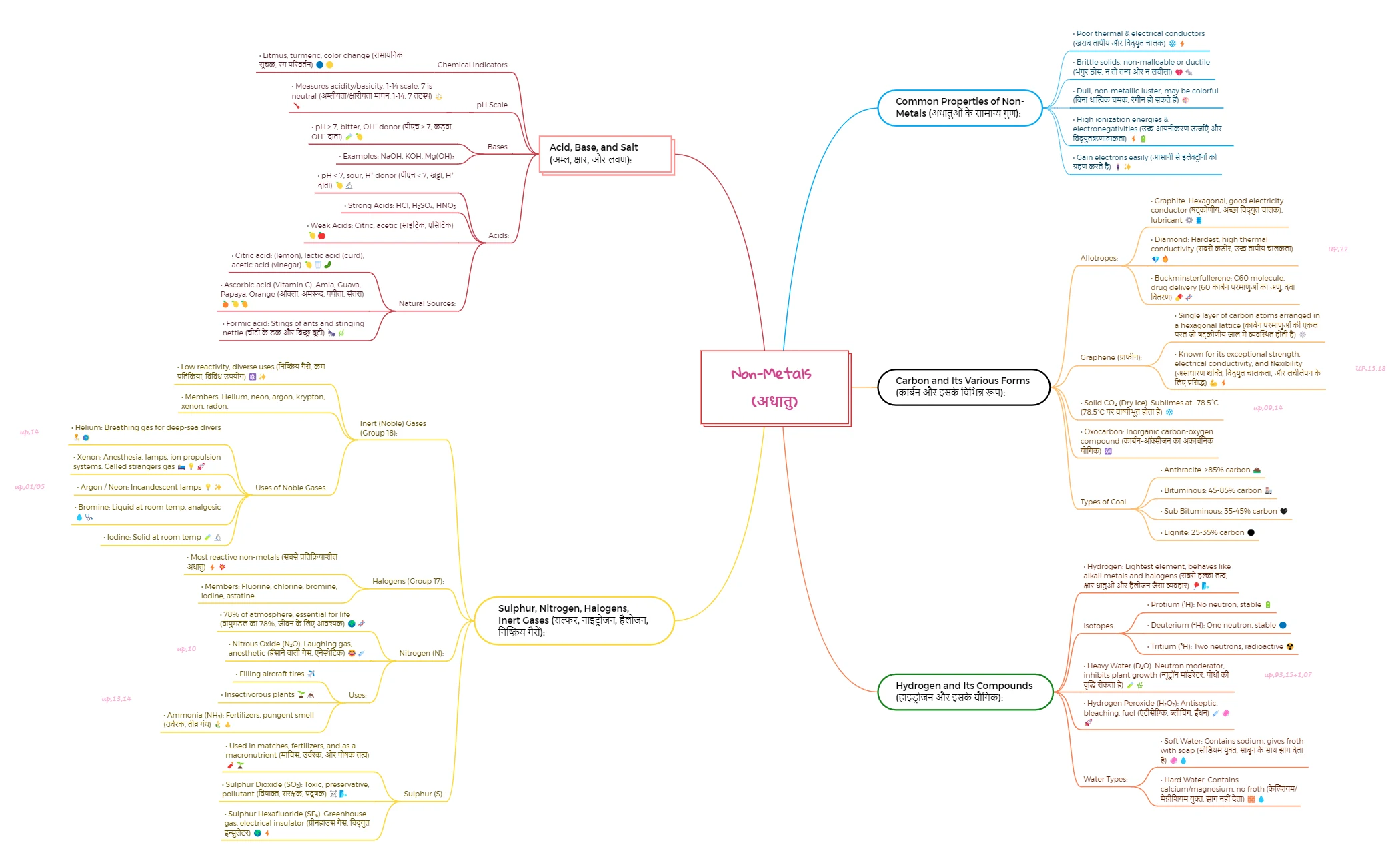
Read the branchesशाखाएँ पढ़ें
Non-Metals (अधातु)
Non-Metals (अधातु)
Common Properties of Non-Metals (अधातुओं के सामान्य गुण):
• Poor thermal & electrical conductors (खराब तापीय और विद्युत चालक) ❄️⚡
• Brittle solids, non-malleable or ductile (भंगुर ठोस, न तो तन्य और न लचीला) 💔🔩
• Dull, non-metallic luster; may be colorful (बिना धात्विक चमक, रंगीन हो सकते हैं) 🎨
• High ionization energies & electronegativities (उच्च आयनीकरण ऊर्जाएँ और विद्युतऋणात्मकता) ⚡🔋
• Gain electrons easily (आसानी से इलेक्ट्रॉनों को ग्रहण करते हैं) 🔌✨
Carbon and Its Various Forms (कार्बन और इसके विभिन्न रूप):
Allotropes:
• Graphite: Hexagonal, good electricity conductor (षट्कोणीय, अच्छा विद्युत चालक), lubricant ⚙️🛢️
• Diamond: Hardest, high thermal conductivity (सबसे कठोर, उच्च तापीय चालकता) 💎🔥
• Buckminsterfullerene: C60 molecule, drug delivery (60 कार्बन परमाणुओं का अणु, दवा वितरण) 💊🧬
UP,22
Graphene (ग्राफीन):
• Single layer of carbon atoms arranged in a hexagonal lattice (कार्बन परमाणुओं की एकल परत जो षट्कोणीय जाल में व्यवस्थित होती है) 🕸️
• Known for its exceptional strength, electrical conductivity, and flexibility (असाधारण शक्ति, विद्युत चालकता, और लचीलेपन के लिए प्रसिद्ध) 💪⚡
UP,15.18
• Solid CO₂ (Dry Ice): Sublimes at -78.5°C (78.5°C पर वाष्पीभूत होता है) ❄️
• Oxocarbon: Inorganic carbon-oxygen compound (कार्बन-ऑक्सीजन का अकार्बनिक यौगिक) ⚛️
Types of Coal:
• Anthracite: >85% carbon 🏔️
• Bituminous: 45-85% carbon 🏭
• Sub Bituminous: 35-45% carbon 🖤
• Lignite: 25-35% carbon ⚫
up,09,14
Hydrogen and Its Compounds (हाइड्रोजन और इसके यौगिक):
• Hydrogen: Lightest element, behaves like alkali metals and halogens (सबसे हल्का तत्व, क्षार धातुओं और हैलोजन जैसा व्यवहार) 🎈🌬️
Isotopes:
• Protium (¹H): No neutron, stable 🔋
• Deuterium (²H): One neutron, stable 🔵
• Tritium (³H): Two neutrons, radioactive ☢️
• Heavy Water (D₂O): Neutron moderator, inhibits plant growth (न्यूट्रॉन मॉडरेटर, पौधों की वृद्धि रोकता है) 🧪🌿
• Hydrogen Peroxide (H₂O₂): Antiseptic, bleaching, fuel (एंटीसेप्टिक, ब्लीचिंग, ईंधन) 💉🧼🚀
Water Types:
• Soft Water: Contains sodium, gives froth with soap (सोडियम युक्त, साबुन के साथ झाग देता है) 🧼💧
• Hard Water: Contains calcium/magnesium, no froth (कैल्शियम/मैग्नीशियम युक्त, झाग नहीं देता) 🧱💧
up,93,15+1,07
Sulphur, Nitrogen, Halogens, Inert Gases (सल्फर, नाइट्रोजन, हैलोजन, निष्क्रिय गैसें):
Inert (Noble) Gases (Group 18):
• Low reactivity, diverse uses (निष्क्रिय गैसें, कम प्रतिक्रिया, विविध उपयोग) ⚛️✨
• Members: Helium, neon, argon, krypton, xenon, radon.
Uses of Noble Gases:
• Helium: Breathing gas for deep-sea divers 🧑🔬🐠
• Xenon: Anesthesia, lamps, ion propulsion systems. Called strangers gas 🛌💡🚀
• Argon / Neon: Incandescent lamps 💡✨
• Bromine: Liquid at room temp, analgesic 💧🩺
• Iodine: Solid at room temp 🧪🔬
up,01/05
up,14
Halogens (Group 17):
• Most reactive non-metals (सबसे प्रतिक्रियाशील अधातु) ⚡💥
• Members: Fluorine, chlorine, bromine, iodine, astatine.
Nitrogen (N):
• 78% of atmosphere, essential for life (वायुमंडल का 78%, जीवन के लिए आवश्यक) 🌍🧬
• Nitrous Oxide (N₂O): Laughing gas, anesthetic (हँसाने वाली गैस, एनेस्थेटिक) 😂💉
Uses:
• Filling aircraft tires ✈️
• Insectivorous plants 🌱🦟
• Ammonia (NH₃): Fertilizers, pungent smell (उर्वरक, तीव्र गंध) 🌾👃
up,10
up,13,14
Sulphur (S):
• Used in matches, fertilizers, and as a macronutrient (माचिस, उर्वरक, और पोषक तत्व) 🧨🌱
• Sulphur Dioxide (SO₂): Toxic, preservative, pollutant (विषाक्त, संरक्षक, प्रदूषक) ☠️🌬️
• Sulphur Hexafluoride (SF₆): Greenhouse gas, electrical insulator (ग्रीनहाउस गैस, विद्युत इन्सुलेटर) 🌍⚡
Acid, Base, and Salt (अम्ल, क्षार, और लवण):
Chemical Indicators:
• Litmus, turmeric, color change (रासायनिक सूचक, रंग परिवर्तन) 🔵🟡
pH Scale:
• Measures acidity/basicity, 1-14 scale, 7 is neutral (अम्लीयता/क्षारीयता मापन, 1-14, 7 तटस्थ) ⚖️🌡️
Bases:
• pH > 7, bitter, OH⁻ donor (पीएच > 7, कड़वा, OH⁻ दाता) 🧪🍋
• Examples: NaOH, KOH, Mg(OH)₂
Acids:
• pH < 7, sour, H⁺ donor (पीएच < 7, खट्टा, H⁺ दाता) 🍋🔬
• Strong Acids: HCl, H₂SO₄, HNO₃
• Weak Acids: Citric, acetic (साइट्रिक, एसिटिक) 🍋🍎
Natural Sources:
• Citric acid: (lemon), lactic acid (curd), acetic acid (vinegar) 🍋🥛🥒
• Ascorbic acid (Vitamin C): Amla, Guava, Papaya, Orange (आंवला, अमरूद, पपीता, संतरा) 🍊🍋🥭
• Formic acid: Stings of ants and stinging nettle (चींटी के डंक और बिच्छू बूटी) 🐜🌿