Mind Mapsमाइंड मैप्स › Chemistryरसायन विज्ञान
Metals, Minerals, Ores: Properties, Uses — mind mapमाइंड मैप
Original study maps by Rishabh Singh. Read dated facts in their exam-year context. Sources & corrections.ऋषभ सिंह के मूल अध्ययन मानचित्र। पुराने तथ्यों को संबंधित परीक्षा वर्ष के संदर्भ में पढ़ें। स्रोत और सुधार।
36 branches and entriesशाखाएँ और बिंदु · 1 sheet(s)शीट
See the original map layoutमूल मानचित्र का स्वरूप देखें
Tap the image to open its full preview. Read individual branches below for comfortable revision.पूरा पूर्वावलोकन खोलने के लिए चित्र पर टैप करें। आसानी से पढ़ने के लिए नीचे शाखाएँ देखें।
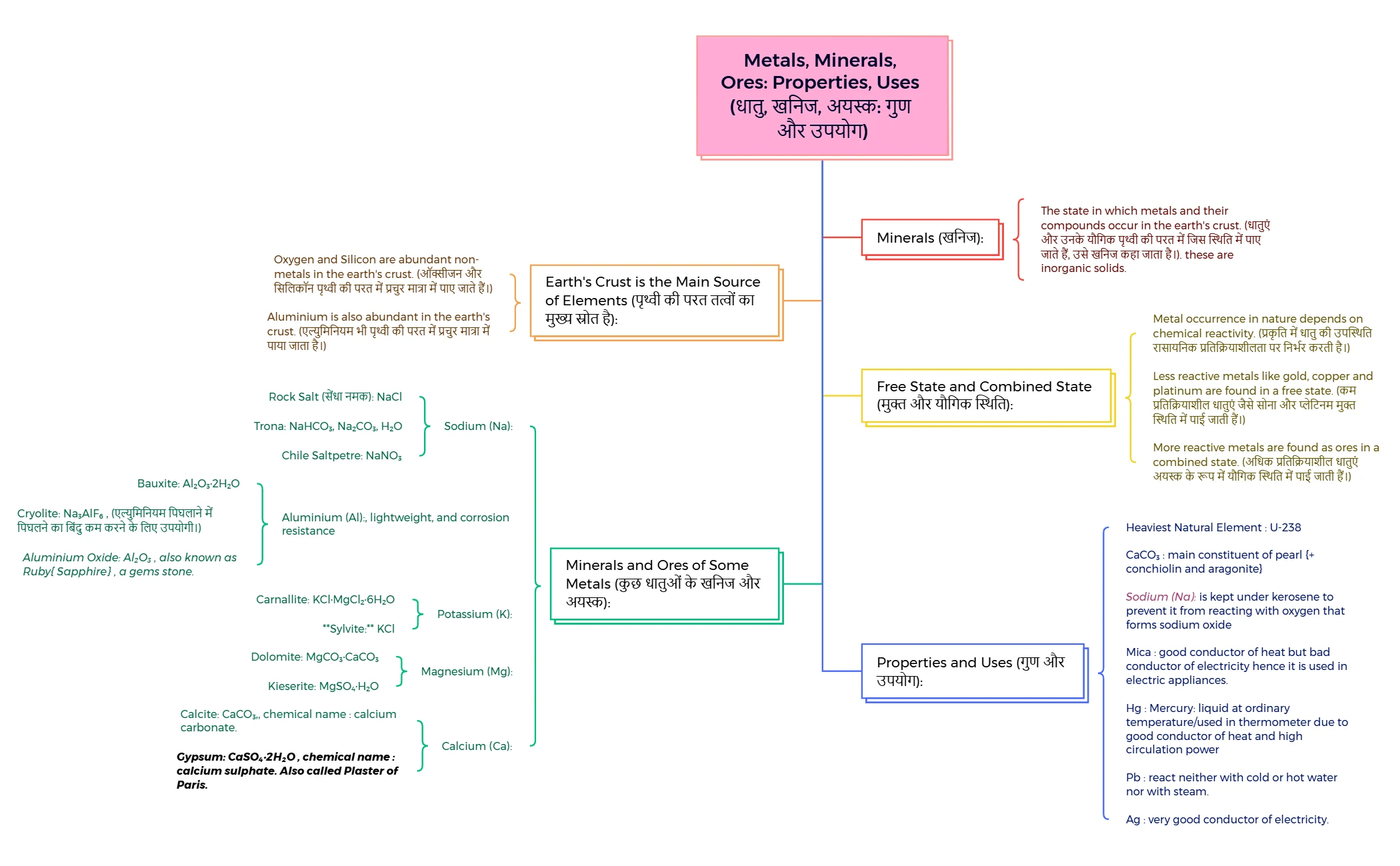
Read the branchesशाखाएँ पढ़ें
Metals, Minerals, Ores: Properties, Uses (धातु, खनिज, अयस्क: गुण और उपयोग)
Metals, Minerals, Ores: Properties, Uses (धातु, खनिज, अयस्क: गुण और उपयोग)
Minerals (खनिज):
The state in which metals and their compounds occur in the earth's crust. (धातुएं और उनके यौगिक पृथ्वी की परत में जिस स्थिति में पाए जाते हैं, उसे खनिज कहा जाता है।). these are inorganic solids.
Earth's Crust is the Main Source of Elements (पृथ्वी की परत तत्वों का मुख्य स्रोत है):
Oxygen and Silicon are abundant non-metals in the earth's crust. (ऑक्सीजन और सिलिकॉन पृथ्वी की परत में प्रचुर मात्रा में पाए जाते हैं।)
Aluminium is also abundant in the earth's crust. (एल्युमिनियम भी पृथ्वी की परत में प्रचुर मात्रा में पाया जाता है।)
Free State and Combined State (मुक्त और यौगिक स्थिति):
Metal occurrence in nature depends on chemical reactivity. (प्रकृति में धातु की उपस्थिति रासायनिक प्रतिक्रियाशीलता पर निर्भर करती है।)
Less reactive metals like gold, copper and platinum are found in a free state. (कम प्रतिक्रियाशील धातुएं जैसे सोना और प्लेटिनम मुक्त स्थिति में पाई जाती हैं।)
More reactive metals are found as ores in a combined state. (अधिक प्रतिक्रियाशील धातुएं अयस्क के रूप में यौगिक स्थिति में पाई जाती हैं।)
Minerals and Ores of Some Metals (कुछ धातुओं के खनिज और अयस्क):
Sodium (Na):
Rock Salt (सेंधा नमक): NaCl
Trona: NaHCO₃, Na₂CO₃, H₂O
Chile Saltpetre: NaNO₃
Aluminium (Al):, lightweight, and corrosion resistance
Bauxite: Al₂O₃·2H₂O
Cryolite: Na₃AlF₆ , (एल्युमिनियम पिघलाने में पिघलने का बिंदु कम करने के लिए उपयोगी।)
Aluminium Oxide: Al₂O₃ , also known as Ruby{ Sapphire} , a gems stone.
Potassium (K):
Carnallite: KCl·MgCl₂·6H₂O
Sylvite: KCl
Magnesium (Mg):
Dolomite: MgCO₃·CaCO₃
Kieserite: MgSO₄·H₂O
Calcium (Ca):
Calcite: CaCO₃,, chemical name : calcium carbonate.
Gypsum: CaSO₄·2H₂O , chemical name : calcium sulphate. Also called Plaster of Paris.
Properties and Uses (गुण और उपयोग):
heaviest natural element : U-238
CaCO₃ : main constituent of pearl {+ conchiolin and aragonite}
Sodium (Na): is kept under kerosene to prevent it from reacting with oxygen that forms sodium oxide
Mica : good conductor of heat but bad conductor of electricity hence it is used in electric appliances.
Hg : Mercury: liquid at ordinary temperature/used in thermometer due to good conductor of heat and high circulation power
Pb : react neither with cold or hot water nor with steam.
Ag : very good conductor of electricity.