Mind Mapsमाइंड मैप्स › Chemistryरसायन विज्ञान
Atomic Structure — mind mapमाइंड मैप
Original study maps by Rishabh Singh. Read dated facts in their exam-year context. Sources & corrections.ऋषभ सिंह के मूल अध्ययन मानचित्र। पुराने तथ्यों को संबंधित परीक्षा वर्ष के संदर्भ में पढ़ें। स्रोत और सुधार।
62 branches and entriesशाखाएँ और बिंदु · 1 sheet(s)शीट
See the original map layoutमूल मानचित्र का स्वरूप देखें
Tap the image to open its full preview. Read individual branches below for comfortable revision.पूरा पूर्वावलोकन खोलने के लिए चित्र पर टैप करें। आसानी से पढ़ने के लिए नीचे शाखाएँ देखें।
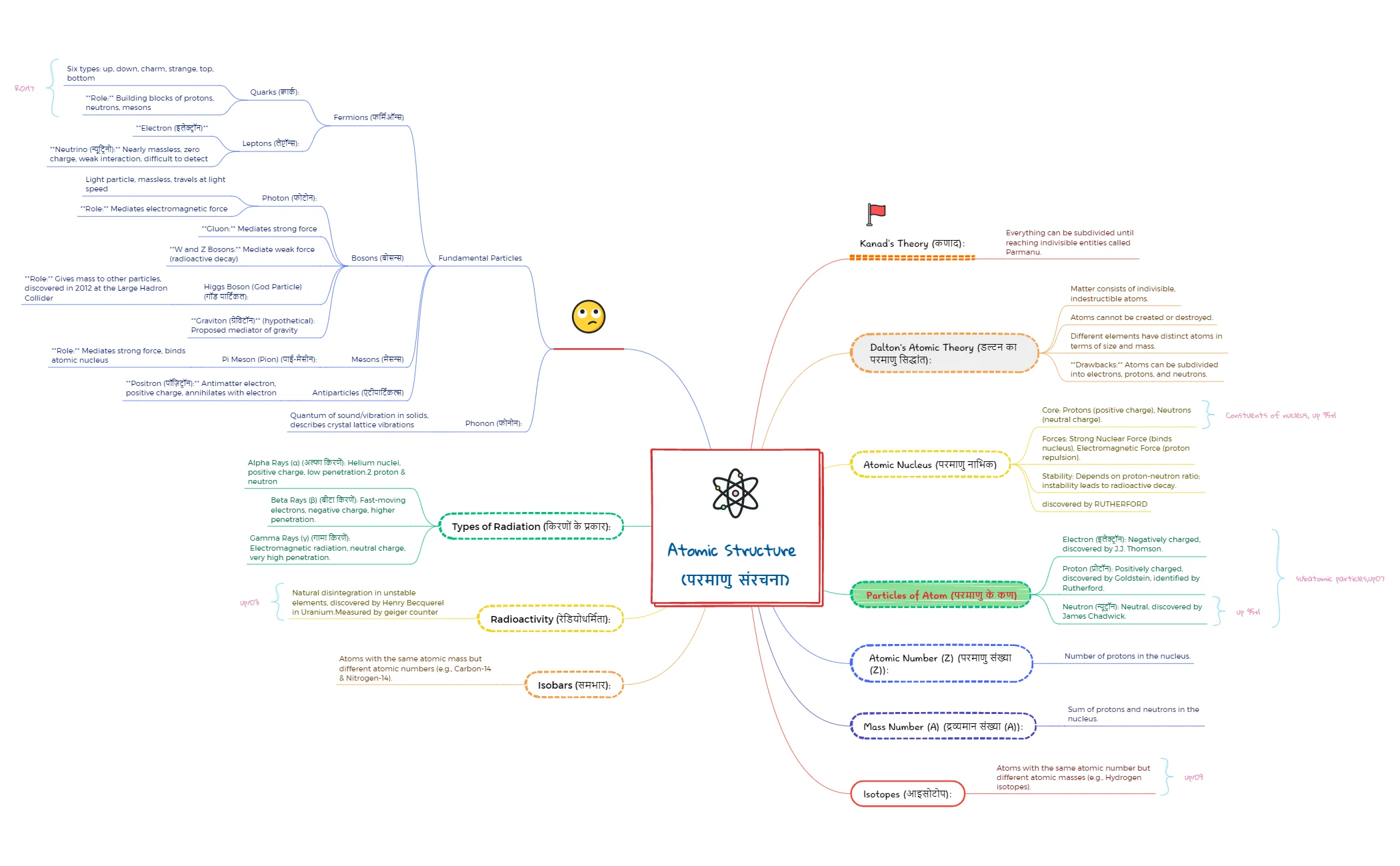
Read the branchesशाखाएँ पढ़ें
Atomic Structure (परमाणु संरचना)
Atomic Structure (परमाणु संरचना)
Kanad's Theory (कणाद):
Everything can be subdivided until reaching indivisible entities called Parmanu.
Dalton’s Atomic Theory (डल्टन का परमाणु सिद्धांत):
Matter consists of indivisible, indestructible atoms.
Atoms cannot be created or destroyed.
Different elements have distinct atoms in terms of size and mass.
Drawbacks: Atoms can be subdivided into electrons, protons, and neutrons.
Atomic Nucleus (परमाणु नाभिक)
Core: Protons (positive charge), Neutrons (neutral charge).
Forces: Strong Nuclear Force (binds nucleus), Electromagnetic Force (proton repulsion).
Stability: Depends on proton-neutron ratio; instability leads to radioactive decay.
discovered by RUTHERFORD
Constuents of nucleus, up 95+1
Particles of Atom (परमाणु के कण)
Electron (इलेक्ट्रॉन): Negatively charged, discovered by J.J. Thomson.
Proton (प्रोटॉन): Positively charged, discovered by Goldstein, identified by Rutherford.
Neutron (न्यूट्रॉन): Neutral, discovered by James Chadwick.
up 95+1
Atomic Number (Z) (परमाणु संख्या (Z)):
Number of protons in the nucleus.
Mass Number (A) (द्रव्यमान संख्या (A)):
Sum of protons and neutrons in the nucleus.
Isotopes (आइसोटोप):
Atoms with the same atomic number but different atomic masses (e.g., Hydrogen isotopes).
up/09
Isobars (समभार):
Atoms with the same atomic mass but different atomic numbers (e.g., Carbon-14 & Nitrogen-14).
Radioactivity (रेडियोधर्मिता):
Natural disintegration in unstable elements, discovered by Henry Becquerel in Uranium.Measured by geiger counter
up/03
Types of Radiation (किरणों के प्रकार):
Alpha Rays (α) (अल्फा किरणें): Helium nuclei, positive charge, low penetration.2 proton & neutron
Beta Rays (β) (बीटा किरणें): Fast-moving electrons, negative charge, higher penetration.
Gamma Rays (γ) (गामा किरणें): Electromagnetic radiation, neutral charge, very high penetration.
Study map
Fundamental Particles
Fermions (फर्मिऑन्स)
Quarks (क्वार्क):
Six types: up, down, charm, strange, top, bottom
Role: Building blocks of protons, neutrons, mesons
Leptons (लेप्टॉन्स):
Electron (इलेक्ट्रॉन)
Neutrino (न्यूट्रिनो): Nearly massless, zero charge, weak interaction, difficult to detect
RO/17
Bosons (बोसन्स)
Photon (फोटोन):
Light particle, massless, travels at light speed
Role: Mediates electromagnetic force
Gluon: Mediates strong force
W and Z Bosons: Mediate weak force (radioactive decay)
Higgs Boson (God Particle) (गॉड पार्टिकल):
Role: Gives mass to other particles, discovered in 2012 at the Large Hadron Collider
Graviton (ग्रेविटॉन) (hypothetical): Proposed mediator of gravity
Mesons (मेसन्स)
Pi Meson (Pion) (पाई-मेसोन):
Role: Mediates strong force, binds atomic nucleus
Antiparticles (एंटीपार्टिकल्स)
Positron (पॉज़िट्रॉन): Antimatter electron, positive charge, annihilates with electron
Phonon (फोनोन):
Quantum of sound/vibration in solids, describes crystal lattice vibrations
subatomic particles,up07