Mind Mapsमाइंड मैप्स › Chemistryरसायन विज्ञान
Acid, Base and Salt — mind mapमाइंड मैप
Original study maps by Rishabh Singh. Read dated facts in their exam-year context. Sources & corrections.ऋषभ सिंह के मूल अध्ययन मानचित्र। पुराने तथ्यों को संबंधित परीक्षा वर्ष के संदर्भ में पढ़ें। स्रोत और सुधार।
43 branches and entriesशाखाएँ और बिंदु · 1 sheet(s)शीट
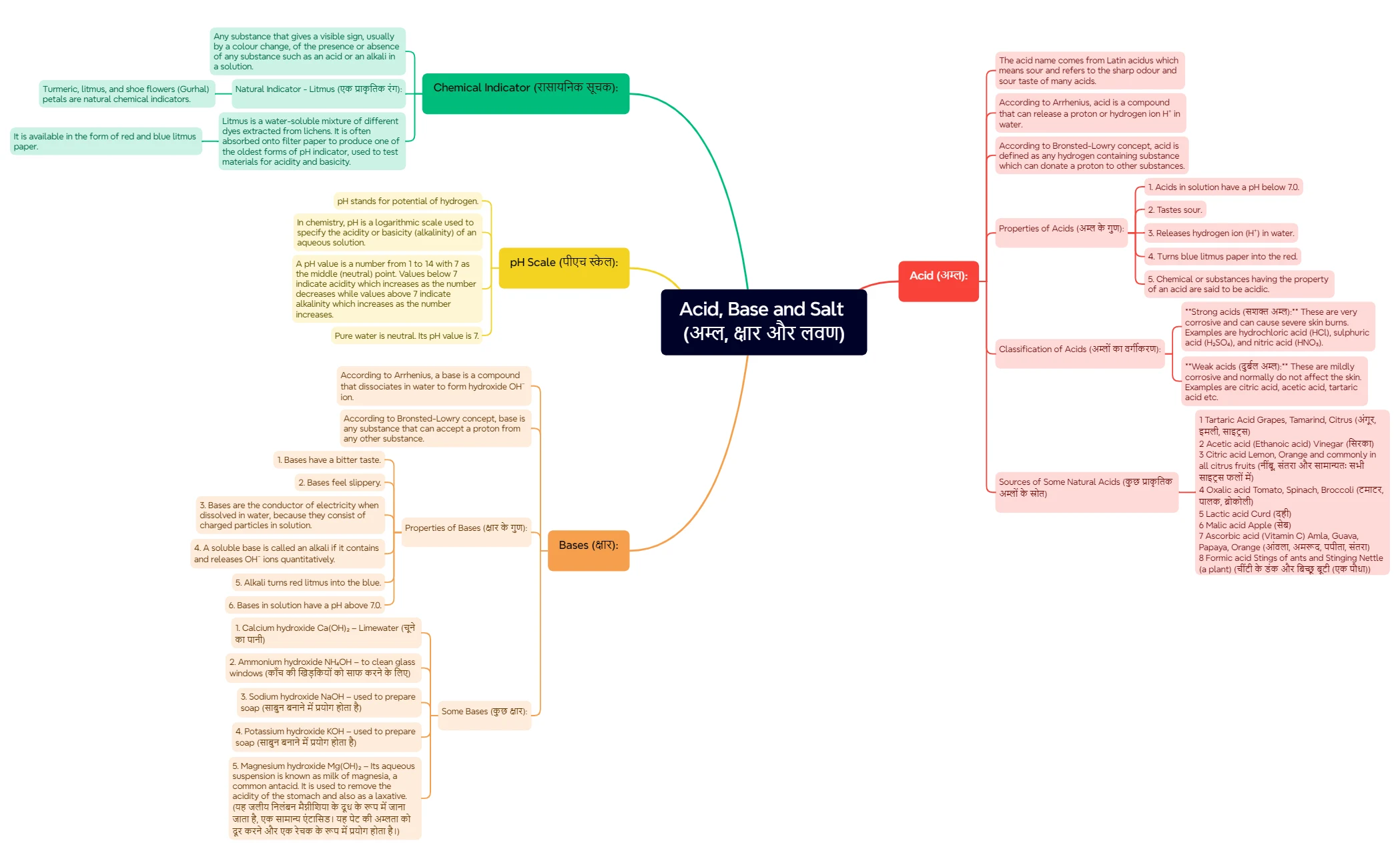
See the original map layoutमूल मानचित्र का स्वरूप देखें
Tap the image to open its full preview. Read individual branches below for comfortable revision.पूरा पूर्वावलोकन खोलने के लिए चित्र पर टैप करें। आसानी से पढ़ने के लिए नीचे शाखाएँ देखें।
Read the branchesशाखाएँ पढ़ें
Acid, Base and Salt (अम्ल, क्षार और लवण)
Acid, Base and Salt (अम्ल, क्षार और लवण)
Acid (अम्ल):
The acid name comes from Latin acidus which means sour and refers to the sharp odour and sour taste of many acids.
According to Arrhenius, acid is a compound that can release a proton or hydrogen ion H⁺ in water.
According to Bronsted-Lowry concept, acid is defined as any hydrogen containing substance which can donate a proton to other substances.
Properties of Acids (अम्ल के गुण):
1. Acids in solution have a pH below 7.0.
2. Tastes sour.
3. Releases hydrogen ion (H⁺) in water.
4. Turns blue litmus paper into the red.
5. Chemical or substances having the property of an acid are said to be acidic.
Classification of Acids (अम्लों का वर्गीकरण):
Strong acids (सशक्त अम्ल): These are very corrosive and can cause severe skin burns. Examples are hydrochloric acid (HCl), sulphuric acid (H₂SO₄), and nitric acid (HNO₃).
Weak acids (दुर्बल अम्ल): These are mildly corrosive and normally do not affect the skin. Examples are citric acid, acetic acid, tartaric acid etc.
Sources of Some Natural Acids (कुछ प्राकृतिक अम्लों के स्रोत)
1 Tartaric Acid Grapes, Tamarind, Citrus (अंगूर, इमली, साइट्रस) 2 Acetic acid (Ethanoic acid) Vinegar (सिरका) 3 Citric acid Lemon, Orange and commonly in all citrus fruits (नींबू, संतरा और सामान्यतः सभी साइट्रस फलों में) 4 Oxalic acid Tomato, Spinach, Broccoli (टमाटर, पालक, ब्रोकोली) 5 Lactic acid Curd (दही) 6 Malic acid Apple (सेब) 7 Ascorbic acid (Vitamin C) Amla, Guava, Papaya, Orange (आंवला, अमरूद, पपीता, संतरा) 8 Formic acid Stings of ants and Stinging Nettle (a plant) (चींटी के डंक और बिच्छू बूटी (एक पौधा))
Bases (क्षार):
According to Arrhenius, a base is a compound that dissociates in water to form hydroxide OH⁻ ion.
According to Bronsted-Lowry concept, base is any substance that can accept a proton from any other substance.
Properties of Bases (क्षार के गुण):
1. Bases have a bitter taste.
2. Bases feel slippery.
3. Bases are the conductor of electricity when dissolved in water, because they consist of charged particles in solution.
4. A soluble base is called an alkali if it contains and releases OH⁻ ions quantitatively.
5. Alkali turns red litmus into the blue.
6. Bases in solution have a pH above 7.0.
Some Bases (कुछ क्षार):
1. Calcium hydroxide Ca(OH)₂ – Limewater (चूने का पानी)
2. Ammonium hydroxide NH₄OH – to clean glass windows (काँच की खिड़कियों को साफ करने के लिए)
3. Sodium hydroxide NaOH – used to prepare soap (साबुन बनाने में प्रयोग होता है)
4. Potassium hydroxide KOH – used to prepare soap (साबुन बनाने में प्रयोग होता है)
5. Magnesium hydroxide Mg(OH)₂ – Its aqueous suspension is known as milk of magnesia, a common antacid. It is used to remove the acidity of the stomach and also as a laxative. (यह जलीय निलंबन मैग्नीशिया के दूध के रूप में जाना जाता है, एक सामान्य एंटासिड। यह पेट की अम्लता को दूर करने और एक रेचक के रूप में प्रयोग होता है।)
pH Scale (पीएच स्केल):
pH stands for potential of hydrogen.
In chemistry, pH is a logarithmic scale used to specify the acidity or basicity (alkalinity) of an aqueous solution.
A pH value is a number from 1 to 14 with 7 as the middle (neutral) point. Values below 7 indicate acidity which increases as the number decreases while values above 7 indicate alkalinity which increases as the number increases.
Pure water is neutral. Its pH value is 7.
Chemical Indicator (रासायनिक सूचक):
Any substance that gives a visible sign, usually by a colour change, of the presence or absence of any substance such as an acid or an alkali in a solution.
Natural Indicator - Litmus (एक प्राकृतिक रंग):
Turmeric, litmus, and shoe flowers (Gurhal) petals are natural chemical indicators.
Litmus is a water-soluble mixture of different dyes extracted from lichens. It is often absorbed onto filter paper to produce one of the oldest forms of pH indicator, used to test materials for acidity and basicity.
It is available in the form of red and blue litmus paper.