Mind Mapsमाइंड मैप्स › Biologyजीवविज्ञान
Human Anatomy and Physiology: Digestive System — mind mapमाइंड मैप
Original study maps by Rishabh Singh. Read dated facts in their exam-year context. Sources & corrections.ऋषभ सिंह के मूल अध्ययन मानचित्र। पुराने तथ्यों को संबंधित परीक्षा वर्ष के संदर्भ में पढ़ें। स्रोत और सुधार।
35 branches and entriesशाखाएँ और बिंदु · 1 sheet(s)शीट
See the original map layoutमूल मानचित्र का स्वरूप देखें
Tap the image to open its full preview. Read individual branches below for comfortable revision.पूरा पूर्वावलोकन खोलने के लिए चित्र पर टैप करें। आसानी से पढ़ने के लिए नीचे शाखाएँ देखें।
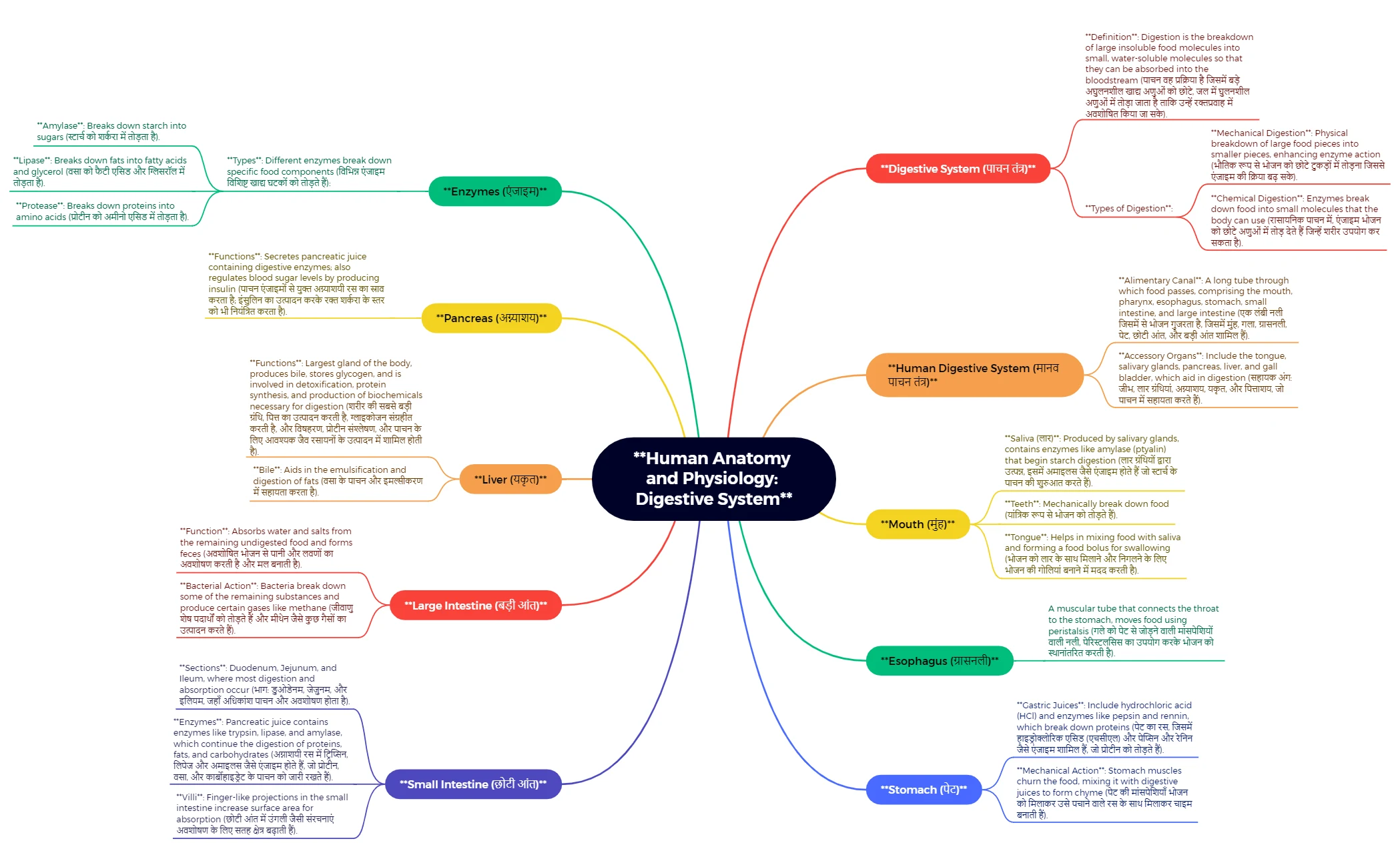
Read the branchesशाखाएँ पढ़ें
Human Anatomy and Physiology: Digestive System
Human Anatomy and Physiology: Digestive System
Digestive System (पाचन तंत्र)
Definition: Digestion is the breakdown of large insoluble food molecules into small, water-soluble molecules so that they can be absorbed into the bloodstream (पाचन वह प्रक्रिया है जिसमें बड़े अघुलनशील खाद्य अणुओं को छोटे, जल में घुलनशील अणुओं में तोड़ा जाता है ताकि उन्हें रक्तप्रवाह में अवशोषित किया जा सके).
Types of Digestion:
Mechanical Digestion: Physical breakdown of large food pieces into smaller pieces, enhancing enzyme action (भौतिक रूप से भोजन को छोटे टुकड़ों में तोड़ना जिससे एंजाइम की क्रिया बढ़ सके).
Chemical Digestion: Enzymes break down food into small molecules that the body can use (रासायनिक पाचन में, एंजाइम भोजन को छोटे अणुओं में तोड़ देते हैं जिन्हें शरीर उपयोग कर सकता है).
Human Digestive System (मानव पाचन तंत्र)
Alimentary Canal: A long tube through which food passes, comprising the mouth, pharynx, esophagus, stomach, small intestine, and large intestine (एक लंबी नली जिसमें से भोजन गुजरता है, जिसमें मुंह, गला, ग्रासनली, पेट, छोटी आंत, और बड़ी आंत शामिल हैं).
Accessory Organs: Include the tongue, salivary glands, pancreas, liver, and gall bladder, which aid in digestion (सहायक अंग: जीभ, लार ग्रंथियां, अग्न्याशय, यकृत, और पित्ताशय, जो पाचन में सहायता करते हैं).
Mouth (मुंह)
Saliva (लार): Produced by salivary glands, contains enzymes like amylase (ptyalin) that begin starch digestion (लार ग्रंथियों द्वारा उत्पन्न, इसमें अमाइलस जैसे एंजाइम होते हैं जो स्टार्च के पाचन की शुरुआत करते हैं).
Teeth: Mechanically break down food (यांत्रिक रूप से भोजन को तोड़ते हैं).
Tongue: Helps in mixing food with saliva and forming a food bolus for swallowing (भोजन को लार के साथ मिलाने और निगलने के लिए भोजन की गोलियां बनाने में मदद करती है).
Esophagus (ग्रासनली)
A muscular tube that connects the throat to the stomach, moves food using peristalsis (गले को पेट से जोड़ने वाली मांसपेशियों वाली नली, पेरिस्टलसिस का उपयोग करके भोजन को स्थानांतरित करती है).
Stomach (पेट)
Gastric Juices: Include hydrochloric acid (HCl) and enzymes like pepsin and rennin, which break down proteins (पेट का रस, जिसमें हाइड्रोक्लोरिक एसिड (एचसीएल) और पेप्सिन और रेनिन जैसे एंजाइम शामिल हैं, जो प्रोटीन को तोड़ते हैं).
Mechanical Action: Stomach muscles churn the food, mixing it with digestive juices to form chyme (पेट की मांसपेशियाँ भोजन को मिलाकर उसे पचाने वाले रस के साथ मिलाकर चाइम बनाती हैं).
Small Intestine (छोटी आंत)
Sections: Duodenum, Jejunum, and Ileum, where most digestion and absorption occur (भाग: डुओडेनम, जेजुनम, और इलियम, जहाँ अधिकांश पाचन और अवशोषण होता है).
Enzymes: Pancreatic juice contains enzymes like trypsin, lipase, and amylase, which continue the digestion of proteins, fats, and carbohydrates (अग्नाशयी रस में ट्रिप्सिन, लिपेज और अमाइलस जैसे एंजाइम होते हैं, जो प्रोटीन, वसा, और कार्बोहाइड्रेट के पाचन को जारी रखते हैं).
Villi: Finger-like projections in the small intestine increase surface area for absorption (छोटी आंत में उंगली जैसी संरचनाएं अवशोषण के लिए सतह क्षेत्र बढ़ाती हैं).
Large Intestine (बड़ी आंत)
Function: Absorbs water and salts from the remaining undigested food and forms feces (अवशोषित भोजन से पानी और लवणों का अवशोषण करती है और मल बनाती है).
Bacterial Action: Bacteria break down some of the remaining substances and produce certain gases like methane (जीवाणु शेष पदार्थों को तोड़ते हैं और मीथेन जैसे कुछ गैसों का उत्पादन करते हैं).
Liver (यकृत)
Functions: Largest gland of the body, produces bile, stores glycogen, and is involved in detoxification, protein synthesis, and production of biochemicals necessary for digestion (शरीर की सबसे बड़ी ग्रंथि, पित्त का उत्पादन करती है, ग्लाइकोजन संग्रहीत करती है, और विषहरण, प्रोटीन संश्लेषण, और पाचन के लिए आवश्यक जैव रसायनों के उत्पादन में शामिल होती है).
Bile: Aids in the emulsification and digestion of fats (वसा के पाचन और इमल्सीकरण में सहायता करता है).
Pancreas (अग्न्याशय)
Functions: Secretes pancreatic juice containing digestive enzymes; also regulates blood sugar levels by producing insulin (पाचन एंजाइमों से युक्त अग्न्याशयी रस का स्राव करता है; इंसुलिन का उत्पादन करके रक्त शर्करा के स्तर को भी नियंत्रित करता है).
Enzymes (एंजाइम)
Types: Different enzymes break down specific food components (विभिन्न एंजाइम विशिष्ट खाद्य घटकों को तोड़ते हैं):
Amylase: Breaks down starch into sugars (स्टार्च को शर्करा में तोड़ता है).
Lipase: Breaks down fats into fatty acids and glycerol (वसा को फैटी एसिड और ग्लिसरॉल में तोड़ता है).
Protease: Breaks down proteins into amino acids (प्रोटीन को अमीनो एसिड में तोड़ता है).