Mind Mapsमाइंड मैप्स › Art & Cultureकला और संस्कृति
Folk Theatre — mind mapमाइंड मैप
Original study maps by Rishabh Singh. Read dated facts in their exam-year context. Sources & corrections.ऋषभ सिंह के मूल अध्ययन मानचित्र। पुराने तथ्यों को संबंधित परीक्षा वर्ष के संदर्भ में पढ़ें। स्रोत और सुधार।
38 branches and entriesशाखाएँ और बिंदु · 1 sheet(s)शीट
See the original map layoutमूल मानचित्र का स्वरूप देखें
Tap the image to open its full preview. Read individual branches below for comfortable revision.पूरा पूर्वावलोकन खोलने के लिए चित्र पर टैप करें। आसानी से पढ़ने के लिए नीचे शाखाएँ देखें।
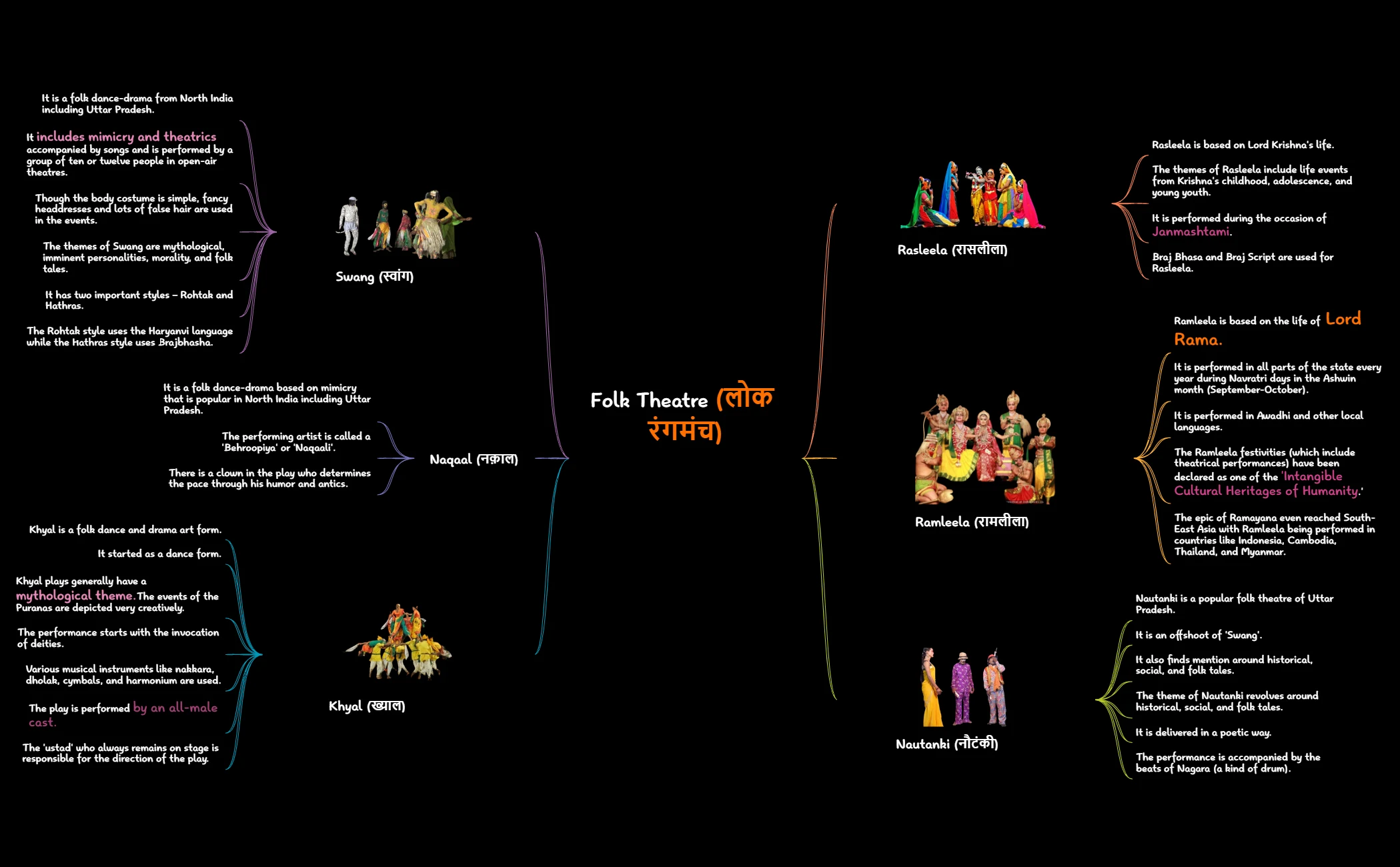
Read the branchesशाखाएँ पढ़ें
Folk Theatre (लोक रंगमंच)
Folk Theatre (लोक रंगमंच)
Rasleela (रासलीला)
Rasleela is based on Lord Krishna's life.
The themes of Rasleela include life events from Krishna's childhood, adolescence, and young youth.
It is performed during the occasion of Janmashtami.
Braj Bhasa and Braj Script are used for Rasleela.
Ramleela (रामलीला)
Ramleela is based on the life of Lord Rama.
It is performed in all parts of the state every year during Navratri days in the Ashwin month (September-October).
It is performed in Awadhi and other local languages.
The Ramleela festivities (which include theatrical performances) have been declared as one of the 'Intangible Cultural Heritages of Humanity.'
The epic of Ramayana even reached South-East Asia with Ramleela being performed in countries like Indonesia, Cambodia, Thailand, and Myanmar.
Nautanki (नौटंकी)
Nautanki is a popular folk theatre of Uttar Pradesh.
It is an offshoot of 'Swang'.
It also finds mention around historical, social, and folk tales.
The theme of Nautanki revolves around historical, social, and folk tales.
It is delivered in a poetic way.
The performance is accompanied by the beats of Nagara (a kind of drum).
Khyal (ख्याल)
Khyal is a folk dance and drama art form.
It started as a dance form.
Khyal plays generally have a mythological theme.The events of the Puranas are depicted very creatively.
The performance starts with the invocation of deities.
Various musical instruments like nakkara, dholak, cymbals, and harmonium are used.
The play is performed by an all-male cast.
The 'ustad' who always remains on stage is responsible for the direction of the play.
Naqaal (नक़ाल)
It is a folk dance-drama based on mimicry that is popular in North India including Uttar Pradesh.
The performing artist is called a 'Behroopiya' or 'Naqaali'.
There is a clown in the play who determines the pace through his humor and antics.
Swang (स्वांग)
It is a folk dance-drama from North India including Uttar Pradesh.
It includes mimicry and theatrics accompanied by songs and is performed by a group of ten or twelve people in open-air theatres.
Though the body costume is simple, fancy headdresses and lots of false hair are used in the events.
The themes of Swang are mythological, imminent personalities, morality, and folk tales.
It has two important styles – Rohtak and Hathras.
The Rohtak style uses the Haryanvi language while the Hathras style uses Brajbhasha.