Mind Mapsमाइंड मैप्स › Ancient Historyप्राचीन इतिहास
Post-Mauryan Period — mind mapमाइंड मैप
Original study maps by Rishabh Singh. Read dated facts in their exam-year context. Sources & corrections.ऋषभ सिंह के मूल अध्ययन मानचित्र। पुराने तथ्यों को संबंधित परीक्षा वर्ष के संदर्भ में पढ़ें। स्रोत और सुधार।
23 branches and entriesशाखाएँ और बिंदु · 1 sheet(s)शीट
See the original map layoutमूल मानचित्र का स्वरूप देखें
Tap the image to open its full preview. Read individual branches below for comfortable revision.पूरा पूर्वावलोकन खोलने के लिए चित्र पर टैप करें। आसानी से पढ़ने के लिए नीचे शाखाएँ देखें।
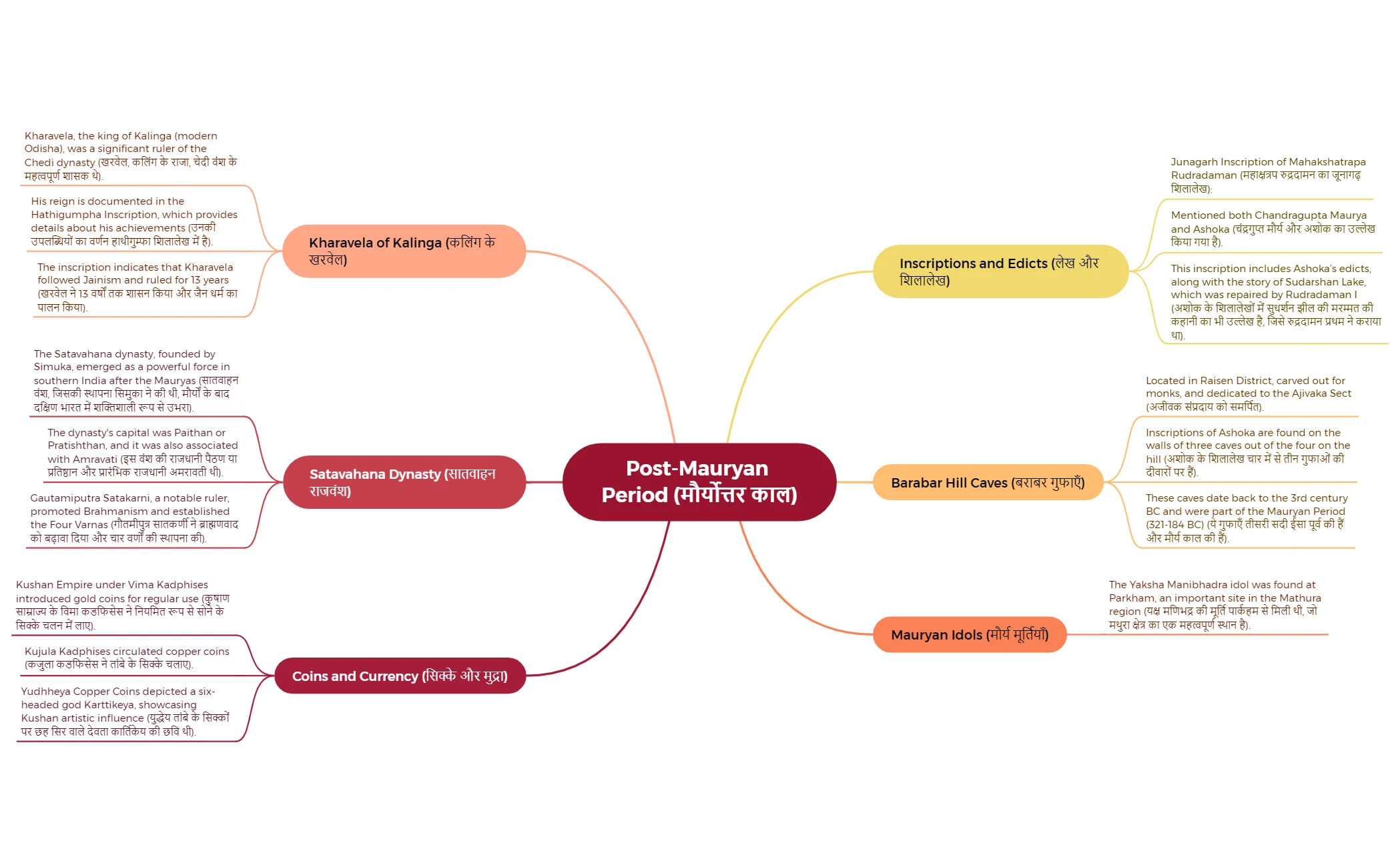
Read the branchesशाखाएँ पढ़ें
Post-Mauryan Period (मौर्योत्तर काल)
Post-Mauryan Period (मौर्योत्तर काल)
Inscriptions and Edicts (लेख और शिलालेख)
Junagarh Inscription of Mahakshatrapa Rudradaman (महाक्षत्रप रुद्रदामन का जूनागढ़ शिलालेख):
Mentioned both Chandragupta Maurya and Ashoka (चंद्रगुप्त मौर्य और अशोक का उल्लेख किया गया है).
This inscription includes Ashoka’s edicts, along with the story of Sudarshan Lake, which was repaired by Rudradaman I (अशोक के शिलालेखों में सुधर्शन झील की मरम्मत की कहानी का भी उल्लेख है, जिसे रुद्रदामन प्रथम ने कराया था).
Barabar Hill Caves (बराबर गुफाएँ)
Located in Raisen District, carved out for monks, and dedicated to the Ajivaka Sect (अजीवक संप्रदाय को समर्पित).
Inscriptions of Ashoka are found on the walls of three caves out of the four on the hill (अशोक के शिलालेख चार में से तीन गुफाओं की दीवारों पर हैं).
These caves date back to the 3rd century BC and were part of the Mauryan Period (321-184 BC) (ये गुफाएँ तीसरी सदी ईसा पूर्व की हैं और मौर्य काल की हैं).
Mauryan Idols (मौर्य मूर्तियाँ)
The Yaksha Manibhadra idol was found at Parkham, an important site in the Mathura region (यक्ष मणिभद्र की मूर्ति पार्कहम से मिली थी, जो मथुरा क्षेत्र का एक महत्वपूर्ण स्थान है).
Coins and Currency (सिक्के और मुद्रा)
Kushan Empire under Vima Kadphises introduced gold coins for regular use (कुषाण साम्राज्य के विमा कडफिसेस ने नियमित रूप से सोने के सिक्के चलन में लाए).
Kujula Kadphises circulated copper coins (कजुला कडफिसेस ने तांबे के सिक्के चलाए).
Yudhheya Copper Coins depicted a six-headed god Karttikeya, showcasing Kushan artistic influence (युद्धेय तांबे के सिक्कों पर छह सिर वाले देवता कार्तिकेय की छवि थी).
Satavahana Dynasty (सातवाहन राजवंश)
The Satavahana dynasty, founded by Simuka, emerged as a powerful force in southern India after the Mauryas (सातवाहन वंश, जिसकी स्थापना सिमुका ने की थी, मौर्यों के बाद दक्षिण भारत में शक्तिशाली रूप से उभरा).
The dynasty's capital was Paithan or Pratishthan, and it was also associated with Amravati (इस वंश की राजधानी पैठण या प्रतिष्ठान और प्रारंभिक राजधानी अमरावती थी).
Gautamiputra Satakarni, a notable ruler, promoted Brahmanism and established the Four Varnas (गौतमीपुत्र सातकर्णी ने ब्राह्मणवाद को बढ़ावा दिया और चार वर्णों की स्थापना की).
Kharavela of Kalinga (कलिंग के खरवेल)
Kharavela, the king of Kalinga (modern Odisha), was a significant ruler of the Chedi dynasty (खरवेल, कलिंग के राजा, चेदी वंश के महत्वपूर्ण शासक थे).
His reign is documented in the Hathigumpha Inscription, which provides details about his achievements (उनकी उपलब्धियों का वर्णन हाथीगुम्फा शिलालेख में है).
The inscription indicates that Kharavela followed Jainism and ruled for 13 years (खरवेल ने 13 वर्षों तक शासन किया और जैन धर्म का पालन किया).