Mind Mapsमाइंड मैप्स › Ancient Historyप्राचीन इतिहास
Mathematics and Astronomy — mind mapमाइंड मैप
Original study maps by Rishabh Singh. Read dated facts in their exam-year context. Sources & corrections.ऋषभ सिंह के मूल अध्ययन मानचित्र। पुराने तथ्यों को संबंधित परीक्षा वर्ष के संदर्भ में पढ़ें। स्रोत और सुधार।
105 branches and entriesशाखाएँ और बिंदु · 1 sheet(s)शीट
See the original map layoutमूल मानचित्र का स्वरूप देखें
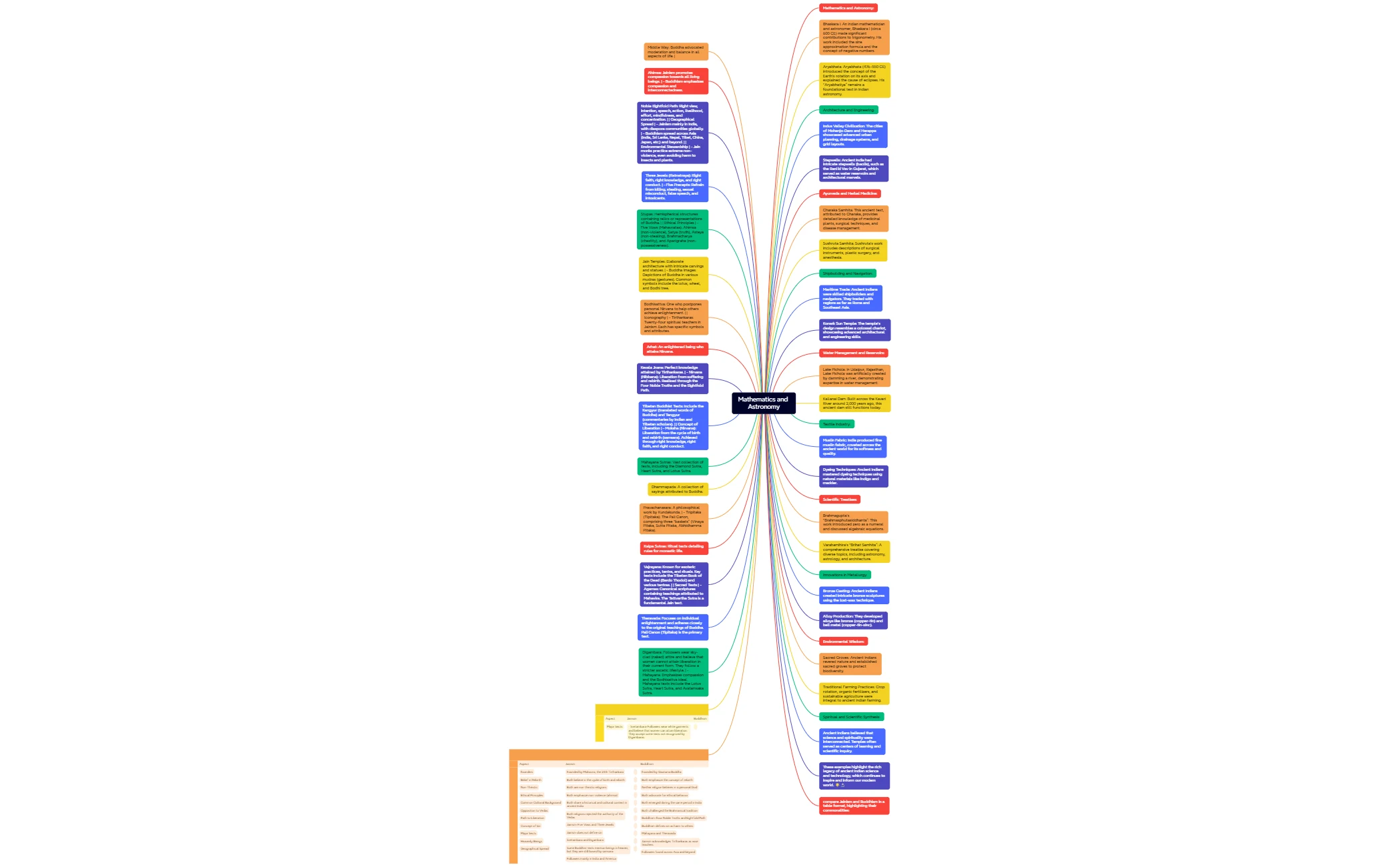
Tap the image to open its full preview. Read individual branches below for comfortable revision.पूरा पूर्वावलोकन खोलने के लिए चित्र पर टैप करें। आसानी से पढ़ने के लिए नीचे शाखाएँ देखें।
Read the branchesशाखाएँ पढ़ें
Mathematics and Astronomy
Mathematics and Astronomy
Mathematics and Astronomy:
Bhaskara I: An Indian mathematician and astronomer, Bhaskara I (circa 600 CE) made significant contributions to trigonometry. His work included the sine approximation formula and the concept of negative numbers.
Aryabhata: Aryabhata (476–550 CE) introduced the concept of the Earth’s rotation on its axis and explained the cause of eclipses. His “Aryabhatiya” remains a foundational text in Indian astronomy.
Architecture and Engineering:
Indus Valley Civilization: The cities of Mohenjo-Daro and Harappa showcased advanced urban planning, drainage systems, and grid layouts.
Stepwells: Ancient India had intricate stepwells (baolis), such as the Rani ki Vav in Gujarat, which served as water reservoirs and architectural marvels.
Ayurveda and Herbal Medicine:
Charaka Samhita: This ancient text, attributed to Charaka, provides detailed knowledge of medicinal plants, surgical techniques, and disease management.
Sushruta Samhita: Sushruta’s work includes descriptions of surgical instruments, plastic surgery, and anesthesia.
Shipbuilding and Navigation:
Maritime Trade: Ancient Indians were skilled shipbuilders and navigators. They traded with regions as far as Rome and Southeast Asia.
Konark Sun Temple: The temple’s design resembles a colossal chariot, showcasing advanced architectural and engineering skills.
Water Management and Reservoirs:
Lake Pichola: In Udaipur, Rajasthan, Lake Pichola was artificially created by damming a river, demonstrating expertise in water management.
Kallanai Dam: Built across the Kaveri River around 2,000 years ago, this ancient dam still functions today.
Textile Industry:
Muslin Fabric: India produced fine muslin fabric, coveted across the ancient world for its softness and quality.
Dyeing Techniques: Ancient Indians mastered dyeing techniques using natural materials like indigo and madder.
Scientific Treatises:
Brahmagupta’s “Brahmasphutasiddhanta”: This work introduced zero as a numeral and discussed algebraic equations.
Varahamihira’s “Brihat Samhita”: A comprehensive treatise covering diverse topics, including astronomy, astrology, and architecture.
Innovations in Metallurgy:
Bronze Casting: Ancient Indians created intricate bronze sculptures using the lost-wax technique.
Alloy Production: They developed alloys like bronze (copper-tin) and bell metal (copper-tin-zinc).
Environmental Wisdom:
Sacred Groves: Ancient Indians revered nature and established sacred groves to protect biodiversity.
Traditional Farming Practices: Crop rotation, organic fertilizers, and sustainable agriculture were integral to ancient Indian farming.
Spiritual and Scientific Synthesis:
Ancient Indians believed that science and spirituality were interconnected. Temples often served as centers of learning and scientific inquiry.
These examples highlight the rich legacy of ancient Indian science and technology, which continues to inspire and inform our modern world. 🌟🔬
compare Jainism and Buddhism in a table format, highlighting their commonalities:
Study map
Aspect
Founders
Belief in Rebirth
Non-Theistic
Ethical Principles
Common Cultural Background
Opposition to Vedas
Path to Liberation
Concept of Sin
Major Sects
Heavenly Beings
Geographical Spread
Jainism
Founded by Mahavira, the 24th Tirthankara
Both believe in the cycle of birth and rebirth
Both are non-theistic religions
Both emphasize non-violence (ahimsa)
Both share a historical and cultural context in ancient India
Both religions rejected the authority of the Vedas
Jainism: Five Vows and Three Jewels
Jainism does not define sin
Svetambara and Digambara
Some Buddhist texts mention beings in heaven, but they are still bound by samsara
Followers mainly in India and America
Study map
Study map
Study map
Study map
Study map
Study map
Study map
Study map
Study map
Study map
Study map
Study map
Buddhism
Founded by Gautama Buddha
Both emphasize the concept of rebirth
Neither religion believes in a personal God
Both advocate for ethical behavior
Both emerged during the same period in India
Both challenged the Brahmanical tradition
Buddhism: Four Noble Truths and Eightfold Path
Buddhism defines sin as harm to others
Mahayana and Theravada
Jainism acknowledges Tirthankaras as wise teachers
Followers found across Asia and beyond
Study map
Aspect
Major Sects
Jainism
- Svetambara: Followers wear white garments and believe that women can attain liberation. They accept some texts not recognized by Digambaras.
Buddhism
Study map
Digambara: Followers wear sky-clad (naked) attire and believe that women cannot attain liberation in their current form. They follow a stricter ascetic lifestyle. | - Mahayana: Emphasizes compassion and the Bodhisattva ideal. Mahayana texts include the Lotus Sutra, Heart Sutra, and Avatamsaka Sutra.
Theravada: Focuses on individual enlightenment and adheres closely to the original teachings of Buddha. Pali Canon (Tipitaka) is the primary text.
Vajrayana: Known for esoteric practices, tantra, and rituals. Key texts include the Tibetan Book of the Dead (Bardo Thodol) and various tantras. | | Sacred Texts | - Agamas: Canonical scriptures containing teachings attributed to Mahavira. The Tattvartha Sutra is a fundamental Jain text.
Kalpa Sutras: Ritual texts detailing rules for monastic life.
Pravachanasara: A philosophical work by Kundakunda. | - Tripitaka (Tipitaka): The Pali Canon, comprising three “baskets” (Vinaya Pitaka, Sutta Pitaka, Abhidhamma Pitaka).
Dhammapada: A collection of sayings attributed to Buddha.
Mahayana Sutras: Vast collection of texts, including the Diamond Sutra, Heart Sutra, and Lotus Sutra.
Tibetan Buddhist Texts: Include the Kangyur (translated words of Buddha) and Tengyur (commentaries by Indian and Tibetan scholars). | | Concept of Liberation | - Moksha (Nirvana): Liberation from the cycle of birth and rebirth (samsara). Achieved through right knowledge, right faith, and right conduct.
Kevala Jnana: Perfect knowledge attained by Tirthankaras. | - Nirvana (Nibbana): Liberation from suffering and rebirth. Realized through the Four Noble Truths and the Eightfold Path.
Arhat: An enlightened being who attains Nirvana.
Bodhisattva: One who postpones personal Nirvana to help others achieve enlightenment. | | Iconography | - Tirthankaras: Twenty-four spiritual teachers in Jainism. Each has specific symbols and attributes.
Jain Temples: Elaborate architecture with intricate carvings and statues. | - Buddha Images: Depictions of Buddha in various mudras (gestures). Common symbols include the lotus, wheel, and Bodhi tree.
Stupas: Hemispherical structures containing relics or representations of Buddha. | | Ethical Principles | - Five Vows (Mahavratas): Ahimsa (non-violence), Satya (truth), Asteya (non-stealing), Brahmacharya (chastity), and Aparigraha (non-possessiveness).
Three Jewels (Ratnatraya): Right faith, right knowledge, and right conduct. | - Five Precepts: Refrain from killing, stealing, sexual misconduct, false speech, and intoxicants.
Noble Eightfold Path: Right view, intention, speech, action, livelihood, effort, mindfulness, and concentration. | | Geographical Spread | - Jainism mainly in India, with diaspora communities globally. | - Buddhism spread across Asia (India, Sri Lanka, Nepal, Tibet, China, Japan, etc.) and beyond. | | Environmental Stewardship | - Jain monks practice extreme non-violence, even avoiding harm to insects and plants.
Ahimsa: Jainism promotes compassion towards all living beings. | - Buddhism emphasizes compassion and interconnectedness.
Middle Way: Buddha advocated moderation and balance in all aspects of life. |