Mind Mapsमाइंड मैप्स › Ancient Historyप्राचीन इतिहास
Gupta Empire — mind mapमाइंड मैप
Original study maps by Rishabh Singh. Read dated facts in their exam-year context. Sources & corrections.ऋषभ सिंह के मूल अध्ययन मानचित्र। पुराने तथ्यों को संबंधित परीक्षा वर्ष के संदर्भ में पढ़ें। स्रोत और सुधार।
78 branches and entriesशाखाएँ और बिंदु · 1 sheet(s)शीट
See the original map layoutमूल मानचित्र का स्वरूप देखें
Tap the image to open its full preview. Read individual branches below for comfortable revision.पूरा पूर्वावलोकन खोलने के लिए चित्र पर टैप करें। आसानी से पढ़ने के लिए नीचे शाखाएँ देखें।
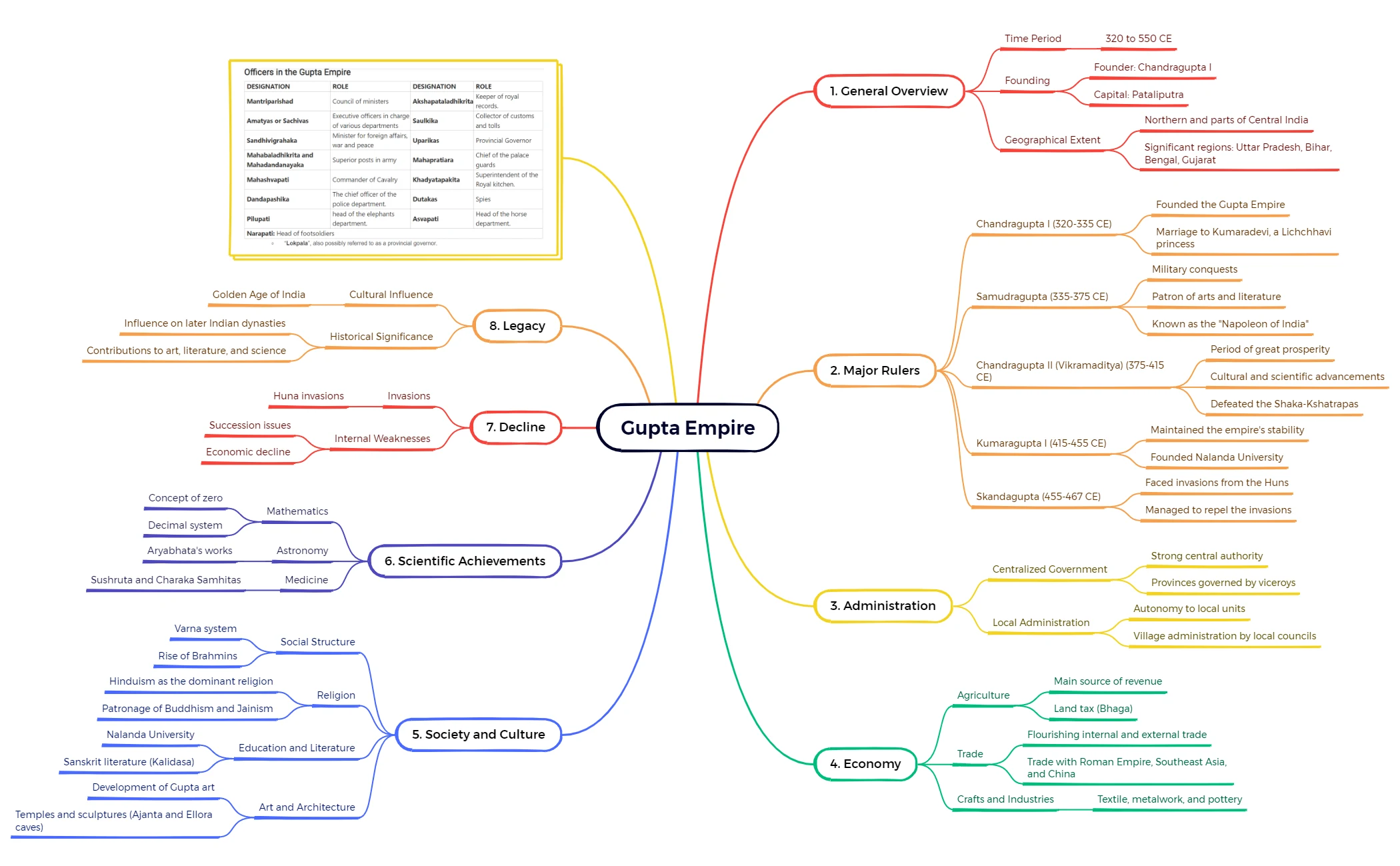
Read the branchesशाखाएँ पढ़ें
Gupta Empire
Gupta Empire
1. General Overview
Time Period
320 to 550 CE
Founding
Founder: Chandragupta I
Capital: Pataliputra
Geographical Extent
Northern and parts of Central India
Significant regions: Uttar Pradesh, Bihar, Bengal, Gujarat
2. Major Rulers
Chandragupta I (320-335 CE)
Founded the Gupta Empire
Marriage to Kumaradevi, a Lichchhavi princess
Samudragupta (335-375 CE)
Military conquests
Patron of arts and literature
Known as the "Napoleon of India"
Chandragupta II (Vikramaditya) (375-415 CE)
Period of great prosperity
Cultural and scientific advancements
Defeated the Shaka-Kshatrapas
Kumaragupta I (415-455 CE)
Maintained the empire's stability
Founded Nalanda University
Skandagupta (455-467 CE)
Faced invasions from the Huns
Managed to repel the invasions
3. Administration
Centralized Government
Strong central authority
Provinces governed by viceroys
Local Administration
Autonomy to local units
Village administration by local councils
4. Economy
Agriculture
Main source of revenue
Land tax (Bhaga)
Trade
Flourishing internal and external trade
Trade with Roman Empire, Southeast Asia, and China
Crafts and Industries
Textile, metalwork, and pottery
5. Society and Culture
Social Structure
Varna system
Rise of Brahmins
Religion
Hinduism as the dominant religion
Patronage of Buddhism and Jainism
Education and Literature
Nalanda University
Sanskrit literature (Kalidasa)
Art and Architecture
Development of Gupta art
Temples and sculptures (Ajanta and Ellora caves)
6. Scientific Achievements
Mathematics
Concept of zero
Decimal system
Astronomy
Aryabhata's works
Medicine
Sushruta and Charaka Samhitas
7. Decline
Invasions
Huna invasions
Internal Weaknesses
Succession issues
Economic decline
8. Legacy
Cultural Influence
Golden Age of India
Historical Significance
Influence on later Indian dynasties
Contributions to art, literature, and science
Study map