Mind Mapsमाइंड मैप्स › Ancient Historyप्राचीन इतिहास
Greek Invasion in India — mind mapमाइंड मैप
Original study maps by Rishabh Singh. Read dated facts in their exam-year context. Sources & corrections.ऋषभ सिंह के मूल अध्ययन मानचित्र। पुराने तथ्यों को संबंधित परीक्षा वर्ष के संदर्भ में पढ़ें। स्रोत और सुधार।
17 branches and entriesशाखाएँ और बिंदु · 1 sheet(s)शीट
See the original map layoutमूल मानचित्र का स्वरूप देखें
Tap the image to open its full preview. Read individual branches below for comfortable revision.पूरा पूर्वावलोकन खोलने के लिए चित्र पर टैप करें। आसानी से पढ़ने के लिए नीचे शाखाएँ देखें।
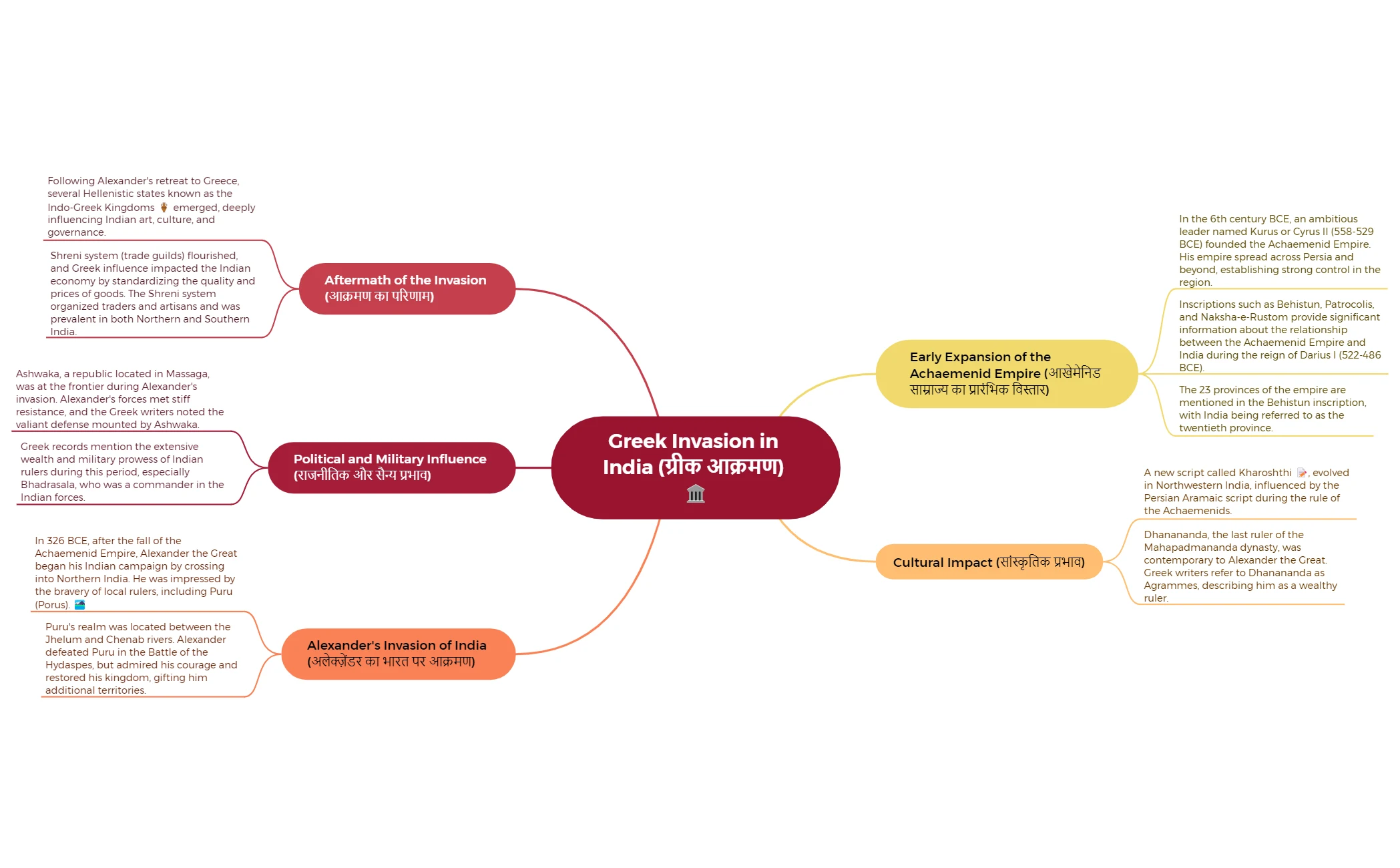
Read the branchesशाखाएँ पढ़ें
Greek Invasion in India (ग्रीक आक्रमण) 🏛️
Greek Invasion in India (ग्रीक आक्रमण) 🏛️
Early Expansion of the Achaemenid Empire (आखेमेनिड साम्राज्य का प्रारंभिक विस्तार)
In the 6th century BCE, an ambitious leader named Kurus or Cyrus II (558-529 BCE) founded the Achaemenid Empire. His empire spread across Persia and beyond, establishing strong control in the region.
Inscriptions such as Behistun, Patrocolis, and Naksha-e-Rustom provide significant information about the relationship between the Achaemenid Empire and India during the reign of Darius I (522-486 BCE).
The 23 provinces of the empire are mentioned in the Behistun inscription, with India being referred to as the twentieth province.
Cultural Impact (सांस्कृतिक प्रभाव)
A new script called Kharoshthi 📝, evolved in Northwestern India, influenced by the Persian Aramaic script during the rule of the Achaemenids.
Dhanananda, the last ruler of the Mahapadmananda dynasty, was contemporary to Alexander the Great. Greek writers refer to Dhanananda as Agrammes, describing him as a wealthy ruler.
Alexander's Invasion of India (अलेक्ज़ेंडर का भारत पर आक्रमण)
In 326 BCE, after the fall of the Achaemenid Empire, Alexander the Great began his Indian campaign by crossing into Northern India. He was impressed by the bravery of local rulers, including Puru (Porus). 🏞️
Puru's realm was located between the Jhelum and Chenab rivers. Alexander defeated Puru in the Battle of the Hydaspes, but admired his courage and restored his kingdom, gifting him additional territories.
Political and Military Influence (राजनीतिक और सैन्य प्रभाव)
Ashwaka, a republic located in Massaga, was at the frontier during Alexander's invasion. Alexander's forces met stiff resistance, and the Greek writers noted the valiant defense mounted by Ashwaka.
Greek records mention the extensive wealth and military prowess of Indian rulers during this period, especially Bhadrasala, who was a commander in the Indian forces.
Aftermath of the Invasion (आक्रमण का परिणाम)
Following Alexander's retreat to Greece, several Hellenistic states known as the Indo-Greek Kingdoms 🏺 emerged, deeply influencing Indian art, culture, and governance.
Shreni system (trade guilds) flourished, and Greek influence impacted the Indian economy by standardizing the quality and prices of goods. The Shreni system organized traders and artisans and was prevalent in both Northern and Southern India.