Mind Mapsमाइंड मैप्स › Ancient Historyप्राचीन इतिहास
Buddhism — mind mapमाइंड मैप
Original study maps by Rishabh Singh. Read dated facts in their exam-year context. Sources & corrections.ऋषभ सिंह के मूल अध्ययन मानचित्र। पुराने तथ्यों को संबंधित परीक्षा वर्ष के संदर्भ में पढ़ें। स्रोत और सुधार।
105 branches and entriesशाखाएँ और बिंदु · 1 sheet(s)शीट
See the original map layoutमूल मानचित्र का स्वरूप देखें
Tap the image to open its full preview. Read individual branches below for comfortable revision.पूरा पूर्वावलोकन खोलने के लिए चित्र पर टैप करें। आसानी से पढ़ने के लिए नीचे शाखाएँ देखें।
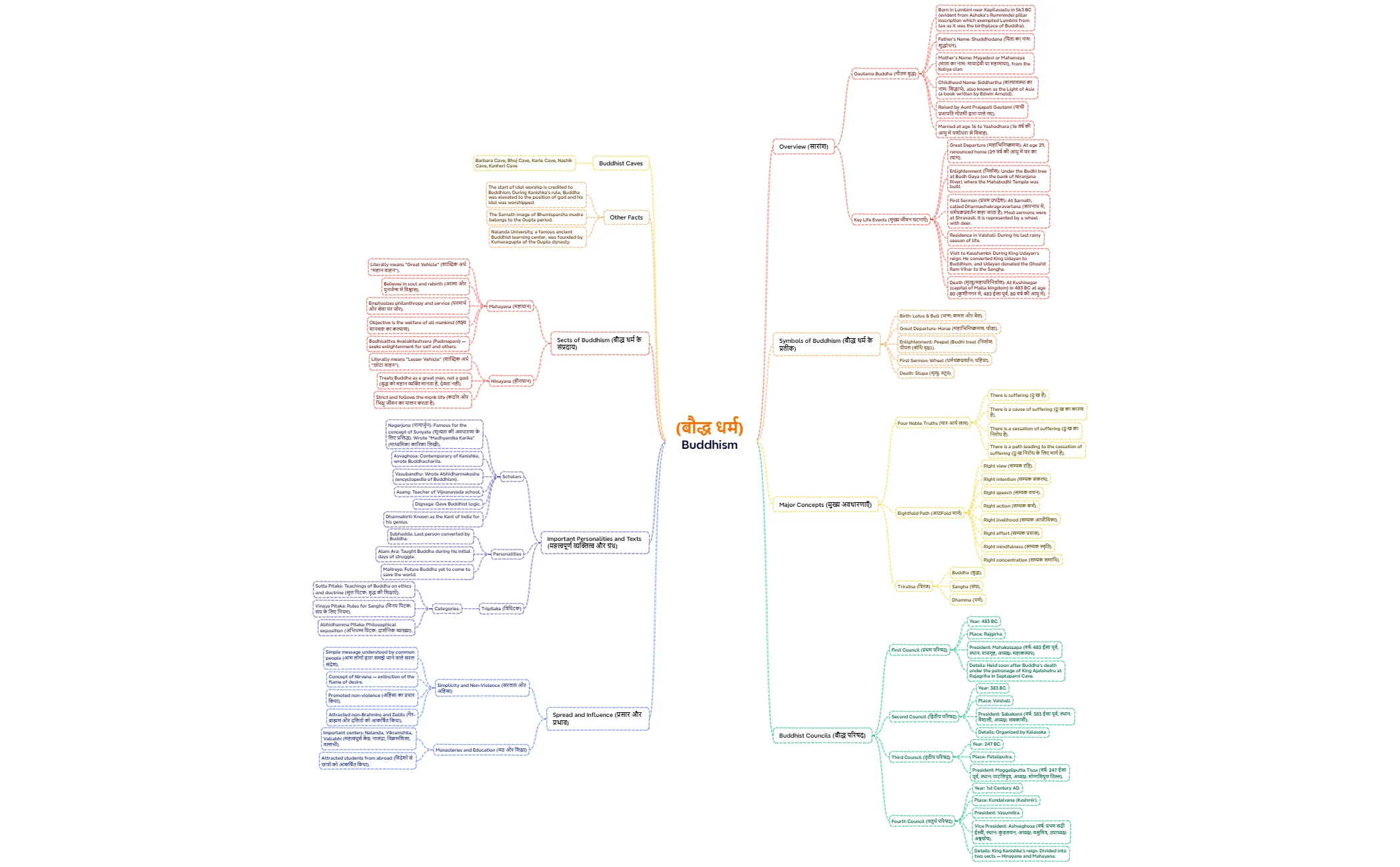
Read the branchesशाखाएँ पढ़ें
(बौद्ध धर्म) Buddhism
(बौद्ध धर्म) Buddhism
Overview (सारांश)
Gautama Buddha (गौतम बुद्ध)
Born in Lumbini near Kapilavastu in 563 BC (evident from Ashoka's Rummindei pillar inscription which exempted Lumbini from tax as it was the birthplace of Buddha).
Father's Name: Shuddhodana (पिता का नाम: शुद्धोधन).
Mother's Name: Mayadevi or Mahamaya (माता का नाम: मायादेवी या महामाया), from the Koliya clan.
Childhood Name: Siddhartha (बाल्यावस्था का नाम: सिद्धार्थ), also known as the Light of Asia (a book written by Edwin Arnold).
Raised by Aunt Prajapati Gautami (चाची प्रजापति गौतमी द्वारा पाले गए).
Married at age 16 to Yashodhara (16 वर्ष की आयु में यशोधरा से विवाह).
Key Life Events (मुख्य जीवन घटनाएँ)
Great Departure (महाभिनिष्क्रमण): At age 29, renounced home (29 वर्ष की आयु में घर का त्याग).
Enlightenment (निर्वाण): Under the Bodhi tree at Bodh Gaya (on the bank of Niranjana River) where the Mahabodhi Temple was built.
First Sermon (प्रथम उपदेश): At Sarnath, called Dharmachakrapravartana (सारनाथ में, धर्मचक्रप्रवर्तन कहा जाता है). Most sermons were at Shravasti. It is represented by a wheel with deer.
Residence in Vaishali: During his last rainy season of life.
Visit to Kaushambi: During King Udayan’s reign. He converted King Udayan to Buddhism, and Udayan donated the Ghoshit Ram Vihar to the Sangha.
Death (मृत्यु/महापरिनिर्वाण): At Kushinagar (capital of Malla kingdom) in 483 BC at age 80 (कुशीनगर में, 483 ईसा पूर्व, 80 वर्ष की आयु में).
Symbols of Buddhism (बौद्ध धर्म के प्रतीक)
Birth: Lotus & Bull (जन्म: कमल और बैल).
Great Departure: Horse (महाभिनिष्क्रमण: घोड़ा).
Enlightenment: Peepal (Bodhi tree) (निर्वाण: पीपल (बोधि वृक्ष)).
First Sermon: Wheel (धर्मचक्रप्रवर्तन: पहिया).
Death: Stupa (मृत्यु: स्तूप).
Major Concepts (मुख्य अवधारणाएँ)
Four Noble Truths (चार आर्य सत्य)
There is suffering (दुःख है).
There is a cause of suffering (दुःख का कारण है).
There is a cessation of suffering (दुःख का निरोध है).
There is a path leading to the cessation of suffering (दुःख निरोध के लिए मार्ग है).
Eightfold Path (आठFold मार्ग)
Right view (सम्यक दृष्टि).
Right intention (सम्यक संकल्प).
Right speech (सम्यक वचन).
Right action (सम्यक कर्म).
Right livelihood (सम्यक आजीविका).
Right effort (सम्यक प्रयास).
Right mindfulness (सम्यक स्मृति).
Right concentration (सम्यक समाधि).
Triratna (त्रिरत्न)
Buddha (बुद्ध).
Sangha (संघ).
Dhamma (धर्म).
Buddhist Councils (बौद्ध परिषद)
First Council (प्रथम परिषद)
Year: 483 BC.
Place: Rajgirha.
President: Mahakassapa (वर्ष: 483 ईसा पूर्व, स्थान: राजगृह, अध्यक्ष: महाकस्यप).
Details: Held soon after Buddha's death under the patronage of King Ajatshatru at Rajagriha in Saptaparni Cave.
Second Council (द्वितीय परिषद)
Year: 383 BC.
Place: Vaishali.
President: Sabakami (वर्ष: 383 ईसा पूर्व, स्थान: वैशाली, अध्यक्ष: सबकामी).
Details: Organized by Kalasoka.
Third Council (तृतीय परिषद)
Year: 247 BC.
Place: Pataliputra.
President: Moggaliputta Tissa (वर्ष: 247 ईसा पूर्व, स्थान: पाटलिपुत्र, अध्यक्ष: मोग्गलिपुत्त तिस्स).
Fourth Council (चतुर्थ परिषद)
Year: 1st Century AD.
Place: Kundalvana (Kashmir).
President: Vasumitra.
Vice President: Ashvaghosa (वर्ष: प्रथम सदी ईस्वी, स्थान: कुंडलवन, अध्यक्ष: वसुमित्र, उपाध्यक्ष: अश्वघोष).
Details: King Kanishka's reign. Divided into two sects — Hinayana and Mahayana.
Spread and Influence (प्रसार और प्रभाव)
Simplicity and Non-Violence (सरलता और अहिंसा)
Simple message understood by common people (आम लोगों द्वारा समझे जाने वाले सरल संदेश).
Concept of Nirvana — extinction of the flame of desire.
Promoted non-violence (अहिंसा का प्रचार किया).
Attracted non-Brahmins and Dalits (गैर-ब्राह्मण और दलितों को आकर्षित किया).
Monasteries and Education (मठ और शिक्षा)
Important centers: Nalanda, Vikramshila, Vallabhi (महत्वपूर्ण केंद्र: नालंदा, विक्रमशिला, वल्लभी).
Attracted students from abroad (विदेशों से छात्रों को आकर्षित किया).
Important Personalities and Texts (महत्वपूर्ण व्यक्तित्व और ग्रंथ)
Scholars
Nagarjuna (नागार्जुन): Famous for the concept of Sunyata (शून्यता की अवधारणा के लिए प्रसिद्ध). Wrote "Madhyamika Karika" (माध्यमिका कारिका लिखी).
Asvaghosa: Contemporary of Kanishka, wrote Buddhacharita.
Vasubandhu: Wrote Abhidharmakosha (encyclopedia of Buddhism).
Asang: Teacher of Vijnanavada school.
Dignaga: Gave Buddhist logic.
Dharmakirti: Known as the Kant of India for his genius.
Personalities
Subhadda: Last person converted by Buddha.
Alam Ara: Taught Buddha during his initial days of struggle.
Maitreya: Future Buddha yet to come to save the world.
Tripitaka (त्रिपिटक)
Categories:
Sutta Pitaka: Teachings of Buddha on ethics and doctrine (सुत्त पिटक: बुद्ध की शिक्षाएँ).
Vinaya Pitaka: Rules for Sangha (विनय पिटक: संघ के लिए नियम).
Abhidhamma Pitaka: Philosophical exposition (अभिधम्म पिटक: दार्शनिक व्याख्या).
Sects of Buddhism (बौद्ध धर्म के संप्रदाय)
Mahayana (महायान)
Literally means "Great Vehicle" (शाब्दिक अर्थ "महान वाहन").
Believes in soul and rebirth (आत्मा और पुनर्जन्म में विश्वास).
Emphasizes philanthropy and service (परमार्थ और सेवा पर जोर).
Objective is the welfare of all mankind (लक्ष्य मानवता का कल्याण).
Bodhisattva Avalokiteshvara (Padmapani) — seeks enlightenment for self and others.
Hinayana (हीनयान)
Literally means "Lesser Vehicle" (शाब्दिक अर्थ "छोटा वाहन").
Treats Buddha as a great man, not a god (बुद्ध को महान व्यक्ति मानता है, देवता नहीं).
Strict and follows the monk life (कठोर और भिक्षु जीवन का पालन करता है).
Other Facts
The start of idol worship is credited to Buddhism. During Kanishka's rule, Buddha was elevated to the position of god and his idol was worshipped.
The Sarnath image of Bhumisparsha mudra belongs to the Gupta period.
Nalanda University, a famous ancient Buddhist learning center, was founded by Kumaragupta of the Gupta dynasty.
Buddhist Caves
Barbara Cave, Bhoj Cave, Karle Cave, Nashik Cave, Kanheri Cave