Mind Mapsमाइंड मैप्स › Agricultureकृषि
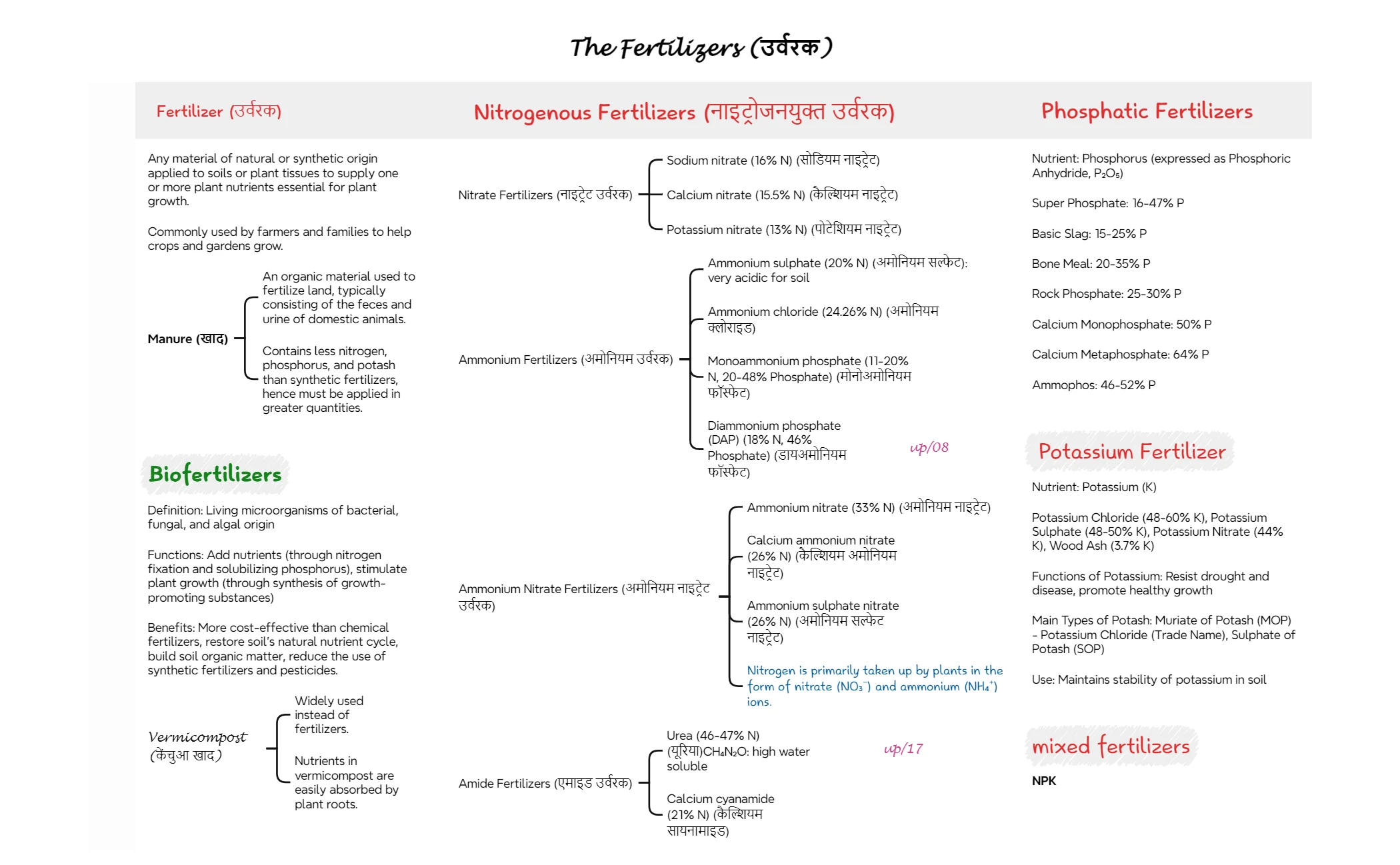
The Fertilizers — mind mapमाइंड मैप
Original study maps by Rishabh Singh. Read dated facts in their exam-year context. Sources & corrections.ऋषभ सिंह के मूल अध्ययन मानचित्र। पुराने तथ्यों को संबंधित परीक्षा वर्ष के संदर्भ में पढ़ें। स्रोत और सुधार।
55 branches and entriesशाखाएँ और बिंदु · 1 sheet(s)शीट
See the original map layoutमूल मानचित्र का स्वरूप देखें
Tap the image to open its full preview. Read individual branches below for comfortable revision.पूरा पूर्वावलोकन खोलने के लिए चित्र पर टैप करें। आसानी से पढ़ने के लिए नीचे शाखाएँ देखें।
Read the branchesशाखाएँ पढ़ें
The Fertilizers (उर्वरक)
The Fertilizers (उर्वरक)
Fertilizer (उर्वरक)
Any material of natural or synthetic origin applied to soils or plant tissues to supply one or more plant nutrients essential for plant growth.
Commonly used by farmers and families to help crops and gardens grow.
Manure (खाद)
An organic material used to fertilize land, typically consisting of the feces and urine of domestic animals.
Contains less nitrogen, phosphorus, and potash than synthetic fertilizers, hence must be applied in greater quantities.
Study map
Biofertilizers
Definition: Living microorganisms of bacterial, fungal, and algal origin
Functions: Add nutrients (through nitrogen fixation and solubilizing phosphorus), stimulate plant growth (through synthesis of growth-promoting substances)
Benefits: More cost-effective than chemical fertilizers, restore soil's natural nutrient cycle, build soil organic matter, reduce the use of synthetic fertilizers and pesticides.
Vermicompost (केंचुआ खाद)
Widely used instead of fertilizers.
Nutrients in vermicompost are easily absorbed by plant roots.
Nitrogenous Fertilizers (नाइट्रोजनयुक्त उर्वरक)
Nitrate Fertilizers (नाइट्रेट उर्वरक)
Sodium nitrate (16% N) (सोडियम नाइट्रेट)
Calcium nitrate (15.5% N) (कैल्शियम नाइट्रेट)
Potassium nitrate (13% N) (पोटेशियम नाइट्रेट)
Ammonium Fertilizers (अमोनियम उर्वरक)
Ammonium sulphate (20% N) (अमोनियम सल्फेट): very acidic for soil
Ammonium chloride (24.26% N) (अमोनियम क्लोराइड)
Monoammonium phosphate (11-20% N, 20-48% Phosphate) (मोनोअमोनियम फॉस्फेट)
Diammonium phosphate (DAP) (18% N, 46% Phosphate) (डायअमोनियम फॉस्फेट)
up/08
Ammonium Nitrate Fertilizers (अमोनियम नाइट्रेट उर्वरक)
Ammonium nitrate (33% N) (अमोनियम नाइट्रेट)
Calcium ammonium nitrate (26% N) (कैल्शियम अमोनियम नाइट्रेट)
Ammonium sulphate nitrate (26% N) (अमोनियम सल्फेट नाइट्रेट)
Nitrogen is primarily taken up by plants in the form of nitrate (NO₃⁻) and ammonium (NH₄⁺) ions.
Amide Fertilizers (एमाइड उर्वरक)
Urea (46-47% N) (यूरिया)CH₄N₂O: high water soluble
Calcium cyanamide (21% N) (कैल्शियम सायनामाइड)
up/17
Phosphatic Fertilizers
Nutrient: Phosphorus (expressed as Phosphoric Anhydride, P₂O₅)
Super Phosphate: 16-47% P
Basic Slag: 15-25% P
Bone Meal: 20-35% P
Rock Phosphate: 25-30% P
Calcium Monophosphate: 50% P
Calcium Metaphosphate: 64% P
Ammophos: 46-52% P
Study map
Potassium Fertilizer
Nutrient: Potassium (K)
Potassium Chloride (48-60% K), Potassium Sulphate (48-50% K), Potassium Nitrate (44% K), Wood Ash (3.7% K)
Functions of Potassium: Resist drought and disease, promote healthy growth
Main Types of Potash: Muriate of Potash (MOP) - Potassium Chloride (Trade Name), Sulphate of Potash (SOP)
Use: Maintains stability of potassium in soil
Study map
mixed fertilizers
NPK
Study map